组成图示
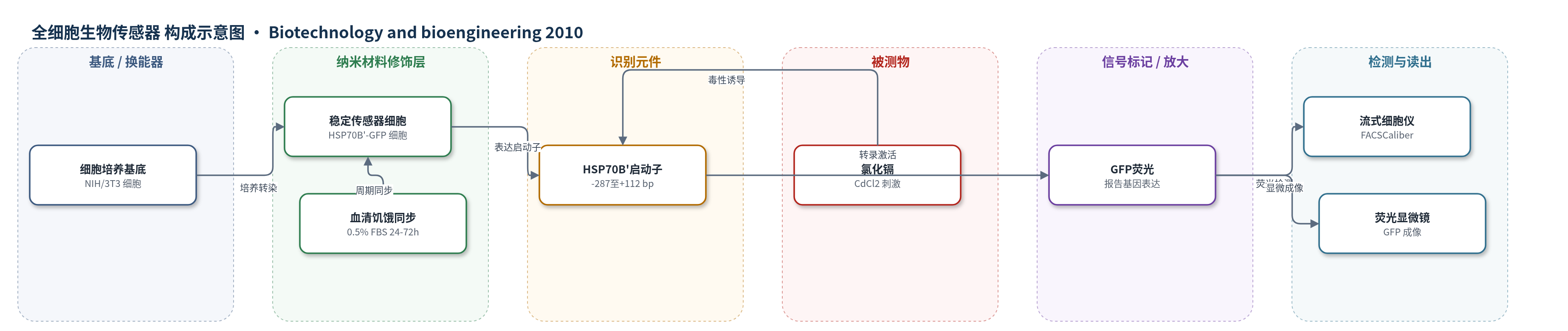
点击图片查看大图 · 依据论文自动绘制
传感器类型
全细胞生物传感器
检测对象
氯化镉(cadmium chloride, CdCl2);样品基质:细胞培养液/细胞暴露体系(NIH/3T3 传感器细胞)
检测原理
稳定转染的 NIH/3T3 传感器细胞携带由工程化 HSP70B' 启动子驱动的 GFP 报告基因。当细胞暴露于氯化镉(CdCl2)时,镉离子诱导胞内蛋白变性/热休克样应激,使 HSP70B' 启动子激活,驱动 GFP 转录与翻译。GFP 荧光随 CdCl2 浓度升高而增强,GFP 阳性细胞比例在 0–10 mg/mL 范围内上升,约 4 mg/mL 后趋于平台。通过流式细胞仪或荧光显微镜读取 GFP 荧光,即可将细胞毒性事件转换为可定量光学信号。血清饥饿同步使细胞更多处于 G0/G1 期,提高响应均一性和阳性率。
检测灵敏度
—
效应效果
在 8 mg/mL CdCl2 处理 8 h 后,48 h 血清饥饿同步细胞的 GFP 阳性率为 78.46%,未同步对照为 43.87%,约为对照的 2 倍;72 h 同步细胞阳性率明显低于未同步细胞,而完全汇合细胞约 70% 产生 GFP 信号。剂量响应显示,同步细胞在 4 mg/mL 以上趋于平台,未同步细胞在 10 mg/mL 时仍为 53.0%。结果表明细胞周期同步可显著提高响应均一性和检测可靠性,作者认为细胞均一化是单细胞阵列等微器件细胞基生物传感器的重要步骤。
传感器的构成
- 细胞基底:NIH/3T3 细胞,作为活细胞传感器载体,培养于 DMEM + 10% FBS + 800 mg/mL G418
- 遗传修饰层:pd2EGFP-1 报告载体,稳定转染并携带 HSP70B' 启动子片段
- 识别元件:HSP70B' 启动子(-287 至 +112 bp),识别细胞毒性/蛋白变性应激
- 信号标记物:GFP,受 HSP70B' 启动子驱动表达,产生荧光
- 同步处理层:0.5% FBS 血清饥饿培养基,使细胞周期同步
- 读出系统:FACSCaliber 流式细胞仪/荧光显微镜,读取 GFP 信号
中文摘要
活细胞基传感器可提供试剂对多种信号级联细胞毒性效应的功能信息。转染细胞毒性响应启动子衍生报告基因载体的细胞可用作智能细胞毒性传感器(传感器细胞)。作者将传感器细胞与可实现多种层流的微流控细胞培养系统结合,建立可靠的高通量细胞毒性检测系统。这些传感器细胞也可用于单细胞阵列。然而,由于传感器细胞响应异质性,单细胞阵列中难以检测细胞响应。本研究旨在通过细胞周期同步实现细胞均一化,以增强细胞基生物传感器响应。将已建立的稳定传感器细胞置于血清饥饿条件下进行细胞周期同步,并在单细胞水平研究氯化镉诱导的细胞毒性响应。同步细胞GFP阳性率约为对照细胞的2倍,表明细胞均一化是使用单细胞阵列等微器件的细胞基生物传感器的重要步骤。
英文摘要
Live cell-based sensors potentially provide functional information about the cytotoxic effect of reagents on various signaling cascades. Cells transfected with a reporter vector derived from a cytotoxic response promoter can be used as intelligent cytotoxicity sensors (i.e., sensor cells). We have combined sensor cells and a microfluidic cell culture system that can achieve several laminar flows, resulting in a reliable high-throughput cytotoxicity detection system. These sensor cells can also be applied to single cell arrays. However, it is difficult to detect a cellular response in a single cell array, due to the heterogeneous response of sensor cells. The objective of this study was cell homogenization with cell cycle synchronization to enhance the response of cell-based biosensors. Our previously established stable sensor cells were brought into cell cycle synchronization under serum-starved conditions and we then investigated the cadmium chloride-induced cytotoxic response at the single cell level. The GFP positive rate of synchronized cells was approximately twice as high as that of the control cells, suggesting that cell homogenization is an important step when using cell-based biosensors with microdevices, such as a single cell array.