组成图示
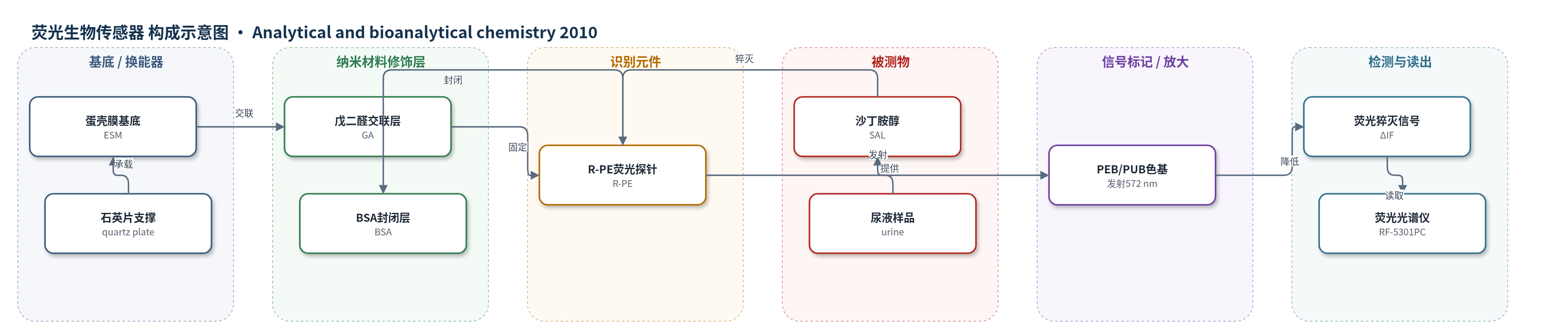
点击图片查看大图 · 依据论文自动绘制
传感器类型
荧光生物传感器
检测对象
沙丁胺醇(salbutamol, SAL);样品基质:人尿液(urine)
检测原理
该传感器以蛋壳膜为固定平台,R-PE经戊二醛共价固定于膜表面,BSA封闭非特异位点。R-PE分子中的PEB和PUB色基在495 nm激发下于572 nm发射强荧光。当尿液或标准液中的SAL接触膜面时,SAL的羟基与R-PE色基及去蛋白之间的氢键发生部分破坏,色基微环境改变,R-PE吸收能力和荧光量子产率下降,导致572 nm发射强度降低。以ΔIF=IF0−IF作为响应信号,ΔIF随SAL浓度升高而增大,在5.00–100 ng/mL范围内与log C呈线性。该过程无需酶催化或核酸扩增,属于直接荧光猝灭检测。
检测灵敏度
LOD: 3.50 ng mL−1 (S/N=3);线性范围: 5.00–100 ng mL−1;灵敏度斜率: 71.562(ΔIF = −43.819 + 71.562 log C,C 为 ng mL−1);相关系数: 0.988
效应效果
传感器对常见离子和氨基酸抗干扰能力较好,多数相对误差在±5%以内,个别如Al3+为−4.24%。方法重复性RSD为3.22%(100 ng/mL,n=4),六片膜制备重现性RSD为3.28%。PBS冲洗1 min后响应可逆,4℃ PBS中保存至少50天荧光强度无明显变化。人尿液加标回收率为84.56%–101.8%,其中30 ng/mL加标回收98.44%。与Ridascreen β-激动剂酶联免疫法相比,健康人尿均不可检出;30 ng/mL加标尿EIA测得37.92 ng/mL(SD=6.15,n=4)。作者认为该方法成本低、操作简便,可用于尿液、血液和肉类中SAL滥用监测。
传感器的构成
- 基底/固定平台:蛋壳膜(eggshell membrane, ESM),天然蛋白纤维膜,提供氨基结合位点与半透支撑
- 荧光探针/识别元件:R-藻红蛋白(R-phycoerythrin, R-PE),含PEB和PUB色基,提供572 nm荧光并响应SAL猝灭
- 交联剂:戊二醛(glutaraldehyde, GA),共价交联R-PE与ESM表面,增强固定稳定性
- 封闭剂:牛血清白蛋白(bovine serum albumin, BSA),封闭ESM剩余结合位点,减少非特异吸附
- 读出支撑:石英片(quartz plate)与固体样品架,承载膜并固定于荧光光谱仪测量
中文摘要
本研究以固定在蛋壳膜表面的R-藻红蛋白(R-phycoerythrin, R-PE)作为荧光探针,构建了一种用于测定沙丁胺醇(salbutamol, SAL)的荧光传感器。R-PE具有强荧光、大Stokes位移和良好稳定性,蛋壳膜为天然蛋白纤维膜,可通过氨基与生物分子结合,适合作为固定平台。扫描电镜和荧光显微图像表明R-PE成功固定在蛋壳膜表面。通过优化戊二醛交联、封闭剂、pH和反应时间等条件,传感器对SAL的荧光猝灭响应在5.00–100 ng/mL范围内呈线性,检出限为3.50 ng/mL(S/N=3)。六片不同膜制备的重现性RSD为3.28%,传感器在4℃ PBS中保存至少50天仍稳定,并可逆响应SAL。常见离子和氨基酸干扰较小,方法成功应用于人尿液样品中SAL的测定。
英文摘要
A fluorescence sensor was fabricated using R-phycoerythrin (R-PE) immobilized on eggshell membrane as the fluorescence probe, and salbutamol was determined based on the decrease in fluorescence intensity of R-phycoerythrin. The scanning electron and fluorescence micrographs showed the microstructure of the eggshell membrane and indicated that the R-PE was successfully immobilized on the eggshell membrane surface. The effects of some experimental parameters on the response of the biosensor were investigated in detail. The fluorescence sensor has a linear response to salbutamol concentrations ranging from 5.00 to 100 ng mL(-1). The detection limit for the salbutamol is 3.50 ng mL(-1) (S/N = 3). The reproducibility of fabricating the biosensors using six different membranes was good with a relative standard deviation (RSD) of 3.28%. The fluorescence sensor showed extremely good stability with a shelf life of at least 50 days and reversible response to salbutamol. Some common potential interferents showed little effect on the response of the salbutamol fluorescence sensor. The proposed method was successfully applied to the determination of the salbutamol in urine samples.