组成图示
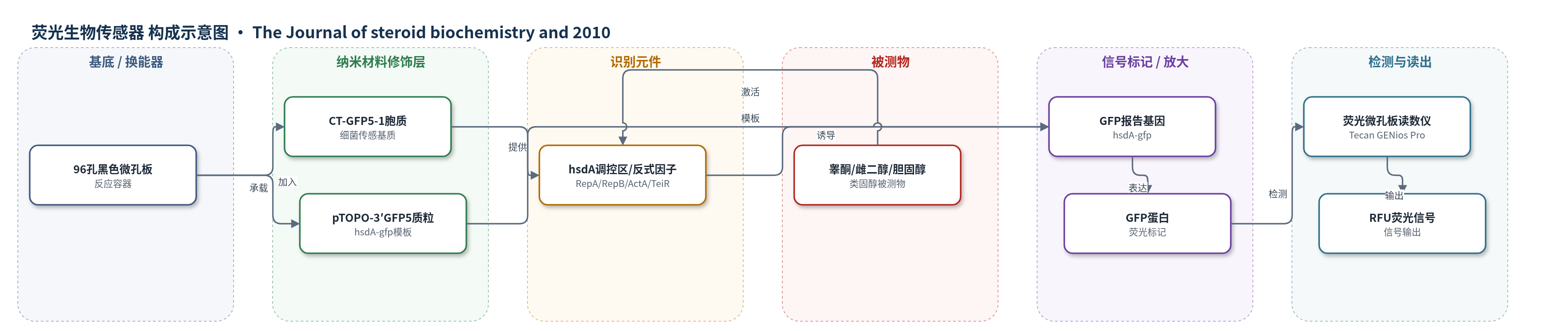
点击图片查看大图 · 依据论文自动绘制
传感器类型
荧光生物传感器
检测对象
睾酮(testosterone)、雌二醇(estradiol)、胆固醇(cholesterol);样品基质:标准溶液/环境水样(文中以96孔板标准品验证,并主张用于污水、环境水样等)
检测原理
COSS将C. testosteroni hsdA基因上游468 bp调控区克隆至gfp基因上游,构建CT-GFP5-1突变体。睾酮、雌二醇或胆固醇进入全细胞或胞质后,被细菌类固醇感应系统识别,经TeiR激酶及RepA、RepB、ActA等反式因子调控,诱导hsdA-gfp转录。GFP表达量随类固醇浓度和作用时间增加,荧光强度(RFU)在确定范围内与浓度相关。无细胞体系加入pTOPO-3′GFP5质粒后,在胞质中完成体外转录翻译,提高灵敏度并简化操作。
检测灵敏度
LOD: 睾酮 29.0 pg/mL;雌二醇 0.027 pg/mL;胆固醇 9.7 pg/mL(无细胞COSS);检测范围: 睾酮 29–576 pg/mL(0.1–2.0 nM);雌二醇 0.027–0.532 pg/mL(0.0001–0.002 nM);胆固醇 9.7–194 pg/mL(0.0245–0.512 nM);全细胞检测范围: 睾酮 57–450 pg/mL(0.195–1.56 nM);雌二醇 1.6–14.4 pg/mL(0.006–0.054 nM);胆固醇 19.3–154.4 pg/mL(0.050–0.390 nM)。
效应效果
COSS在96孔板中30 min内即可达到最大荧光,适合高通量筛查;无细胞胞质体系比全细胞体系灵敏度提高约2个数量级,且无需每次培养新鲜细胞。胞质可在-20 ℃保存至少1个月,系统稳健、受细胞毒性干扰小、结果变异较低,硬件要求低、成本低。与GC–MS/LC–MS、SPR、电化学免疫传感器、E-Screen、YES/YAS、ELRA、BRYS和RIfS相比,COSS不依赖单一化学结构,可基于激素效应检测多种类固醇及混合物,适合环境样品初筛。局限是检测范围有限且荧光背景较高。
传感器的构成
- 反应容器:96孔黑色微孔板,承载全细胞或胞质样品并适配荧光微孔板读数。
- 传感基质:C. testosteroni CT-GFP5-1突变体全细胞或胞质,提供细菌类固醇感应与表达系统。
- 识别调控元件:hsdA上游468 bp调控区及反式因子RepA、RepB、ActA、TeiR,响应类固醇并启动报告基因表达。
- 报告基因:gfp基因,位于hsdA调控区下游,表达GFP作为荧光信号。
- 无细胞表达模板:质粒pTOPO-3′GFP5,携带hsdA调控区-gfp序列,用于胞质无细胞检测。
- 被测物:睾酮、雌二醇、胆固醇,作为诱导细菌类固醇感应系统的信号分子。
- 信号读出:Tecan GENios Pro荧光微孔板读数仪,检测GFP荧光强度(RFU)。
中文摘要
天然和合成类固醇激素不受控制地排入环境,因其内分泌活性及对各类生物的不利影响而被视为污染物。由于它们广泛存在、低浓度即具内分泌活性,并可能危害环境与人类健康,亟需快速、灵敏、定量的痕量类固醇检测技术。除GC–MS、LC–MS等经典方法外,基于人核类固醇受体的报告系统已建立,但许多系统需人或酵母细胞培养,费时昂贵,或灵敏度不足、仅覆盖单一类固醇。利用Comamonas testosteroni转化降解类固醇核并诱导类固醇调控基因表达的能力,作者构建了COSS类固醇传感系统。全细胞突变体和胞质均被用作新型灵敏荧光生物传感器,成功定量多种类固醇。COSS可检测睾酮、雌二醇和胆固醇,浓度分别为29 pg/mL、0.027 pg/mL和9.7 pg/mL。其快速、可重复且可在微孔板中高通量筛查,适合低成本检测环境样品中单一或混合类固醇激素。
英文摘要
Natural and synthetic steroid hormones are released uncontrolled into the environment and are considered as pollutants with regard to their endocrine activity and negative influence on all kind of organisms. Due to their widespread presence, endocrine activity even at low concentrations, and their potential adverse effects in both the environment and human health, there is an increasing need for the development of rapid, sensitive and quantitative techniques for measuring trace levels of these steroids. In addition to classical analytical methods like GC-MS, LC-MS and others, several techniques have been established that are based on human nuclear steroid receptors as reporter systems. However, many of these systems require human or yeast cell culture and are therefore time consuming and expensive, while others suffer from too low sensitivity or cover only one specific steroid compound. These are some of the main reasons that limit current techniques for environmental application. The remarkable ability of certain microorganisms to transform and degrade the steroid nucleus and to respond with the induced expression of steroid regulated genes lead us to explore, whether the steroid signalling machinery of Comamonas testosteroni could be used to construct a steroid sensoring system that is sensitive, rapid, easy to perform, and which could also be applied to detect environmental steroid mixtures at low concentrations. Both whole C. testosteroni mutant cells as well as the cytosol thereof were used as new and sensitive fluorescence based biosensor systems for the successful determination and quantification of a variety of different steroids. We could show that our COSS (Comamonas testosteroniSteroid Sensor) is able to detect testosterone, estradiol and cholesterol in concentrations of 29pg/mL, 0.027pg/mL, and 9.7pg/mL, respectively. The sensitivity of the COSS together with the fact that it is very fast, reproducible and can be used for high-throughput screening in a microplate format makes it suitable for the detection of single steroid hormones or steroid hormone mixtures in environmental samples at low costs. In summary, the COSS is able to detect steroid hormone effects at the molecular level through activation of bacterial steroid-sensing systems. In the future, it may be further developed as a useful tool for the integrative assessment of ecotoxicological potentials caused by hormonally active agents and endocrine-disrupting compounds.