组成图示
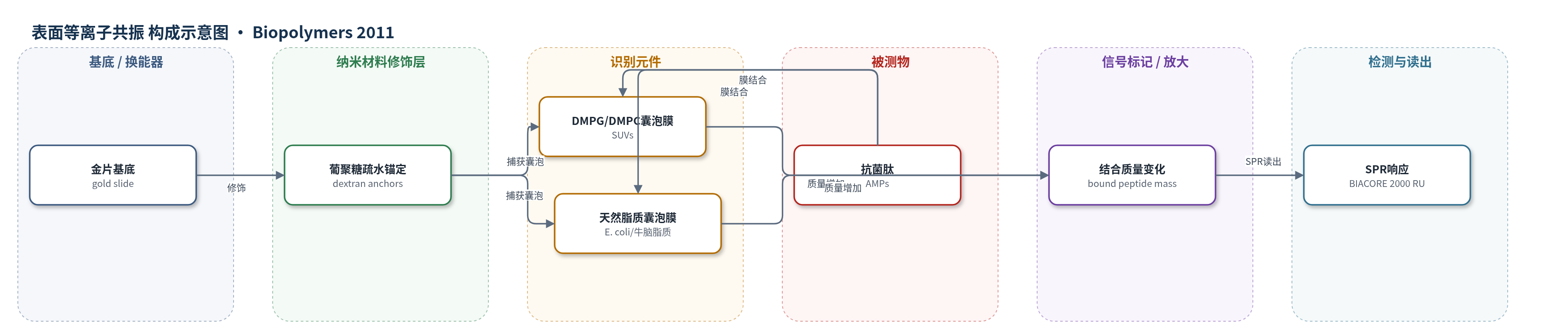
点击图片查看大图 · 依据论文自动绘制
传感器类型
表面等离子共振(SPR)生物传感器
检测对象
抗菌肽(antimicrobial peptides, AMPs;caerin、citropin、maculatin 及其类似物),样品基质:PBS 缓冲液
检测原理
该检测基于表面等离子共振(SPR)质量传感。首先将小单层囊泡(SUVs)流过金片上的羧甲基葡聚糖疏水锚定层,使 DMPG、DMPC、大肠杆菌或牛脑脂质膜被捕获并铺展在传感表面,形成不同组成的膜模拟层。随后 PBS 中的阳离子两亲性抗菌肽流过芯片,肽通过静电吸引和疏水作用与膜结合,结合量随肽浓度和膜脂质组成变化。肽结合使金表面局部质量/折射率改变,引起 SPR 共振条件变化,BIACORE 2000 以响应单位(RU)读出。作者将平衡结合 RU 按肽分子量和捕获脂质量归一化,以比较不同肽对细菌样膜与哺乳动物样膜的选择性。该方法无酶放大,信号直接反映肽-膜结合质量。
检测灵敏度
原文未报告 LOD、线性范围或相关系数。
效应效果
SPR 结果显示,除 maculatin 1.1 P15A 外,各肽对 DMPG 和大肠杆菌脂质膜的结合均强于 DMPC 和牛脑脂质膜,且天然脂质提取物的选择性数据与 MIC 及溶血活性相关性更好。Citropin 1.1 M20 对革兰阳性菌 MIC 最低(2 μg/mL),对大肠杆菌脂质结合最强,hRBC IC50 为 256 μg/mL,选择性最佳。Maculatin 1.1 P15A 无抗菌活性且无膜结合。Caerin 类似物 MIC 为 8–32 μg/mL,膜结合变化较小。电镜显示 MIC 时金黄色葡萄球菌膜出现局部裂解,2 倍 MIC 时完全裂解。DiSC3(5) 荧光泄漏实验表明 citropin 在 MIC 即可立即引起膜去极化,而万古霉素无泄漏;4 倍 MIC 的 citropin 1.1 在 10 min 内完全杀灭金黄色葡萄球菌。
传感器的构成
- 基底/换能器:金片(gold slide),承载表面等离子体共振(SPR)信号。
- 修饰层:羧甲基葡聚糖(carboxymethylated dextran)衍生疏水锚定(hydrophobic anchors),用于捕获脂质囊泡。
- 识别/膜模拟层:小单层囊泡(SUVs)脂质膜,包括 DMPG、DMPC、E. coli 总脂质提取物和牛脑总脂质提取物,模拟细菌或哺乳动物膜。
- 清洗/再生剂:CHAPS(3-胆氨丙基二甲基氨基-1-丙烷磺酸盐),用于去除捕获囊泡和结合肽。
- 样品/分析物:抗菌肽(caerin、citropin、maculatin 及其类似物)PBS 溶液,流过芯片表面发生膜结合。
- 读出:BIACORE 2000 SPR 仪,以响应单位(RU)反映结合质量变化。
中文摘要
Citropin 1.1、maculatin 1.1 和 caerin 1.1 是源自澳大利亚树蛙 Litoria 皮肤腺的短链阳离子抗菌肽。为阐明肽结构与抗菌及溶血活性的关系,作者合成了若干类似物,并利用表面等离子共振(SPR)生物传感器结合脂质囊泡捕获芯片,研究这些肽及其类似物对 1,2-二肉豆蔻酰-sn-甘油-3-磷酸甘油(DMPG)和 1,2-二肉豆蔻酰-sn-甘油-3-磷酸胆碱(DMPC)囊泡,以及由大肠杆菌和牛脑脂质提取物制备囊泡的选择性。结果表明,使用天然脂质提取物获得的膜选择性数据与革兰阳性菌最低抑菌浓度(MIC)及溶血活性的相关性优于合成 DMPG 和 DMPC。对革兰阳性菌的电镜观察和膜泄漏研究进一步揭示了肽的膜扰动特性。对 maculatin 1.1,中心脯氨酸残基不仅对 α-螺旋弯曲和抗菌活性至关重要,也对膜结合与膜扰动必不可少。caerin 类似物的 MIC 和膜结合变化较小;而 citropin 1.1 中 Asp 替换为 Lys 的类似物对革兰阳性菌 MIC 最低,对大肠杆菌脂质提取物膜结合最强,并伴随肽疏水矩增大。这些数据为将这些天然产物及其类似物开发为潜在抗生素提供了依据。
英文摘要
Citropin 1.1, maculatin 1.1, and caerin 1.1 are short antibacterial cationic peptides from the skin glands of the Australian tree frog Litoria species. Several analogues have been synthesized to give a better insight into the relationship between the structure of the peptides and their antibacterial and haemolytic activity. Binding studies using a surface plasmon resonance (SPR) biosensor together with a vesicle-capture sensor chip have been used to investigate selectivity of the peptides and their analogues for 1,2-dimyristoyl-sn-glycero-3-phosphoglycerol (DMPG) and 1,2-dimyristoyl-sn-glycero-3-phosphocholine (DMPC) vesicles, as well as for vesicles made from lipid extracts from Escherichia coli and bovine brain. Data obtained for membrane selectivity using natural lipid extracts show better correlation with minimum inhibitory concentration (MIC) values against Gram-positive bacteria and haemolytic activity than that obtained using synthetic DMPG and DMPC. Electron microscopy and membrane leakage studies using Gram-positive bacteria gave further insight into the membrane disruption properties of the peptides. For maculatin 1.1, it was found that the central proline residue, which is responsible for a bend in the alpha-helical structure, is essential not only for the antibacterial activity but also for binding, and perturbation of membranes. The caerin analogues showed only small variations in their MIC values and membrane binding. In contrast, for citropin 1.1, the analogue replacing the aspartate with a lysine showed the lowest MIC against Gram-positive bacteria and best membrane binding to E. coli lipid extracts, coinciding with an increased hydrophobic moment of the peptide. These data give further insight into these antimicrobial natural products, toward the development and evaluation of these and other analogues as potential antibiotics.