组成图示
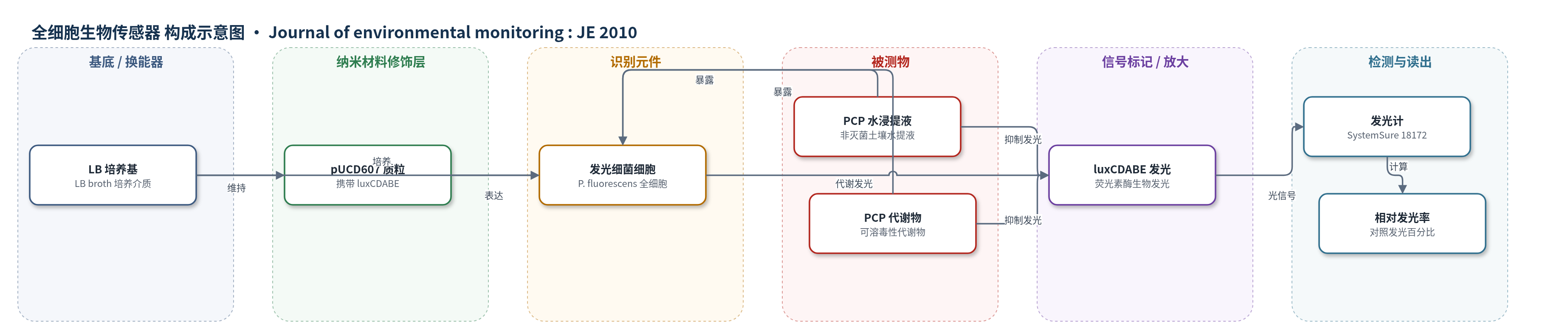
点击图片查看大图 · 依据论文自动绘制
传感器类型
全细胞生物传感器
检测对象
五氯苯酚(pentachlorophenol, PCP)及其可溶代谢物;样品基质:非灭菌土壤水浸提液(water extract)
检测原理
该检测采用全细胞发光生物传感器。Pseudomonas fluorescens pUCD607 携带 pUCD607 质粒,其 luxCDABE 荧光素酶基因位于一般代谢启动子下游,细胞正常代谢时合成荧光素酶并产生生物发光。将细菌离心收获后用 0.1 M KCl 重悬,暴露于含 PCP 的非灭菌土壤水浸提液 20 min。PCP 及其可溶代谢物干扰细菌一般代谢或能量状态,使荧光素酶活性/发光底物供应下降,光输出降低。SystemSure 发光计测量光强,并以样品发光占未污染土壤水浸提液对照发光的百分比表示;毒性越强,相对发光率越低。该方法不依赖特异性抗体或适配体,而是通过全细胞代谢响应反映生态毒性。
检测灵敏度
原文未报告 LOD、线性范围、灵敏度斜率或相关系数。
效应效果
该传感器为一般代谢报告型,不具 PCP 特异性,主要用于生态毒性而非定量。非灭菌土壤水浸提液中,20 d 相对发光率为 52.4% 对照,60 d 为 72.7%,120 d 为 74.4%,显示毒性随时间略降,与 60 和 120 d 约 9% 的 PCP 降解量一致。水浸提生物可利用性分别为 46.5±12%、19.7±8% 和 32.9±11%。蚯蚓 BCF 随老化下降:15 mg kg−1 由 0.78±0.5 降至 1.33×10⁻²±0.6×10⁻²;150 mg kg−1 由 0.54±0.2 降至 0.27±0.1,240 d 存活率为 0。NRRT 呈剂量依赖但无老化效应。作者主张化学提取、蚯蚓生物标志物与全细胞生物传感器联合用于土壤 PCP 风险监测。
传感器的构成
- 识别元件:Pseudomonas fluorescens pUCD607 全细胞,携带 pUCD607 质粒,作为生物识别与一般代谢响应单元
- 信号标记物:luxCDABE 荧光素酶基因(lux 基因簇),催化生物发光反应,光强反映细胞代谢受抑制程度
- 培养介质:LB 培养基(LB broth),用于细菌培养;kanamycin(Kan)维持 pUCD607 质粒
- 细胞重悬液:0.1 M KCl,用于离心收获后重悬细胞并暴露样品
- 样品基质:非灭菌土壤水浸提液(water extract),提供 PCP 及其可溶代谢物
- 读出装置:SystemSure luminometer Model 18172,测量发光强度并计算相对对照百分比
中文摘要
本文报道了监测灭菌与非灭菌土壤中五氯苯酚(PCP)生物可利用性和生态毒性随老化时间变化的多种方法。采用 Porapak 树脂解吸和水浸提分别评估 PCP 的生物可及性和生物可利用性,老化效应主要在 240 d 后明显。以蚯蚓体内 PCP 生物累积量衡量的实际生物可利用性随时间下降更显著。蚯蚓体腔细胞中性红保留时间(NRRT)呈剂量依赖效应,但暴露于污染土壤后未观察到老化效应;然而在 150 mg kg−1 污染水平下,蚯蚓死亡率在 240 d 后升高。相反,发光细菌生物传感器 Pseudomonas fluorescens pUCD607 在非灭菌样品中显示生态毒性随时间略有降低,可能与 PCP 降解有关。结果表明,需结合不同化学与生物学方法研究土壤污染物归趋,PCP 不同降解途径及蚯蚓与细菌敏感性差异可解释上述不同行为。
英文摘要
Several approaches to monitor the bioavailability and ecotoxicity of pentachlorophenol (PCP) in sterile and non sterile soils as a function of aging are reported. Porapak resins and water were used to assess the bioaccessibility and the bioavailability of PCP in soil. Aging effects were observed mainly after 240 d of aging. Actual bioavailability, measured as PCP bioaccumulation in earthworms, decreased more markedly with time. The ecotoxicological biomarker neutral red retention time (NRRT) displayed a dose dependent effect but no aging effects after exposing the earthworms to polluted soils. Nevertheless, mortality of earthworms increased after 240 d at 150 mg kg(-1) contamination. In contrast, the luminescent biosensor Pseudomonas fluorescens pUCD607 evidenced in non sterilized samples a slight reduction of ecotoxicity in time related to the degradation of the molecule. Once again, results highlight the necessity to study the fate of soil pollutants with different chemical and biological approaches. Different PCP degradation pathways and/or the different sensitivity of earthworms and bacteria could explain the different behaviours observed.