组成图示
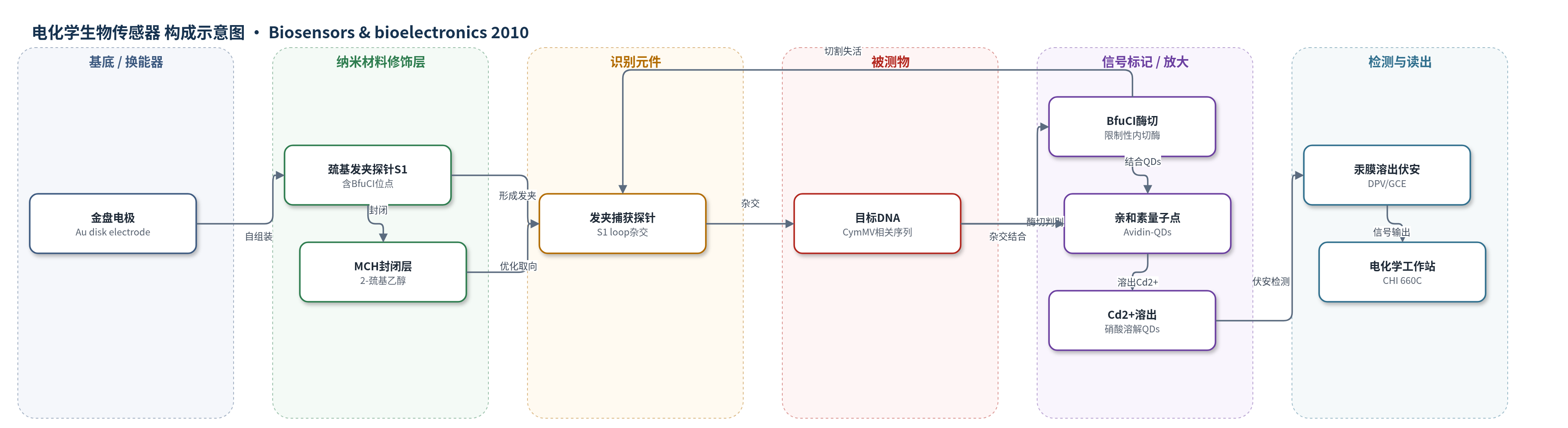
点击图片查看大图 · 依据论文自动绘制
传感器类型
电化学生物传感器
检测对象
兰科植物病毒 Cymbidium mosaic virus(CymMV)相关 DNA 序列(目标 DNA T1/T2/T3),样品基质为杂交缓冲液/溶液(未涉及实际植物样品)。
检测原理
巯基发夹探针 S1 通过 S-Au 键固定于金电极,茎部含 BfuCI 识别位点 5'-GATC-3'。无目标 DNA 时探针保持发夹双链茎,BfuCI 可切割茎部,使探针脱落或破坏,生物素端无法结合亲和素量子点(Avidin-QDs),背景低。存在完全匹配目标 DNA 时,环区与目标杂交,茎打开为单链,BfuCI 不能切割,探针保留生物素端并结合 Avidin-QDs。随后用硝酸溶解 QDs 释放 Cd2+,在含 HgCl2 的 HOAC-NaAC 缓冲液中于玻璃碳电极上以汞膜溶出伏安/DPV 检测 Cd2+,峰电流随目标 DNA 浓度增加而增大。BfuCI 酶切作为信号开判别,降低背景并提高选择性;量子点提供 Cd2+ 信号放大。
检测灵敏度
LOD: 3.3 × 10⁻¹⁴ M;线性范围: 1.0 × 10⁻¹³∼1.8 × 10⁻¹² M;灵敏度斜率: 0.1366(I (μA) = 0.1366 log C (0.1 pM) + 0.1953);r = 0.9956。
效应效果
传感器对完全匹配目标 DNA 响应明显,对单碱基错配和非互补序列响应显著降低,可区分单碱基错配;在 1.8×10⁻¹² M 下非互补几乎无峰电流。10 次重复测定 1.0×10⁻¹² M 目标 DNA 的 RSD 为 2.8%。作者称其检出限低于部分以量子点为报告物的现有电化学生物传感器。荧光分子信标(TAMRA/DABCYL)验证结果与电化学一致。该策略设计简单、背景低、仪器成本低,可用于病毒或疾病相关 DNA 杂交检测,但文中未报告实际样品加标回收率。
传感器的构成
- 基底/换能器电极:金盘电极(Au disk electrode, GE),用于巯基 DNA 自组装和 EIS 表征。
- 检测工作电极:玻璃碳电极(GCE),用于汞膜溶出伏安/DPV 检测 Cd2+。
- 识别元件:巯基修饰发夹捕获探针 S1(5'-HS-...-3',茎部含 BfuCI 识别位点 5'-GATC-3'),通过 S–Au 键固定并识别目标 DNA。
- 封闭剂:2-巯基乙醇(MCH),形成混合单分子层,减少非特异性吸附并优化探针取向。
- 酶切判别元件:限制性内切核酸酶 BfuCI(REN),特异性切割含识别位点的双链 DNA,用于区分杂交状态。
- 信号标记物:亲和素量子点(Avidin-QDs,CdSe/ZnS 核壳约 10 nm),通过生物素-亲和素结合标记未被酶切的探针,溶出后提供 Cd2+ 信号。
- 电化学介质:0.1 M pH 5.3 HOAC-NaAC 缓冲液含 HgCl2,用于汞膜溶出伏安;2 mM Fe(CN)6^3-/4- 用于 EIS 表征。
中文摘要
本文报道了一种基于限制性内切酶位点特异性 DNA 切割、并以量子点作为报告物的新型电化学生物传感器构建策略。该传感器通过在金电极上固定巯基修饰、另一端标记生物素的捕获发夹探针制备而成。BfuCI 核酸酶只能特异性切割双链 DNA 而不能切割单链 DNA,用于降低背景电流并提高灵敏度。结果表明,无目标 DNA 时捕获发夹探针可被 BfuCI 切割,存在目标 DNA 时则不能被切割;酶切前后的差异在量子点从杂交体中溶出后用电化学方法监测。结果显示,BfuCI 核酸酶显著提高了传感器的灵敏度和选择性。该方法成功实现了完全匹配与错配目标 DNA(包括单碱基错配)的序列选择性区分,并可检测低至 3.3×10^-14 M 的互补目标 DNA。此外,作者还设计了由捕获发夹探针及荧光基团 TAMRA 和淬灭基团 DABCYL 组成的荧光分子信标,以荧光法验证上述策略,荧光结果与电化学分析一致,进一步证明该策略可行。
英文摘要
A new strategy for development of electrochemical DNA biosensor based on site-specific DNA cleavage of restriction endonuclease and using quantum dots as reporter was reported in this paper. The biosensor was fabricated by immobilizing a capture hairpin probe, thiolated single strand DNA labeled with biotin group, on a gold electrode. BfuCI nuclease, which is able to specifically cleave only double strand DNA but not single strand DNA, was used to reduce background current and improve the sensitivity. We demonstrated that the capture hairpin probe can be cleaved by BfuCI nuclease in the absence of target DNA, but cannot be cleaved in the presence of target DNA. The difference before and after enzymatic cleavage was then monitored by electrochemical method after the quantum dots were dissolved from the hybrids. Our results suggested that the usage of BfuCI nuclease obviously improved the sensitivity and selectivity of the biosensor. We successfully applied this method to the sequence-selective discrimination between perfectly matched and mismatched target DNA including a single-base mismatched target DNA, and detected as low as 3.3 × 10(-14) M of complementary target DNA. Furthermore, our above strategy was also verified with fluorescent method by designing a fluorescent molecular beacon (MB), which combined the capture hairpin probe and a pair of fluorophore (TAMRA) and quencher (DABCYL). The fluorescent results are consistent with that of electroanalysis, further indicating that the proposed new strategy indeed works as we expected.