组成图示
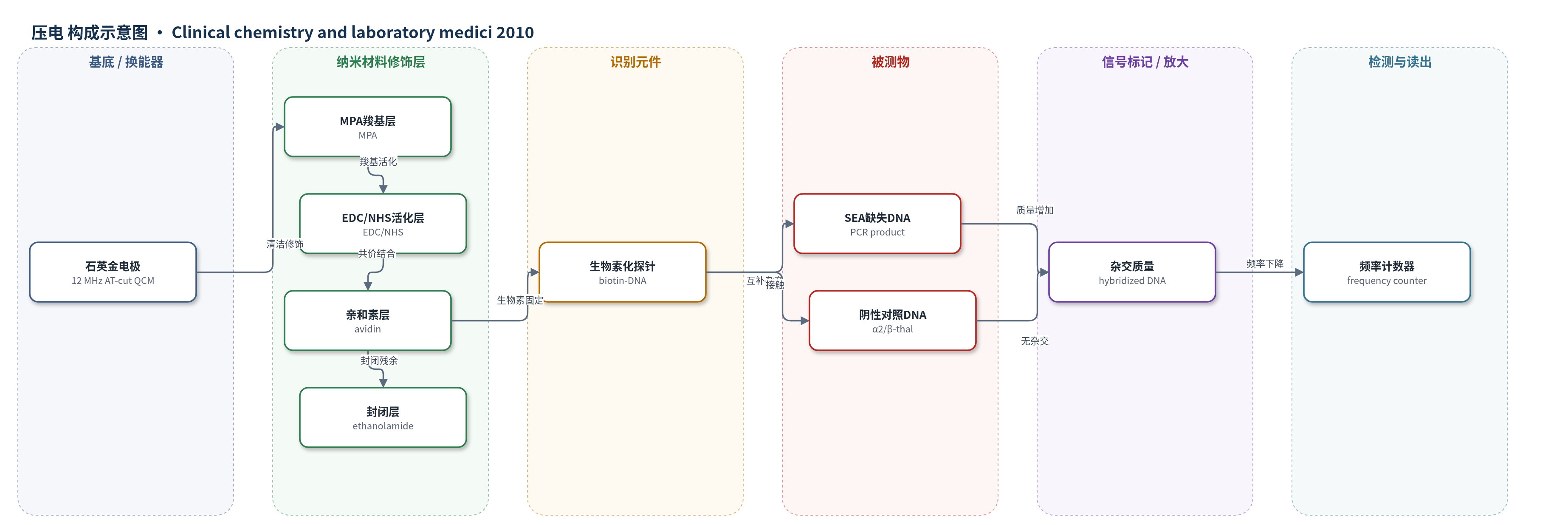
点击图片查看大图 · 依据论文自动绘制
传感器类型
压电(QCM)生物传感器
检测对象
α-地中海贫血1(SEA deletion)异常α-珠蛋白基因PCR产物(alpha-thalassemia 1 SEA deletion PCR product),样品基质:EDTA全血/血样
检测原理
该传感器采用无标记压电检测。金电极经MPA自组装形成羧基,EDC/NHS活化后与avidin氨基共价结合,再用乙醇酰胺封闭残余羧基,最后通过生物素-亲和素作用固定生物素化DNA探针。血样DNA经PCR扩增后,目标片段在杂交缓冲液中变性并与探针互补杂交。杂交DNA沉积在石英表面,使有效质量增加;根据Sauerbrey方程,沉积质量与石英共振频率变化呈线性关系,因此被测物浓度越高,杂交DNA越多,频率下降越明显。频率变化由自制振荡频率计数器读出。PCR扩增作为前处理放大,传感器本身无酶促或标记放大。
检测灵敏度
最低可诊断浓度: 25 mg/mL(Hb Bart's hydrops fetalis);正常与α-地中海贫血1携带者区分: 100 mg/mL;凝胶电泳对照: 100 mg/mL;100 mg/mL时频率变化: 正常 34.7±4.04 Hz,携带者 50.3±2.52 Hz
效应效果
该传感器对α-地中海贫血1(SEA缺失)具有高度特异性,α-地中海贫血2和β-地中海贫血样品的频率变化与正常基因型相似,未见交叉反应。灵敏度方面,识别Hb Bart's水肿胎儿患者最低DNA浓度为25 mg/mL,而凝胶电泳需100 mg/mL,作者称其比凝胶电泳高4倍;区分正常与携带者需100 mg/mL,此时正常和携带者频率变化分别为34.7±4.04 Hz和50.3±2.52 Hz。传感器室温保存180天诊断能力稳定。44份盲法血样中12份阳性,与凝胶电泳结果100%一致。作者认为其可用于偏远地区地中海贫血防控。
传感器的构成
- 基底/换能器:12 MHz AT-cut石英晶体金电极(12 MHz AT-cut quartz crystal, 4 mm gold electrode, 0.1257 cm2),经热piranha溶液(H2O2/H2SO4, 1:3)清洁,作为压电换能器和电极基底
- 功能化修饰层:巯基丙酸(MPA, mercaptopropionic acid, 10 mM)在金表面自组装形成羧基
- 化学活化层:EDC(1-ethyl-3-(3-dimethylaminopropyl) carbodiimide, 20 mM)和NHS(N-hydroxysuccinimide, 50 mM)活化羧基形成活性酯
- 识别元件桥接层:亲和素(avidin, 0.1 mg/mL)通过氨基与活化羧基结合,提供生物素结合位点
- 封闭层:乙醇酰胺盐酸盐(ethanolamide hydrochloride, 1 mM)将残余羧基转化为β-hydroxyethanolamide,封闭非特异结合位点
- 识别元件:生物素化寡核苷酸DNA探针(biotinylated oligonucleotide DNA probe, 1 mM, 5'-biotin-TTTTTTGAAGGAGGGGAGAAGCTGAG-3'),通过生物素-亲和素固定并识别SEA缺失PCR产物
- 信号标记物:无标记(label-free),杂交DNA沉积质量直接作为信号
- 读出装置:自制振荡频率计数器(in-house oscillation frequency counter, PIC-microcontroller, oscillator circuit, read out display),记录共振频率变化
中文摘要
本文报道了一种基于石英晶体微天平(QCM)的无标记DNA压电生物传感器,用于检测导致α-地中海贫血1(SEA缺失)的异常人类珠蛋白基因。传感器以12 MHz AT切石英晶体金电极为基底,经热piranha溶液清洁后,用巯基丙酸(MPA)自组装形成羧基表面,并以EDC和NHS活化,通过氨基共价结合亲和素(avidin),再用乙醇酰胺盐酸盐封闭残余羧基,最后固定5'端生物素化的寡核苷酸DNA探针。血样基因组DNA经PCR扩增后,目标片段与固定探针杂交,杂交DNA沉积质量使石英共振频率发生可测变化。研究用已知和未知血样验证诊断能力,并与标准凝胶电泳比较。结果显示,该传感器可区分正常基因型、α-地中海贫血1携带者和Hb Bart's水肿胎儿患者,对α-地中海贫血2和β-地中海贫血无交叉反应,室温保存180天仍保持诊断准确性,作者认为其可用于地中海贫血防控。
英文摘要
BACKGROUND: DNA piezoelectric biosensors have become a promising tool in molecular medicine since they do not require any label or staining. Here, a DNA piezoelectric biosensor based on a quartz crystal microbalance (QCM) was created to identify abnormal genes causing α-thalassemia 1 (SEA deletion).
METHODS: The functionalized gold electrode of the quartz crystal was coated with avidin and the biotinylated DNA probe was attached. The target gene causing α-thalassemia 1 was amplified and hybridized with the immobilized probe. DNA hybridization was indicated by changes in the quartz resonance frequencies. Diagnostic ability of the new α-thalassemia 1 biosensor was validated using both known and unknown blood samples. Specificity was tested using samples of β-thalassemia and α-thalassemia 2. Stability of the sensor was also evaluated.
RESULTS: The new biosensor could clearly identify α-thalassemia 1 (SEA deletion), both carrier and disease states, from the normal genotype. Identification accuracy was compatible to the standard gel electrophoresis. It was specific only to α-thalassemia 1 since no cross reaction was found with β-thalassemia and α-thalassemia 2. The sensor could be kept at room temperature up to 6 months with consistent identification accuracy.
CONCLUSIONS: The label free QCM based biosensor was successfully developed to diagnose an abnormal human globin gene causing α-thalassemia 1 (SEA deletion). Its accuracy, specificity and sensitivity were comparable to the standard method. Its stable diagnostic potency up to 6 months implied its field application in thalassemic control program.