组成图示
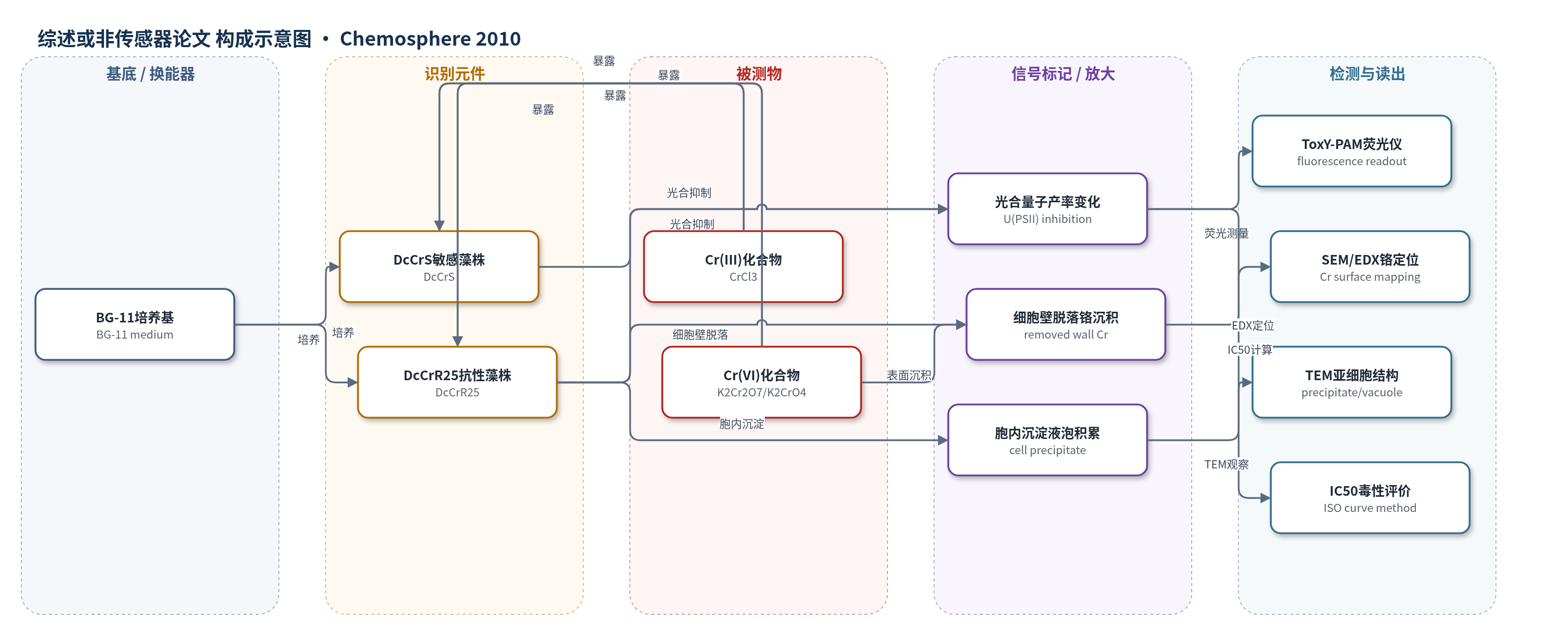
点击图片查看大图 · 依据论文自动绘制
传感器类型
综述或非传感器论文
检测对象
三价铬 Cr(III)(CrCl3)、六价铬 Cr(VI)(K2Cr2O7、K2CrO4);样品基质为 BG-11 藻培养基(模拟水样)
检测原理
铬化合物进入或接触藻细胞后,干扰光系统II的电子传递与叶绿素荧光过程,使最大荧光 F0m 和稳态荧光 Ft 发生变化,光合量子产率 U(PSII)=(F0m-Ft)/F0m 随铬浓度升高而下降。作者以 ToxY-PAM 荧光仪测定 72 h 抑制率,并按 ISO 曲线面积法计算 IC50(72)。敏感株 DcCrS 对 Cr(III) 和 Cr(VI) 均敏感,而抗性株 DcCrR25 对 Cr(VI) 显著耐受、对 Cr(III) 仍敏感,因此比较两株 U(PSII) 响应可区分铬氧化态。SEM/EDX 和 TEM 还显示抗性株出现细胞壁脱落、表面铬沉积、胞内沉淀和液泡积累,提示解毒与结构适应机制;本文未使用额外信号放大策略。
检测灵敏度
未报告 LOD、线性范围、灵敏度斜率或相关系数。
效应效果
实验以 8 个重复测定 72 h IC50(72)。敏感株 DcCrS 对 K2Cr2O7、K2CrO4、CrCl3 的 IC50(72) 分别为 8.87、12.36、17.34 mg/L;抗性株 DcCrR25 分别为 161.32、2573.59、13.06 mg/L,表明其对 Cr(VI) 有显著抗性而对 Cr(III) 敏感性相近。SEM/EDX 显示抗性株脱落细胞壁表面铬含量为 0.27±0.06 atomic%,敏感株未检出;TEM 显示胞内有 45–85 nm 沉淀及液泡积累。作者主张利用两株光合响应差异开发铬氧化态特异性微藻生物传感器。
传感器的构成
- 未报道具体传感器构成:本文未构建实际传感器,仅以藻细胞毒性响应作为潜在传感原理
- 生物识别/指示细胞:Dyctiosphaerium chlorelloides 敏感株系 DcCrS 与 Cr(VI) 抗性株系 DcCrR25,作为铬氧化态毒性响应细胞
- 样品基质:BG-11 培养基,用于藻细胞培养与铬化合物暴露
- 被测物/刺激物:Cr(III) 化合物 CrCl3 与 Cr(VI) 化合物 K2Cr2O7、K2CrO4,诱导光合抑制
- 换能/信号读出:ToxY-PAM 荧光仪,测量 F0m 与 Ft 并计算 U(PSII)
- 结构表征:SEM/EDX 与 TEM,观察细胞壁、表面铬沉积、胞内沉淀和液泡
中文摘要
铬因工业用途广泛而成为多种环境中的常见污染物。本研究旨在考察铬暴露对绿藻 Dyctiosphaerium chlorelloides 敏感株系和抗性株系的光合性能毒性效应,并分析出现的铬抗性细胞的性质与机制。作者以 Cr(III) 化合物 CrCl3 和 Cr(VI) 化合物 K2Cr2O7、K2CrO4 处理两种藻株,利用 ToxY-PAM 荧光仪测定 72 h 光合量子产率 U(PSII),并按 ISO 方法计算 50% 抑制浓度 IC50(72)。结果表明,两种株系的光合性能均受到抑制;在野生型敏感细胞中,两种铬氧化态的 IC50(72) 无显著差异,但在 Cr(VI) 抗性细胞中差异显著。Cr(III) 暴露下两种株系的 IC50(72) 相近。SEM/EDX 和 TEM 观察显示,野生株暴露六价铬后发生快速形态演化,并可能存在细胞壁脱落、表面铬沉积、胞内沉淀和液泡积累等解毒机制。作者认为,敏感与抗性细胞对 Cr(VI) 和 Cr(III) 的不同光合响应可用于开发铬氧化态特异性真核微藻生物传感器。
英文摘要
Due to its various uses, chromium contamination has become widespread in a diverse array of environments. The present study was carried out to investigate the toxic effect of chromium exposures on sensitive and resistant strains of the green algae Dyctiosphaerium chlorelloides, and to determine the nature and mechanism of chromium-resistant cells that arise. The toxic effect on the photosynthetic performance of chromium exposures in both cell populations, and the sensitive differences due to chromium oxidation state, were estimated, and the results indicate that although the photosynthetic performance in both strains were inhibited, there are not significant differences among IC(50(72)) values obtained in toxicity assays with both chromium oxidation states in wild-type cells, and however these differences are very significant when the assays were performed with Cr(VI) resistant cells. The 72-h 50% inhibitory concentration values obtained with Cr(III) exposures were similar for both strains. Additionally, by means of the SEM/EDX and TEM microscopic techniques, the occurrence of rapid morphological evolution in the microalgal cells and the possible detoxificant mechanisms was observed after exposure of the wild strain to chromium hexavalent. Moreover, the different response in photosynthetic activity observed between sensitive and resistant cells of D. chlorelloides in the presence of Cr(VI) and Cr(III) could be used to obtain a chromium-specific eukaryotic microalgal biosensor.