组成图示
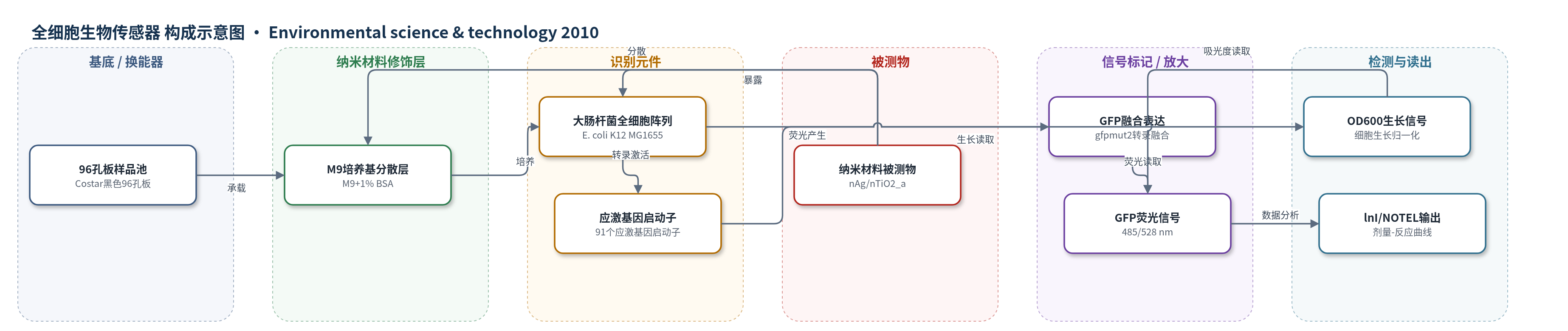
点击图片查看大图 · 依据论文自动绘制
传感器类型
全细胞生物传感器
检测对象
纳米银(nanosilver, nAg)、纳米二氧化钛锐钛矿(nanotitanium dioxide anatase, nTiO2_a);样品基质:M9培养基(含1% BSA分散剂)
检测原理
纳米银或纳米二氧化钛加入含大肠杆菌全细胞阵列的M9培养基后,纳米材料与细胞接触并诱导氧化应激、膜/转运损伤或DNA损伤等毒性事件。相应应激基因启动子被激活,驱动下游绿色荧光蛋白GFP(gfpmut2)转录表达,形成生物级联放大。读板机同步测量OD600细胞生长和GFP荧光,将实验组与对照组归一化得到基因表达水平Pe/Pc,计算诱导因子I及其自然对数lnI。不同纳米材料浓度改变差异表达基因数量和表达模式,从而形成化合物特异、浓度依赖的转录指纹;基于差异表达基因比例与浓度的剂量-反应曲线可确定NOTEL。
检测灵敏度
未报告LOD、线性范围、灵敏度斜率或相关系数。原文报告NOTEL: 0.658 (±0.260) mg/L (nAg);NOTEL: 0.557 (±0.545) mg/L (nTiO2_a)
效应效果
该方法在2 h内以3 min间隔同步读取OD600和GFP,获得91个应激基因的实时表达谱,相比微阵列更简单、快速、可靠、可重复使用并可定制。nAg和nTiO2_a均引起氧化应激、膜/转运损伤和DNA损伤,但差异表达基因谱不同,显示化合物特异性;1 mg/L低浓度仅少数基因改变,50 mg/L高浓度更多全局应激基因。NOTEL分别为nAg 0.658±0.260 mg/L、nTiO2_a 0.557±0.545 mg/L,与BOD值116.4和64.9 µmole-TEU/L一致,可作为风险评价终点。候选标志物包括nAg的oxyR、cls、cspB和nTiO2_a的mutT、sodB、pbpG。
传感器的构成
- 样品池/培养基底:黑色96孔板(Costar),承载细胞培养与纳米材料暴露
- 识别/响应元件:91株重组大肠杆菌K12 MG1655全细胞阵列,携带91个应激基因启动子-GFP融合
- 遗传信号元件:低拷贝质粒pUA66/pUA139,含卡那霉素抗性基因与fast-folding gfpmut2,实现分钟级转录表达
- 信号标记物:绿色荧光蛋白GFP(gfpmut2),由应激基因启动子驱动,荧光强度指示基因表达
- 样品基质/分散剂:M9培养基含1% BSA,用于配制nAg/nTiO2_a并维持分散
- 读出装置:Synergy HT Multi-Mode微孔板读板机,同步读取OD600与GFP荧光(485/528 nm)
中文摘要
本研究采用毒理基因组学方法,利用由91株重组大肠杆菌K12(MG1655)组成的全细胞阵列,对纳米银(nAg)和锐钛矿型纳米二氧化钛(nTiO2_a)进行机制性毒性评估。该细胞阵列携带覆盖多数已知应激反应基因的转录绿色荧光蛋白(GFP)融合,可在暴露后实时监测启动子活性。结果首次揭示了nAg和nTiO2_a更详细的转录毒性机制,有助于理解金属及金属氧化物纳米材料的作用模式。基于时间基因表达谱建立的氧化应激和SOS DNA损伤修复通路网络,阐明了关键基因之间的关系与激活时序。两种纳米材料均引起氧化应激以及细胞膜和转运损伤,并观察到遗传毒性和DNA损伤;nTiO2_a通过已识别的SOS通路诱导修复,而nAg似乎通过不同于SOS的通路诱导DNA修复。低浓度下更易诱导化学特异性毒性反应,高浓度下则以全局应激反应为主。实时基因表达数据可识别潜在生物标志物,用于特定毒素检测和生物传感器开发;浓度依赖的基因表达响应还可确定未观察到转录效应水平(NOTEL),可应用于监管与风险评估。
英文摘要
This study performed mechanistic toxicity assessment of nanosilver (nAg) and nanotitanium dioxide anatase (nTiO2_a) via toxicogenomic approach, employing a whole-cell-array library consisting of 91 recombinated Escherichia coli K12 strains with transcriptional GFP-fusions covering most known stress response genes. The results, for the first time, revealed more detailed transcriptional information on the toxic mechanism of nAg and nTiO2_a, and led to a better understanding of the mode of action (MOA) of metal and metal oxide nanomaterials (NMs). The detailed pathways network established for the oxidative stress system and for the SOS (DNA damage) repair system based on the temporal gene expression profiling data revealed the relationships and sequences of key genes involved in these toxin response systems. Both NMs were found to cause oxidative stress as well as cell membrane and transportation damage. Genotoxicity and DNA damage were also observed, although nTiO2_a induced SOS response via previously identified pathway and nAg seemed to induce DNA repair via a pathway different from SOS. We observed that the NMs at lower concentration tend to induce more chemical-specific toxicity response, while at higher concentrations, more general global stress response dominates. The information-rich real-time gene expression data allowed for identification of potential biomarkers that can be employed for specific toxin detection and biosensor developments. The concentration-dependent gene expression response led to the determination of the No Observed Transcriptional Effect Level (NOTEL) values, which can be potentially applied in the regulatory and risk assessment framework as an alternative toxicity assessment end point.