组成图示
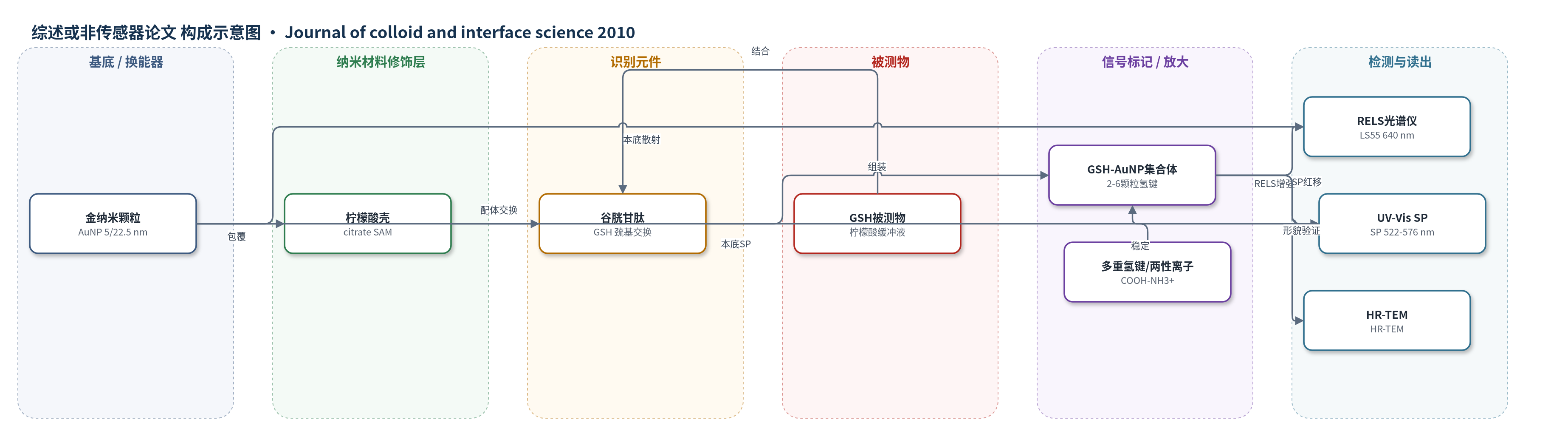
点击图片查看大图 · 依据论文自动绘制
传感器类型
综述或非传感器论文
检测对象
谷胱甘肽(glutathione, GSH)、氧化型谷胱甘肽(glutathione disulfide, GSSG);样品基质为柠檬酸缓冲水溶液(pH 3.24)。
检测原理
在 pH 3.24 柠檬酸缓冲液中,GSH 主要以两性离子形式存在。其巯基与金表面形成强 Au-S 键,置换柠檬酸短链配体,完成配体交换并形成 GSH 包覆 AuNP。随后 GSH 分子间通过 COOH-COOH、COOH-NH2 等单重、双重或三重氢键,以及 COO--NH3+ 静电相互作用,将多个 AuNP 连接成 2-6 颗粒的小集合体。集合体有效粒径增大,按 Rayleigh 散射规律,弹性散射强度随粒径六次方增强,因此 RELS 信号在 60 s 内显著上升。GSH 浓度低于阈值时交换/成核不足,超过阈值后快速成核生长,使 Isc-CGSH 呈 S 形。长期过程中集合体弛豫、有序化和沉降使信号下降;较大 AuNP 因聚集和沉降更快而表现为 RELS 猝灭。
检测灵敏度
原文未报告 LOD、线性范围、灵敏度斜率或相关系数。
效应效果
对 5 nm AuNP,GSH 注入 60 s 后 RELS 强度增大 9.09 倍,有效直径增至 2.09 倍,对应 2-6 颗粒小集合体;SP 吸收峰由 522 nm 红移至 576 nm,阈值 GSH 浓度约 1.5-2.5 mM。对 22.5 nm AuNP,GSH 加入后 RELS 明显猝灭,归因于更大聚集、光屏蔽和快速沉降。10 h 监测显示初始跳跃后约 1.5 h 内 RELS 下降 12%,随后约 3 h 胶体相对稳定,之后因沉降继续下降。GSSG 的半转变浓度 0.83 mM 低于 GSH 的 2.0 mM,说明二硫键可提供更多 GS- 成核位点。作者认为 RELS 对颗粒间相互作用灵敏,适合监测其他单层保护金属簇的快速反应与组装。
传感器的构成
- 纳米颗粒换能器:柠檬酸包覆金纳米颗粒(citrate-capped AuNP,5 nm 或 22.5 nm),提供局域表面等离子体共振与弹性光散射信号。
- 初始修饰层:柠檬酸单分子层(citrate SAM),短链配体,可被 GSH 置换。
- 识别/配体交换元件:还原型谷胱甘肽(glutathione, GSH),含巯基,与 Au 形成 Au-S 键并置换柠檬酸。
- 样品基质:柠檬酸缓冲水溶液(pH 3.24),维持 GSH 两性离子状态并控制配体交换。
- 信号放大/组装元件:GSH 连接的金纳米颗粒小集合体(GSH-linked AuNP ensembles,2-6 颗粒),通过多重氢键和两性离子静电相互作用形成,增大有效粒径并增强 RELS。
- 读出装置:LS55 光谱仪(Perkin Elmer)配氙灯、PMT/雪崩光电二极管,记录共振弹性光散射(RELS)强度。
- 辅助验证:UV-Vis 表面等离子体吸收光谱与高分辨透射电镜(HR-TEM),用于确认 SP 红移/展宽和颗粒组装形貌。
中文摘要
本研究以柠檬酸包覆金纳米颗粒(AuNP)与生物分子谷胱甘肽(GSH)的相互作用为模型,评估金纳米颗粒载体快速捕获 GSH 的可行性,并为纳米增强型功能生物传感器界面和纳米医学应用提供依据。采用共振弹性光散射(RELS)光谱监测 GSH 诱导的 AuNP 组装,发现 GSH 诱导的散射截面对 AuNP 尺寸具有强依赖性。对 5 nm 小粒径 AuNP,在 GSH 注入后 60 s 内 RELS 强度显著增大,归因于快速配体交换后 AuNP 组装;其非 Langmuir 型浓度依赖表明配体交换遵循二维成核与生长机制。对 22.5 nm 较大 AuNP,GSH 加入后 RELS 强度反而猝灭,与更大聚集和沉降有关。10 h 长期 RELS 监测显示配体交换、小集合体形成及后续弛豫过程。分子动力学与量子力学计算支持 GSH 连接体形成及颗粒间多重氢键和静电两性离子相互作用驱动组装。RELS 被证明是研究颗粒间相互作用的灵敏工具,可拓展用于监测其他单层保护金属簇的快速反应与组装。
英文摘要
The interactions of a biomolecule glutathione (GSH) with citrate-capped gold nanoparticles (AuNP) have been investigated to evaluate the viability of a rapid GSH-capture by gold nanoparticle carriers, as a model system for applications ranging from designing nanoparticle-enhanced functional biosensor interfaces to nanomedicine. The measurements, performed using resonance elastic light scattering (RELS) spectroscopy, have shown a strong dependence of GSH-induced scattering cross-section on gold nanoparticle size. A large increase in RELS intensity after injection of GSH, in a short reaction time (tau=60 s), has been observed for small AuNP (5nm dia.) and ascribed to the fast ligand-exchange followed by AuNP assembly. The unexpected non-Langmuirian concentration dependence of scattering intensity for AuNP (5 nm) indicates on a 2D nucleation and growth mechanism of the ligand-exchange process. The ligand-exchange and small nanoparticle ensemble formation followed by relaxation have been observed in long term (10 h) monitoring of GSH-AuNP interactions by RELS. The results of molecular dynamics and quantum mechanical calculations corroborate the mechanism of the formation of hydrogen-bonded GSH-linkages and interparticle interactions and show that the assembly is driven by multiple H-bonding between GSH-capped AuNP and electrostatic zwitterionic interactions. The RELS spectroscopy has been found as a very sensitive tool for studying interparticle interactions. The application of RELS can be expanded to monitor reactivities and assembly of other monolayer-protected metal clusters, especially in very fast processes which cannot be followed by other techniques.