组成图示
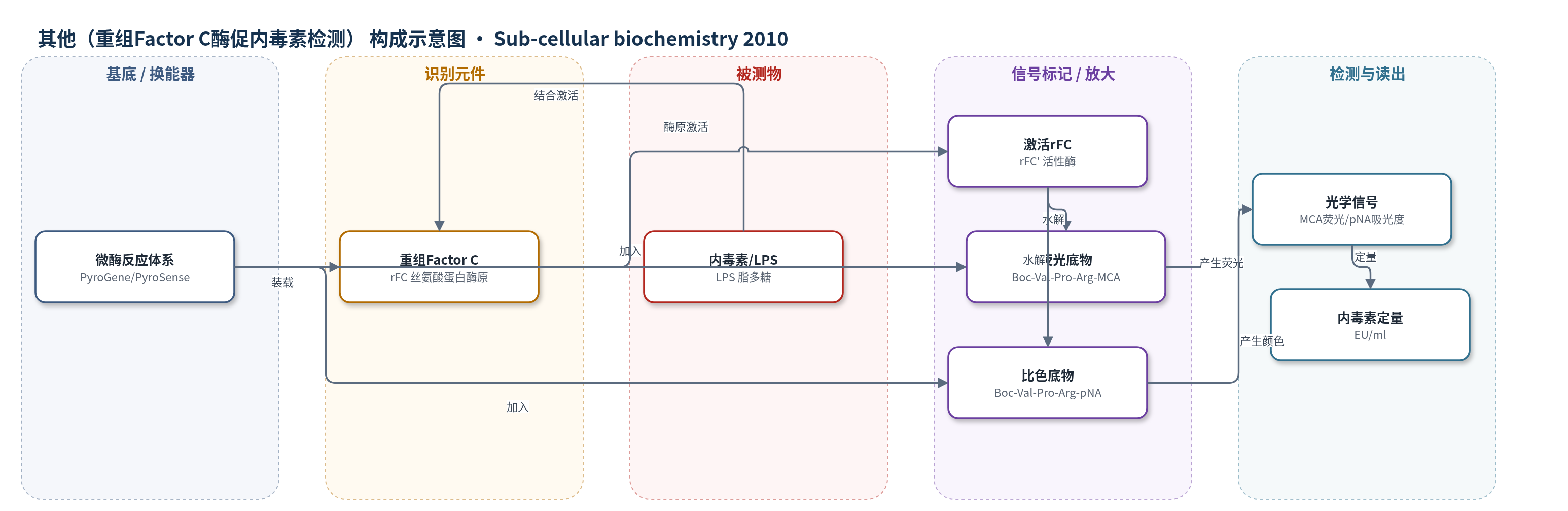
点击图片查看大图 · 依据论文自动绘制
传感器类型
其他(重组Factor C酶促内毒素检测)
检测对象
内毒素/脂多糖(endotoxin/LPS);样品基质:注射药物、医疗器械、水样等生物医学产品/流体
检测原理
重组 Factor C(rFC)是一种 132 kDa 丝氨酸蛋白酶原,其 N 端重链区具有内毒素结合位点。当样品中痕量内毒素/脂多糖(LPS)存在时,LPS 与 rFC 结合并诱导其自催化激活为活性 rFC'。激活后的 rFC' 作为酶催化水解荧光底物 Boc-Val-Pro-Arg-MCA 或比色底物 Boc-Val-Pro-Arg-pNA,释放 MCA 或 pNA。MCA 在 380 nm 激发下产生荧光,pNA 产生可测吸光度;信号强度随内毒素浓度增加而增强。通过提高 rFC 用量可进一步降低检出限,实现单步、高通量定量检测。
检测灵敏度
LOD: 0.001 EU/ml;原文另述提高 rFC 量可将检测灵敏度从 0.005 EU/ml 提升至 0.001 EU/ml
效应效果
与传统鲎试剂(LAL)相比,rFC 检测体系在相同条件下背景读数更低,对内毒素响应更敏感,并可通过单步酶促反应实现快速高通量筛查。由于体系中不含 LAL 的其他凝血蛋白,可避免 1–3 β-D-葡聚糖等替代凝血通路造成的假阳性,提高特异性。rFC 来源稳定、可标准化生产,避免依赖濒危鲎血,已用于 PyroGene 试剂盒和 PyroSense 在线监测,适用于注射药物、医疗器械及生物制药生产用水等内毒素质控。
传感器的构成
- 识别元件:重组 Factor C(rFC),132 kDa 丝氨酸蛋白酶原,特异性识别并被内毒素/LPS 激活
- 信号底物:荧光底物 Boc-Val-Pro-Arg-MCA(MCA,7-氨基-4-甲基香豆素)或比色底物 Boc-Val-Pro-Arg-pNA(pNA,对硝基苯胺),被激活 rFC 水解产生可测信号
- 检测载体:微酶法检测系统(PyroGene 试剂盒、PyroSense 在线监测系统),承载 rFC 与底物反应并实现高通量或连续监测
- 读出装置:微荧光/微比色检测系统,读取 MCA 荧光或 pNA 吸光度变化
中文摘要
革兰氏阴性菌内毒素又称脂多糖(LPS),是位于细菌外膜的生物致热原,静脉引入后可引起发热,并在脓毒症中刺激巨噬细胞释放炎症细胞因子,过度炎症可导致多器官衰竭和死亡。鲎变形细胞裂解物(LAL)已广泛用于注射药物和医疗器械的内毒素质控,其丝氨酸蛋白酶级联反应最终形成凝胶凝块。Factor C 是该凝血级联的启动酶原,在体内可作为识别革兰氏阴性菌入侵的生物传感器。然而,LAL 的敏感性和特异性存在批间差异,且鲎资源日益减少,促使开发替代检测方法。重组 Factor C(rFC)为 132 kDa 酶原,可被痕量内毒素诱导激活,构成 PyroGene 试剂盒的基础,用于内毒素高通量微酶法检测;Lonza 公司进一步开发 PyroSense 用于生物制药生产线的内毒素检查点监测。rFC 从克隆到商业化应用,开启了内毒素检测的新阶段,同时减少对濒危鲎的依赖。
英文摘要
Gram negative bacterial endotoxin is a biological pyrogen that causes fever when introduced intravenously. The endotoxin, also known as lipopolysaccharide (LPS), is found in the outer membrane of Gram-negative bacteria. During Gram-negative sepsis, endotoxin stimulates host macrophages to release inflammatory cytokines. However, excessive inflammation causes multiple organ failure and death. Endotoxins, which are ubiquitous pathogenic molecules, are a bane to the pharmaceutical industry and healthcare community. Thus early and sensitive detection of endotoxin is crucial to prevent endotoxaemia. The limulus amebocyte lysate (LAL) has been widely used for ~30 years for the detection of endotoxin in the quality assurance of injectable drugs and medical devices. The LAL constitutes a cascade of serine proteases which are triggered by trace levels of endotoxin, culminating in a gel clot at the end of the reaction. The Factor C, which normally exists as a zymogen, is the primer of this coagulation cascade. In vivo, Factor C is the perfect biosensor, which alerts the horseshoe crab of the presence of a Gram-negative invader. The hemostatic end-point entraps the invader, killing it and limiting further infection. However, as an in vitro endotoxin detection tool, variations in the sensitivity and specificity of LAL to endotoxin, and the dwindling supply of horseshoe crabs are posing increasing challenges to the biotechnology industry. This has necessitated the innovation of an alternative test for endotoxin. Thus, Factor C became the obvious, albeit tricky target for the recombinant technology effort. This chapter documents the backwater of mining the natural blood lysate of the endangered species to the monumental effort of genetic engineering, to produce recombinant Factor C (rFC). The rFC is a 132 kDa molecule, which was produced as a proenzyme inducible by the presence of trace levels of endotoxin. The rFC forms the basis of the "PyroGene" kit, which is a novel micro-enzymatic endotoxin diagnostic assay for high-throughput screens of endotoxin. Using the rFC, Lonza Inc. has spawned the "PyroSense" which serves as checkpoints of the biotechnology production line. Thus, from cloning to commercial applications, the rFC has initiated a new era in endotoxin-testing for the quality assurance of biomedical products and for the healthcare industry, whilst sparing the endangered horseshoe crabs.