组成图示
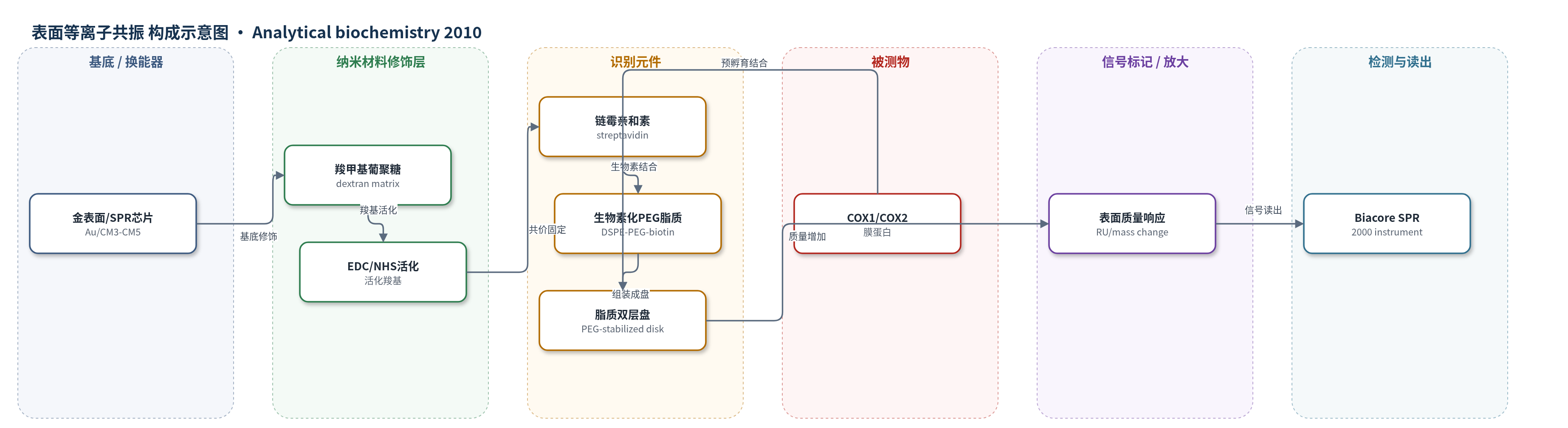
点击图片查看大图 · 依据论文自动绘制
传感器类型
表面等离子共振(SPR)生物传感器
检测对象
环氧合酶 1(COX1)、环氧合酶 2(COX2);样品基质为含辅因子(肾上腺素、谷胱甘肽、血红素)的 Tris 缓冲液中的脂质双层盘预孵育液
检测原理
CM 系列 SPR 芯片的金表面经 EDC/NHS 活化羧基,共价固定链霉亲和素,乙醇胺封闭剩余活性位点。含 DSPE-PEG2000-biotin 的 PEG 稳定脂质双层盘通过生物素-链霉亲和素高亲和结合固定到芯片上,形成可及性高的模型膜。COX1 或 COX2 先与脂质盘在含辅因子 Tris 缓冲液中预孵育,蛋白以膜结合基序结合到盘表面;随后蛋白-盘复合物注入传感器表面并被捕获。SPR 通过监测金表面附近折射率/质量变化产生共振单位(RU)信号。单独脂质盘产生基础固定信号,含 COX 的盘因额外蛋白质量使信号增强,增强值随蛋白/脂质比例增加而增加。该体系无酶或核酸放大,信号直接来自表面质量/折射率变化。
检测灵敏度
未报告 LOD、线性范围、灵敏度斜率或 R^2。
效应效果
含 1 或 4 mol% DSPE-PEG2000-biotin 的盘在链霉亲和素表面长期稳定;0.05 mol% 时 30 min 信号下降 20%,12 h 下降 85%。CM5 上最大链霉亲和素信号为 9050±396 RU,盘固定信号为 3210±408 RU;ceramide-PEG2000 稳定盘信号为 2971±24 RU。CM3、CM4、CM5 的盘/链霉亲和素信号比分别为 0.71、0.57、0.38。L1 亲脂锚定对 PEG 化盘固定差,PEG 化脂质体过夜信号下降 59%,非 PEG 脂质体下降 14%。COX1/COX2 预孵育盘信号为 2273 和 2450 RU,单独盘为 1774 和 1870 RU,估算每流室固定约 4.5 和 4.8 fmol COX。控制实验排除 COX 直接结合链霉亲和素或葡聚糖。作者认为双层盘适合用于 SPR 膜蛋白相互作用研究。
传感器的构成
- 基底/换能器:金表面(Au)与羧甲基葡聚糖基质(CM3/CM4/CM5),提供 SPR 折射率检测与羧基固定位点
- 活化/封闭层:EDC/NHS 活化羧基,乙醇胺封闭剩余 NHS 酯,形成共价固定界面
- 识别/固定元件:链霉亲和素(streptavidin)共价固定于葡聚糖,通过生物素-链霉亲和素结合捕获模型膜
- 模型膜/识别载体:PEG 稳定脂质双层盘,含 DSPC、胆固醇、DSPE-PEG2000 或 ceramide-PEG2000 及 DSPE-PEG2000-biotin,生物素化 PEG 脂质用于固定,PEG 稳定盘边缘
- 膜蛋白/分析物:COX1/COX2(cyclooxygenases 1/2)预孵育结合到脂质盘,作为膜蛋白相互作用研究对象
- 信号标记:无外源标记,SPR 直接检测表面质量/折射率变化,以共振单位(RU)读出
中文摘要
本研究旨在评估聚乙二醇(PEG)稳定脂质双层盘作为表面等离子共振(SPR)生物传感器模型膜的潜力。作者制备了含 1,2-二硬脂酰-sn-甘油-3-磷酸乙醇胺-N-[生物素基(聚乙二醇)2000](DSPE-PEG2000-biotin)的纳米级双层盘,并通过冷冻透射电镜(cryo-TEM)对其结构进行表征。随后,将生物素化双层盘经链霉亲和素固定到三种不同羧甲基化程度和葡聚糖基质厚度的传感器芯片(CM3、CM4 和 CM5)上。结果表明,双层盘能够与链霉亲和素修饰表面发生相互作用并稳定结合。作为将双层盘用于膜蛋白 SPR 研究的初步探索,作者分别以环氧合酶 1 和环氧合酶 2(COX1 和 COX2)为对象,先将双层盘与相应蛋白预孵育,再注入传感器表面。两种情况下,蛋白-盘复合物产生的 SPR 信号均显著高于单独注入双层盘所得信号。研究结果表明,PEG 稳定脂质双层盘是一种新型且有望用于 SPR 生物传感器膜蛋白相互作用研究的模型膜。
英文摘要
The aim of this study was to investigate the potential of polyethylene glycol (PEG)-stabilized lipid bilayer disks as model membranes for surface plasmon resonance (SPR)-based biosensor analyses. Nanosized bilayer disks that included 1,2-distearoyl-sn-glycero-3-phosphoethanolamine-N-[biotinyl(polyethylene glycol)(2000)] (DSPE-PEG(2000)-biotin) were prepared and structurally characterized by cryo-transmission electron microscopy (cryo-TEM) imaging. The biotinylated disks were immobilized via streptavidin to three different types of sensor chips (CM3, CM4, and CM5) varying in their degree of carboxymethylation and thickness of the dextran matrix. The bilayer disks were found to interact with and bind stably to the streptavidin-coated sensor surfaces. As a first step toward the use of these bilayer disks as model membranes in SPR-based studies of membrane proteins, initial investigations were carried out with cyclooxygenases 1 and 2 (COX 1 and COX 2). Bilayer disks were preincubated with the respective protein and thereafter allowed to interact with the sensor surface. The signal resulting from the interaction was, in both cases, significantly enhanced as compared with the signal obtained when disks alone were injected over the surface. The results of the study suggest that bilayer disks constitute a new and promising type of model membranes for SPR-based biosensor studies.