组成图示
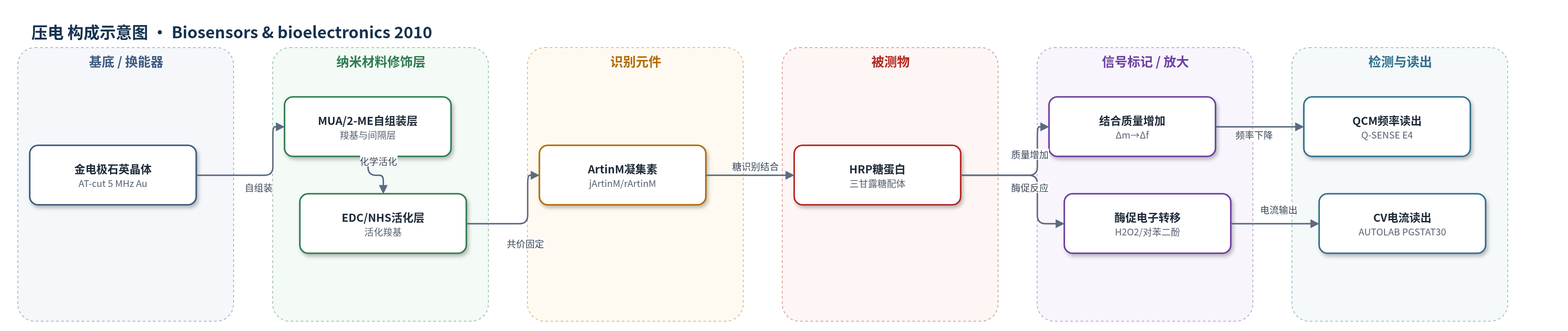
点击图片查看大图 · 依据论文自动绘制
传感器类型
压电(QCM)生物传感器
检测对象
辣根过氧化物酶糖蛋白(horseradish peroxidase glycoprotein, HRP);样品基质:PBS 缓冲液(0.10 M, pH 7.4, 含 0.15 M NaCl)
检测原理
传感器以金电极石英晶体为压电换能器,表面先形成 MUA 与 2-ME 的自组装单分子层,MUA 提供羧基,2-ME 作为间隔层;EDC/NHS 活化羧基后,将 ArtinM 凝集素共价固定,明胶封闭残余基团。HRP 糖蛋白携带 N-糖链三甘露糖核心,被 ArtinM 的碳水化合物识别域特异性识别并结合。结合使传感器表面质量增加,QCM 谐振频率随之下降;实时频率弛豫曲线按简单结合/解离模型拟合,可得到结合速率常数 k1、解离速率常数 k−1 和亲和常数 Ka。HRP 浓度越高,平衡结合质量越大,频率变化越大;弛豫时间常数与 HRP 浓度呈线性关系,用于估算动力学参数。另以循环伏安法验证 HRP 酶活性,结合后 H2O2/对苯二酚电子转移使阴极电流增加。
检测灵敏度
—
效应效果
该 QCM 方法可实时、无标记监测 ArtinM–HRP 结合。以 BSA 为阴性对照,HRP 最大饱和浓度下频率变化仅约 3±2 Hz,说明非糖蛋白不结合,选择性良好。jArtinM 与 rArtinM 的实时结合曲线和最终频率变化相同,CV 阴极电流也等价,表明两者糖识别活性一致。动力学参数为:jArtinM k1=28±4 L mol−1 s−1,k−1=(4±2)×10−3 s−1,Ka=(7±3)×103 L mol−1;rArtinM k1=27±2 L mol−1 s−1,k−1=(4±1)×10−3 s−1,Ka=(7±2)×103 L mol−1。作者认为 rArtinM 反应性较低源于 CRD 数量差异,而非单个 CRD 结合能差异,并主张重组 ArtinM 可替代天然物用于免疫调节和组织修复研究。
传感器的构成
- 基底/换能器:AT-cut 石英晶体微天平(QCM),5 MHz,金电极,提供压电换能与质量传感。
- 自组装单分子层:11-巯基十一烷酸(MUA)与 2-巯基乙醇(2-ME)共自组装,MUA 提供羧基,2-ME 作间隔层。
- 交联/活化层:EDC/NHS 活化 MUA 羧基,与 ArtinM 氨基形成酰胺键。
- 识别元件:天然 ArtinM(jArtinM)或重组 ArtinM(rArtinM)凝集素,其碳水化合物识别域(CRD)识别三甘露糖。
- 封闭剂:明胶(gelatin,0.001% w/v),封闭残余羧基,降低非特异结合。
- 分析物/信号源:辣根过氧化物酶糖蛋白(HRP),结合后质量增加;其酶活性用于 CV 验证。
- 电子供体/底物:对苯二酚(hydroquinone)与 H2O2,用于 HRP 催化电子转移的电化学验证。
- 读出系统:Q-SENSE E4 QCM 监测频率变化;AUTOLAB PGSTAT30 进行循环伏安。
中文摘要
ArtinM 是一种 D-甘露糖结合凝集素,因能诱导 Th1 免疫应答、保护宿主免受胞内病原体感染而受到关注。为开发其重组形式 rArtinM,需要比较天然 jArtinM 与 rArtinM 的糖结合特性。本文建立了基于石英晶体微天平(QCM)的生物传感器框架,用于比较两种 ArtinM 的活性。QCM 换能器经策略性功能化,采用简单蛋白结合动力学模型,测定 jArtinM 和 rArtinM 与辣根过氧化物酶糖蛋白(HRP)的结合/解离速率常数及亲和平衡常数。HRP 为 N-糖基化蛋白,含有三甘露糖核心 Manα1–3[Manα1–6]Man,是 jArtinM 的已知配体。实时监测表明,rArtinM 能结合 HRP,其分析曲线与 jArtinM 相似,且两种形式的动力学速率和亲和平衡常数在统计上等价。rArtinM 对 HRP 的反应性较低被认为源于两种凝集素分子中碳水化合物识别域(CRD)数量不同,而非每个 CRD 的结合能差异。
英文摘要
ArtinM is a D-mannose binding lectin that has been arousing increasing interest because of its biomedical properties, especially those involving the stimulation of Th1 immune response, which confers protection against intracellular pathogens. The potential pharmaceutical applications of ArtinM have motivated the production of its recombinant form (rArtinM) so that it is important to compare the sugar-binding properties of jArtinM and rArtinM in order to take better advantage of the potential applications of the recombinant lectin. In this work, a biosensor framework based on a Quartz Crystal Microbalance was established with the purpose of making a comparative study of the activity of native and recombinant ArtinM protein. The QCM transducer was strategically functionalized to use a simple model of protein binding kinetics. This approach allowed for the determination of the binding/dissociation kinetics rate and affinity equilibrium constant of both forms of ArtinM with horseradish peroxidase glycoprotein (HRP), a N-glycosylated protein that contains the trimannoside Manα1-3[Manα1-6]Man, which is a known ligand for jArtinM (Jeyaprakash et al., 2004). Monitoring of the real-time binding of rArtinM shows that it was able to bind HRP, leading to an analytical curve similar to that of jArtinM, with statistically equivalent kinetic rates and affinity equilibrium constants for both forms of ArtinM. The lower reactivity of rArtinM with HRP than jArtinM was considered to be due to a difference in the number of Carbohydrate Recognition Domains (CRDs) per molecule of each lectin form rather than to a difference in the energy of binding per CRD of each lectin form.