组成图示
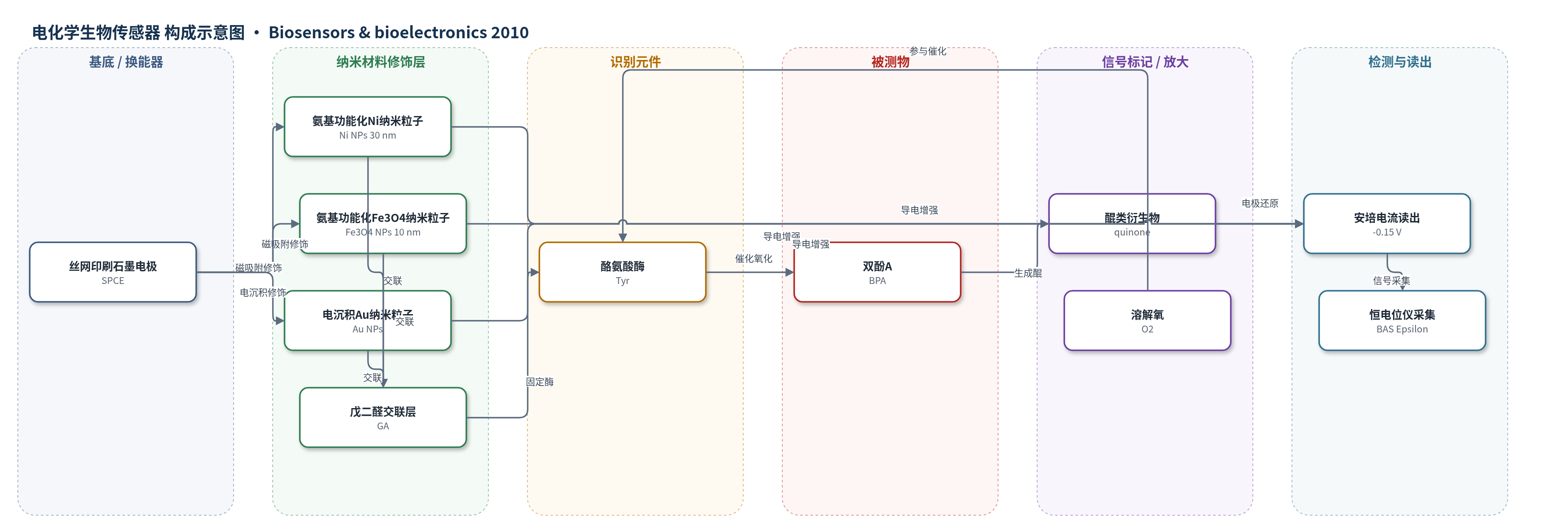
点击图片查看大图 · 依据论文自动绘制
传感器类型
电化学生物传感器
检测对象
双酚A(Bisphenol A, BPA);样品基质:0.1 M PBS(pH 6.5)水溶液,文中提及可应用于临床、食品和水样
检测原理
传感器以丝网印刷石墨电极为基底,表面修饰氨基功能化Ni、Fe3O4或电沉积Au纳米粒子,并用戊二醛交联固定酪氨酸酶。检测时,BPA在酪氨酸酶催化下与溶解氧反应生成醌类衍生物;醌类衍生物扩散至电极表面并在−0.15 V下被还原,产生与BPA浓度成正比的安培电流。纳米粒子通过增大有效表面积、提高界面导电性和增加酶负载量增强信号,其中Ni纳米粒子还表现出较好的电催化还原醌类能力。该体系无需外源标记,依靠酶催化和纳米材料界面效应实现信号放大。
检测灵敏度
Ni: LOD: 7.1 × 10⁻⁹ M;线性范围: 9.1 × 10⁻⁷–4.8 × 10⁻⁵ M;灵敏度: 758.1 μA mmol−1 L;t95%: 40 s;Fe3O4: LOD: 8.3 × 10⁻⁹ M;线性范围: 2.7 × 10⁻⁸–4.0 × 10⁻⁵ M(摘要为2.2 × 10⁻⁸–4.0 × 10⁻⁵ M);灵敏度: 543.8 μA mmol−1 L;t95%: 26 s;Au: LOD: 1.0 × 10⁻⁸ M;线性范围: 4.2 × 10⁻⁸–3.6 × 10⁻⁵ M;灵敏度: 419.1 μA mmol−1 L;t95%: 18 s;单位面积灵敏度: Ni 10.2 × 10^4 μA mmol−1 L cm−2,Fe3O4 14.2 × 10^4 μA mmol−1 L cm−2,Au 1.96 × 10^4 μA mmol−1 L cm−2。
效应效果
三种传感器对BPA响应快速,t95%分别为18、26和40 s。批间重现性良好,灵敏度相对标准偏差分别为4.7%(Au)、5.2%(Fe3O4)和10.0%(Ni)。连续100次检测后残余活性分别为74%、70%和98%,Ni传感器稳定性最佳。选择性方面,传感器对儿茶酚、苯酚和L-酪氨酸有响应,但对葡萄糖、抗坏血酸、尿酸和苯丙氨酸无明显干扰。与文献中碳材料、硼掺杂金刚石和吩噻嗪聚合物膜传感器相比,其检出限低近一个数量级,线性范围宽至少一个数量级,适合食品和环境水样中BPA的快速、低成本现场检测。
传感器的构成
- 基底/换能器电极:丝网印刷石墨电极(SPCE),几何面积0.17 cm2,作为工作电极和电子传导基底
- 纳米材料修饰层:氨基功能化镍纳米粒子(Ni NPs,30 nm),通过磁吸附固定于电极表面,提高导电性、表面积和酶负载
- 纳米材料修饰层:氨基功能化四氧化三铁纳米粒子(Fe3O4 NPs,10 nm),通过磁吸附固定于电极表面,提供磁性操控和酶固定平台
- 纳米材料修饰层:电化学沉积金纳米粒子(Au NPs,由HAuCl4在−0.20 V沉积),形成高比表面积金纳米簇,增强电子传递
- 交联固定层:戊二醛(GA),作为双功能交联剂连接氨基功能化纳米粒子与酪氨酸酶,实现酶共价固定
- 识别元件:酪氨酸酶(Tyr),催化BPA氧化生成醌类衍生物,是生物识别与催化元件
- 信号标记物:无外源标记;酶催化BPA生成的醌类衍生物(quinone)作为电活性信号分子,在电极表面还原产生安培电流
中文摘要
本研究开发了一种基于不同组成酶功能化纳米粒子的电化学生物传感器,用于检测双酚A(BPA)。作者首次将磁性镍纳米粒子作为酶固定平台和电极材料,构建丝网印刷酶生物传感器,并与四氧化三铁(Fe3O4)和金(Au)纳米粒子传感器进行比较。三种传感器均对BPA表现出快速、灵敏的安培响应,响应时间小于30 s。其中镍纳米粒子传感器在检出限和灵敏度方面与Fe3O4和Au相当或更优。传感器具有良好的重现性和稳定性,可完成100次以上检测,镍传感器残余活性为98%。线性范围分别为:Ni 9.1×10⁻⁷–4.8×10⁻⁵ M,Fe3O4 2.2×10⁻⁸–4.0×10⁻⁵ M,Au 4.2×10⁻⁸–3.6×10⁻⁵ M。三种传感器的检出限分别为7.1×10⁻⁹、8.3×10⁻⁹和1×10⁻⁸ M。结果表明,镍纳米粒子可用于构建酚类化合物电化学生物传感器。
英文摘要
We developed electrochemical biosensors based on enzyme functionalized nanoparticles of different compositions for the detection of bisphenol A. We utilized for the first time magnetic nickel nanoparticles as an enzyme immobilization platform and electrode material to construct screen-printing enzyme biosensors for bisphenol A. We compared the analytical performance of these sensors with those based on iron oxide (Fe(3)O(4)) and gold nanoparticles. The proposed biosensor format exhibited fast and sensitive amperometric responses to bisphenol A with a response time of less then 30s. Among the three configurations, nickel provided comparable or better characteristics in terms of detection limit and sensitivity than Fe(3)O(4) and gold nanoparticles. The biosensors were characterized by good reproducibility, stability of more than 100 assays (residual activity for nickel was 98%) and a wide linear range which spanned from 9.1 × 10(-7) to 4.8 × 10(-5)M for nickel, 2.2 × 10(-8) to 4.0 × 10(-5)M for Fe(3)O(4) and 4.2 × 10(-8) to 3.6 × 10(-5)M for gold. The highest sensitivity was obtained with nickel. The detection limits for the three types of biosensors were: 7.1 × 10(-9), 8.3 × 10(-9) and 1 × 10(-8)M for nickel, Fe(3)O(4) and gold nanoparticles in that order, respectively. These results demonstrate that nickel nanoparticles can be successfully used in the construction of electrochemical enzyme sensors for the detection of phenolic compounds.