组成图示
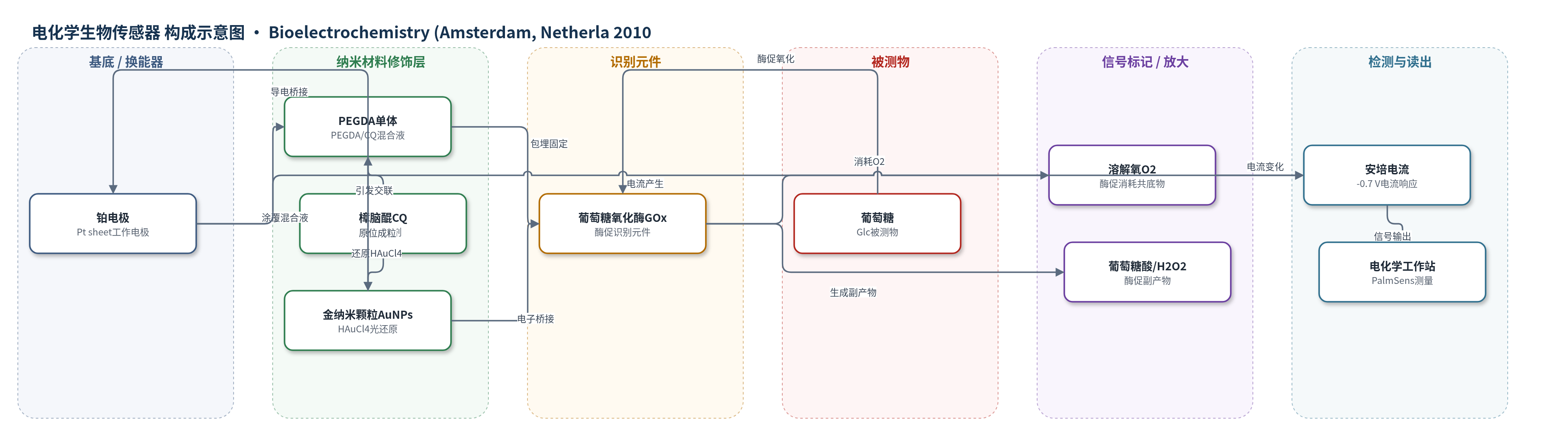
点击图片查看大图 · 依据论文自动绘制
传感器类型
电化学生物传感器
检测对象
葡萄糖(glucose, Glc);样品基质:缓冲液标准溶液、冰茶、樱桃汁等非酒精饮料。
检测原理
该传感器以 Pt 电极为基底,PEGDA/CQ 光交联形成 PEG 水凝胶,同时 HAuCl4 被光还原为 AuNPs,GOx 被包埋于网络中。葡萄糖进入凝胶后,GOx 催化其氧化,以 O2 为共底物生成葡萄糖酸和 H2O2。AuNPs 在酶活性中心与 Pt 电极之间形成纳米导电桥,降低电子传递能垒;循环伏安中以 [Fe(CN)6]4-/3- 为扩散介质验证其促进电子传递。在 −0.7 V 下,电极监测 O2 还原的计时安培电流;葡萄糖浓度升高,O2 消耗增强,电流响应随之线性变化。高浓度下 H2O2 积累会抑制 GOx,导致偏离线性。
检测灵敏度
LOD: 0.06 mM(S/N=3);线性范围: 0.1–1.0 mM;斜率: 10.893 µA/mM;R^2=0.988;无AuNPs: 线性范围 0.1–0.5 mM,斜率 2.733 µA/mM,R^2=0.997
效应效果
优化条件下,传感器在 0.1–1.0 mM 范围内对葡萄糖呈线性响应,LOD 为 0.06 mM;不含 AuNPs 时线性范围仅 0.1–0.5 mM,说明 AuNPs 提高响应。传感器在缓冲液中工作 3 h 后电流下降 25%,期间完成 14 次测量;0.5 mM 葡萄糖 6 次重复变异系数 3.8%,3 个电极间变异系数 4.3%。实际样品无需前处理,冰茶和樱桃汁结果与 HPLC 相近,回收率分别为 105% 和 92%,无明显基质效应。作者认为该一步法可用于丝网印刷或喷墨打印,制备低成本一次性生物传感器及生物燃料电池。
传感器的构成
- 基底/换能器电极:铂片电极(Pt sheet,0.5×0.5 cm),经氧化铝抛光,作为工作电极并传导电子。
- 光引发/交联网络:聚乙二醇二丙烯酸酯(PEGDA)与樟脑醌(CQ),光照引发自由基交联形成 PEG 水凝胶网络。
- 纳米材料修饰层:金纳米颗粒(AuNPs),由 HAuCl4 在光诱导电子转移中原位还原生成,增强电子传递。
- 识别/生物催化元件:葡萄糖氧化酶(GOx),包埋于水凝胶中,催化葡萄糖氧化并消耗 O2。
- 信号换能介质:溶解氧(O2)作为酶促共底物,在 −0.7 V 下于 Pt 电极发生还原,产生安培电流。
- 缓冲介质:50 mM 醋酸钠缓冲液(pH 4.0),维持 GOx 活性与电化学测量环境。
- 三电极体系:Ag/AgCl 参比电极与 Pt 对电极,用于循环伏安和计时安培测量。
中文摘要
本文报道了一种通过光诱导电子转移过程原位合成含金纳米颗粒(AuNPs)和葡萄糖氧化酶(GOx)的聚乙二醇(PEG)水凝胶生物纳米复合材料,并将其作为模型体系用于电化学葡萄糖生物传感。该生物纳米复合基质通过简单一步法制备,使酶活性中心与网络内 AuNPs 保持良好接触,从而促进电子传递;循环伏安法和安培响应均表明,与不含 AuNPs 的基质相比,其电子传递性能和传感信号显著提高。研究优化了 pH、酶负载量和 AuNP 含量等参数,并在 50 mM、pH 4.0 醋酸钠缓冲液中,于 −0.7 V 通过监测酶促反应消耗氧气产生的计时安培响应,获得 0.1–1.0 mM 葡萄糖的线性响应,检出限为 0.06 mM(信噪比 3)。透射电镜证实 AuNPs 的存在。最后将该传感器用于冰茶和樱桃汁中葡萄糖分析,并与 HPLC 参考方法比较,以考察样品基质效应。
英文摘要
In situ synthesis of poly(ethylene glycol) (PEG) hydrogels containing gold nanoparticles (AuNPs) and glucose oxidase (GOx) enzyme by photo-induced electron transfer process was reported here and applied in electrochemical glucose biosensing as the model system. Newly designed bionanocomposite matrix by simple one-step fabrication offered a good contact between the active site of the enzyme and AuNPs inside the network that caused the promotion in the electron transfer properties that was evidenced by cyclic voltammetry as well as higher amperometric biosensing responses in comparing with response signals obtained from the matrix without AuNPs. As well as some parameters important in the optimization studies such as optimum pH, enzyme loading and AuNP amount, the analytical characteristics of the biosensor (AuNP/GOx) were examined by the monitoring of chronoamperometric response due to the oxygen consumption through the enzymatic reaction at -0.7 V under optimized conditions at sodium acetate buffer (50 mM, pH 4.0) and the linear graph was obtained in the range of 0.1-1.0 mM glucose. The detection limit (LOD) of the biosensor was calculated as 0.06 mM by using the signal to noise ratio of 3. Moreover, the presence of AuNPs was visualized by TEM. Finally, the biosensor was applied for glucose analysis for some beverages and obtained data were compared with HPLC as the reference method to test the possible matrix effect due to the nature of the samples.