组成图示
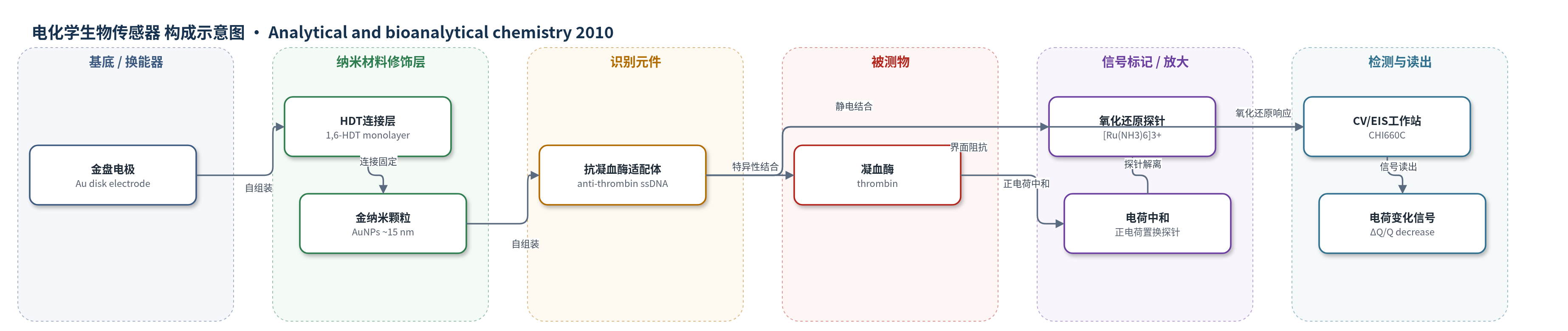
点击图片查看大图 · 依据论文自动绘制
传感器类型
电化学生物传感器
检测对象
凝血酶(thrombin);样品基质:血清(加标回收实验)及I-B缓冲液
检测原理
该传感器采用signal-off电化学适配体机制。抗凝血酶适配体通过Au-S键自组装于AuNP表面,其DNA磷酸骨架带负电,可静电结合氧化还原探针[Ru(NH3)6]3+。当正电荷凝血酶与适配体特异性结合后,凝血酶中和DNA负电荷并置换表面结合的[Ru(NH3)6]3+,使进入溶液的探针增多,电极表面可还原探针减少,循环伏安还原峰电荷下降。AuNPs通过增大有效表面积使适配体装载量提高约6倍,从而放大信号变化。以CV积分电荷Q和相对电荷变化ΔQ/Q定量,结合Langmuir模型获得线性响应;EIS用于监测界面电子转移电阻变化。
检测灵敏度
LOD: 1 pmol L−1;线性范围: 1 pmol L−1–30 nmol L−1;R = 0.9996
效应效果
该传感器对凝血酶具有良好选择性:在10 μmol/L干扰蛋白(溶菌酶、牛血红蛋白、牛血清白蛋白)存在下,相对信号低于约5%。稳定性方面,缓冲液中保存1个月后CV信号仅降低6.07%。实际血清加标回收实验中,加入0.02、0.22、3.22和8.22 nmol/L凝血酶,回收率分别为90.0%、92.3%、91.9%和96.6%(正文报告96.9%),RSD为2.82%–4.24%。与裸金电极相比,AuNP修饰电极的ΔQ/Q响应更高,灵敏度显著增强。作者认为该法简单、低成本、便携,适用于凝血酶及其他蛋白的电化学检测。
传感器的构成
- 基底/换能器电极:金盘电极(Au disk electrode,直径2 mm),作为工作电极和电子传导基底
- 连接修饰层:1,6-己二硫醇(HDT, HS(CH2)6SH)自组装单层,连接金电极与金纳米颗粒并钝化金表面
- 纳米材料修饰层:约15 nm金纳米颗粒(AuNPs),增大有效电极面积并提供导电通道,承载更多适配体
- 识别元件:5′-巯基己基修饰抗凝血酶单链DNA适配体(anti-thrombin aptamer, ssDNA),通过Au-S自组装固定于AuNP表面并识别凝血酶
- 封闭层:6-巯基-1-己醇(MCH)封闭未占据金表面,减少非特异性吸附
- 信号标记物:六氨合钌(III)([Ru(NH3)6]3+)氧化还原探针,静电结合DNA磷酸骨架,提供循环伏安信号
- 读出系统:CHI660C电化学工作站,通过循环伏安(CV)和电化学阻抗谱(EIS)读取电流/电荷变化
中文摘要
本文报道了一种基于适配体修饰电极的简单电化学方法,用于检测凝血酶。利用金纳米颗粒可显著增强后续检测信号。1,6-己二硫醇作为连接介质,将金纳米颗粒固定于裸金电极表面;抗凝血酶适配体通过自组装固定于金纳米颗粒表面。通过循环伏安法研究氧化还原阳离子(如[Ru(NH3)6]3+)与DNA磷酸骨架的静电结合,测定适配体装载密度。结果表明,金纳米颗粒表面固定的适配体总量为裸电极的六倍,从而提高适配体传感器灵敏度,检出限为1 pmol/L。基于Langmuir模型,传感器信号在1 pmol/L至30 nmol/L范围内呈现几乎完美的线性关系。此外,该适配体传感器具有高度选择性和稳定性。总之,该生物传感器结构简单、灵敏度高、选择性好,有利于开发具有简单电学读出方式的便携式生物分析器件。
英文摘要
This paper presents a simple electrochemical approach for the detection of thrombin, using aptamer-modified electrodes. The use of gold nanoparticles results in significant signal enhancement for subsequent detection. 1,6-Hexanedithiol was used as the medium to link Au nanoparticles to a bare gold electrode. Anti-thrombin aptamers were immobilized on the gold nanoparticles' surfaces by self-assembly. The packing density of aptamers was determined by cyclic voltammetric (CV) studies of redox cations (e.g., [Ru(NH(3))(6)](3+)) which were electrostatically bound to the DNA phosphate backbones. The results indicate that the total amount of aptamer probes immobilized on the gold nanoparticle surface is sixfold higher than that on the bare electrode, leading to increased sensitivity of the aptasensor and a detection limit of 1 pmol L(-1). Based on the Langmuir model, the sensor signal displayed an almost perfect linear relationship over the range of 1 pmol L(-1) to 30 nmol L(-1). Moreover, the proposed aptasensor is highly selective and stable. In summary, this biosensor is simple, highly sensitive, and selective, which is beneficial to the ever-growing interest in fabricating portable bio-analytical devices with simple electrical readout procedures.