组成图示
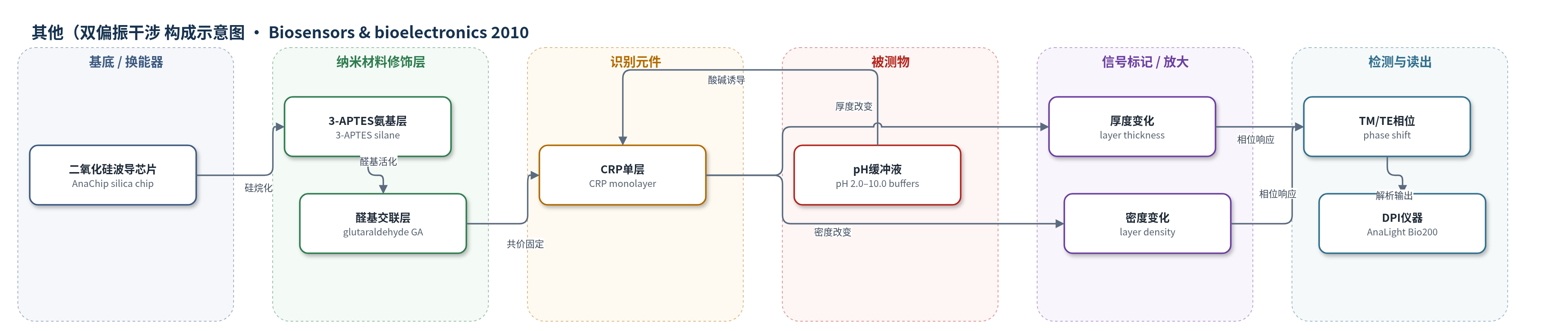
点击图片查看大图 · 依据论文自动绘制
传感器类型
其他(双偏振干涉(DPI)生物传感器)
检测对象
C反应蛋白(C-reactive protein, CRP)五聚体/单体构象;样品基质:PBS 及 pH 2.0–10.0 缓冲液(glycine-HCl、acetate、citrate-phosphate、Tris-HCl、carbonate-bicarbonate)
检测原理
CRP 通过 3-APTES 和 glutaraldehyde 共价固定于二氧化硅波导芯片表面;不同 CRP 浓度(5–100 µg/mL)使层厚度和表面覆盖量增加,并在约 50 µg/mL 后趋于饱和。当不同 pH 缓冲液流过时,CRP 亚基间静电作用、盐桥和疏水相互作用改变,五聚体可解离为单体或发生部分亚基重排,使吸附层厚度和密度变化。DPI 使用 632.8 nm He-Ne 激光,经 FLC 半波片切换 TE/TM 偏振,光在波导中传播的相位随蛋白层折射率和厚度改变。仪器通过 Maxwell 方程解析 TM/TE 相位,得到层厚度和密度,实时反映 CRP 构象状态。该过程无酶或核酸放大,信号直接来自界面光学几何参数变化。
检测灵敏度
未报告
效应效果
DPI 可分辨约 0.01 nm 厚度变化。50 µg/mL CRP 固定后为 2.019 ng/mm²、1.71×10⁻¹⁴ mol/mm²、97.4 nm²/分子。pH 6.0 时 TM/TE 变化较小,pH 4.0、8.0、10.0 时相位变化约 1.8–2.2。返回 pH 7.0 后质量负载为 1.767±0.235、1.777±0.239、1.776±0.239、1.778±0.243、1.782±0.238 ng/mm²,厚度为 4.75±0.31、4.32±0.37、4.30±0.41、4.32±0.48、4.39±0.47 nm,低于 5.70±0.12 nm,提示四级结构不可逆变化但单层稳定,作者认为可用于重复实验和生物传感器应用。
传感器的构成
- 基底/换能器:AnaChip 二氧化硅波导芯片(silica-based waveguide chip),提供光波导和 TM/TE 偏振干涉读出基础
- 氨基功能化层:3-aminopropyltriethoxysilane(3-APTES)硅烷化,在二氧化硅表面形成氨基功能化层
- 醛基交联层:4% glutaraldehyde(GA)水溶液处理,将氨基表面转化为醛基功能化表面,用于共价固定 CRP
- 分析物层:C-reactive protein(CRP)单层,50 µg/mL PBS 固定,形成约 2.019 ng/mm² 表面覆盖
- 流动相介质:PBS(pH 7.0)及 pH 2.0–10.0 缓冲液(glycine-HCl、acetate、citrate-phosphate、Tris-HCl、carbonate-bicarbonate),用于基线稳定和诱导构象变化
中文摘要
新兴证据表明,C反应蛋白(CRP)的构象在人体炎症和心血管疾病(CVD)中发挥重要作用,但不同pH条件下CRP结构构象差异仍是解释其在生理和病理条件下功能的关键问题。本研究采用双偏振干涉(DPI)生物传感器直接测量pH诱导的CRP结构构象变化。将CRP以50 µg/mL浓度固定于醛基功能化DPI传感器芯片上,获得2.019 ng/mm²的表面覆盖量,形成1.71×10⁻¹⁴ mol/mm²的CRP单层。在pH 7.0下,CRP呈五边形结构,平均单层厚度为5.70±0.12 nm,层密度为0.374±0.058 g/cm³。在pH 2.0–10.0范围内,DPI生物传感器信号直接反映了CRP显著的结构参数和构象变化现象。结果表明,当pH向酸性和碱性方向偏移时,CRP五聚体结构可能解离为单体或单体聚集体,但在极酸性生理条件下仅发生部分亚基重排。考虑到CRP的促炎作用和亚临床慢性炎症,单体与五聚体之间pH诱导的构象变化可能与血管动脉粥样硬化及后续CVD密切相关。
英文摘要
Emerging evidence indicates that the conformation of C-reactive protein (CRP) plays important roles in human inflammation and cardiovascular disease (CVD). The different conformations in the structure of CRP under different pH conditions remain an important issue to be investigated for explaining various functions of CRP under certain physiologic and pathologic conditions. We directly measured the pH-induced conformational changes in the structure of CRP by dual polarization interferometry (DPI). The CRP was attached to an aldehyde-functionalized DPI sensor chip at a concentration of 50 μg/ml, and attained 2.019 ng/mm2 to form a surface coverage with a 1.71×10(-14) mol/mm2 CRP monolayer. A pentagonal structure with an average monolayer thickness value of 5.70±0.12nm and a layer density of 0.374±0.058 g/cm2 was obtained at pH 7.0. Moreover, the DPI biosensor signals directly reflected the considerable structural parameters and phenomena of conformational changes of CRP in a pH range of 2.0-10.0. The results obtained showed that the pentameric structure of CRP might dissociated into monomers or monomer aggregates as the pH shifts toward both acidic and alkaline conditions, but only partial rearrangements of CRP subunits might occur at extremely acidic physiological conditions. Considering the proinflammatory effect and subclinical chronic inflammation, pH-induced conformational changes in the structure of CRP between monomeric and pentameric formations may strongly relate to vascular atherosclerosis and subsequent CVD.