组成图示
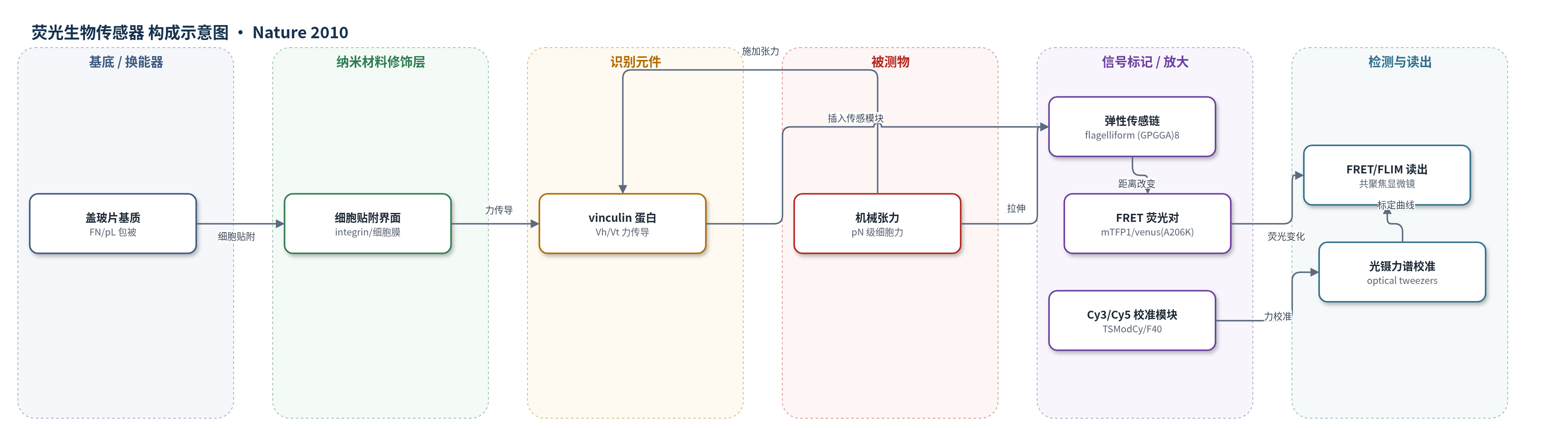
点击图片查看大图 · 依据论文自动绘制
传感器类型
荧光生物传感器
检测对象
vinculin 跨蛋白机械张力(mechanical tension/force across vinculin);样品基质:活细胞(vinculin-/- 细胞、BAECs、MEFs)贴附于 fibronectin 或 poly-L-lysine 包被盖玻片
检测原理
vinculin 被招募到局灶黏附后,Vh 结合 talin、Vt 结合 F-actin/paxillin,使跨 vinculin 的细胞收缩力加载到 TSMod。TSMod 中的 flagelliform 弹性链(GPGGA)8 作为熵纳米弹簧,受力后末端距离增加,使 mTFP1 供体与 venus(A206K) 受体距离增大。FRET 效率随距离增大而下降,力越大 FRET 指数越低、供体寿命越长。共聚焦 FRET/FLIM 显微镜读出 FRET 指数或寿命;校准采用 Cy3/Cy5 标记的 TSModCy,通过 optical tweezers 单分子荧光力谱获得 0.25–19 pN 的 FRET–力曲线,最敏感区间为 1–6 pN,从而将活细胞 FRET 信号换算为 pN 级张力。
检测灵敏度
未报告 LOD、线性范围、灵敏度斜率或 R^2;pN 灵敏度;校准范围 0.25–19 pN;最敏感 1–6 pN;静止 FA 平均力 ~2.5 pN。
效应效果
VinTS 正常招募至 FA,FA 形态、大小和 F-actin 组织与 VinV 无差异;FRAP 半衰期 VinTS 87.6±6.6 s、VinV 68.3±13.1 s(P=0.205)。分子间 FRET 可忽略,vinculin 构象变化不影响 TSMod。零力 pL/裂解液 FRET 高,FN 贴附 FA 中 VinTS FRET 降低而 VinTL 不变。Y-27632 或 MIIa 耗竭降低 FA 大小和牵引力,但 vinculin 仍定位 FA,FRET 升至 VinTL 水平。迁移 BAECs 前缘小 FA 高张力、尾部大 FA 低张力;组装 FA 力高后降至平均,解聚 FA 力低。MIIa 或活性 RhoA 仅在含 vinculin 细胞中稳定 FA(P<0.005、P<0.05)。该 pN 级遗传编码张力传感器可推广至其他力传导分子。
传感器的构成
- 识别/力传导蛋白:vinculin 头域(Vh)与尾域(Vt),Vh 结合 talin 介导招募,Vt 结合 F-actin/paxillin 传导力
- 张力传感模块:TSMod,含 40 氨基酸 flagelliform 弹性链(GPGGA)8,作为熵纳米弹簧受力伸长
- 荧光标记物:mTFP1 供体与 venus(A206K) 受体,构成 FRET 对,距离变化改变 FRET 效率
- 校准传感模块:TSModCy,F40 弹性链连接 Cy3/Cy5 有机荧光团,用于单分子荧光力谱校准
- 细胞力源/基质:fibronectin(FN)或 poly-L-lysine(pL)包被盖玻片,提供贴附力与零力对照
- 读出系统:共聚焦 FRET/FLIM 显微镜与 optical tweezers 单分子荧光力谱,输出 FRET 指数/寿命/力
中文摘要
机械力在发育、生理和病理过程中起核心作用,但细胞亚结构内力传递机制仍不清楚。本文报道了一种经校准的遗传编码生物传感器,可单分子荧光力谱法在活细胞中测量特定蛋白跨蛋白机械张力,灵敏度达皮牛(pN)级。作者将该方法应用于连接整合素与肌动蛋白丝的vinculin,其向局灶黏附(FA)的招募依赖力。结果显示,稳定FA中vinculin跨蛋白张力约为2.5 pN,且vinculin向FA的招募与跨vinculin力传递可被独立调控。最高张力与黏附组装和增大相关;而在迁移细胞尾部解聚或滑动FA中vinculin受力较低。此外,vinculin是力条件下稳定黏附所必需的。这些数据表明,力条件下FA稳定既需要vinculin招募,也需要力传递,且两者可独立控制。
英文摘要
Mechanical forces are central to developmental, physiological and pathological processes. However, limited understanding of force transmission within sub-cellular structures is a major obstacle to unravelling molecular mechanisms. Here we describe the development of a calibrated biosensor that measures forces across specific proteins in cells with piconewton (pN) sensitivity, as demonstrated by single molecule fluorescence force spectroscopy. The method is applied to vinculin, a protein that connects integrins to actin filaments and whose recruitment to focal adhesions (FAs) is force-dependent. We show that tension across vinculin in stable FAs is approximately 2.5 pN and that vinculin recruitment to FAs and force transmission across vinculin are regulated separately. Highest tension across vinculin is associated with adhesion assembly and enlargement. Conversely, vinculin is under low force in disassembling or sliding FAs at the trailing edge of migrating cells. Furthermore, vinculin is required for stabilizing adhesions under force. Together, these data reveal that FA stabilization under force requires both vinculin recruitment and force transmission, and that, surprisingly, these processes can be controlled independently.