组成图示
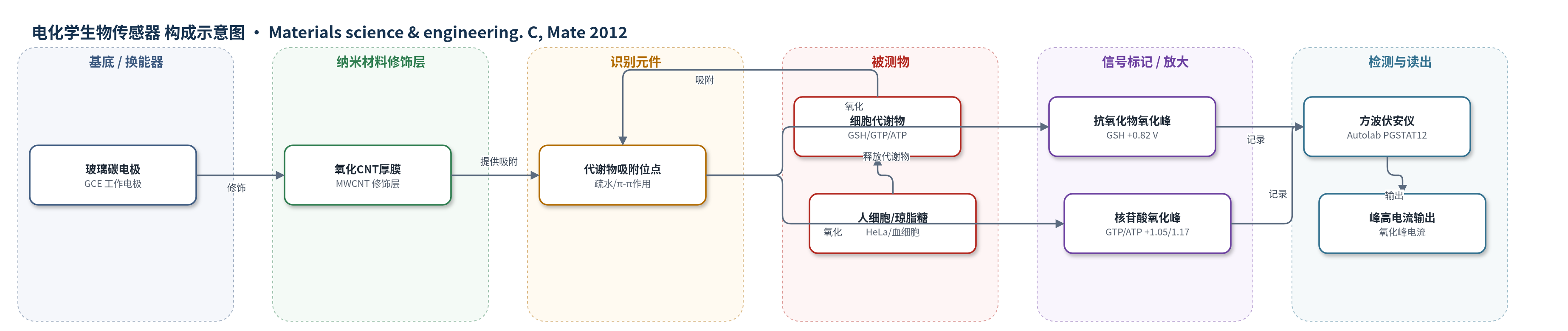
点击图片查看大图 · 依据论文自动绘制
传感器类型
电化学生物传感器
检测对象
细胞代谢物:谷胱甘肽(glutathione, GSH)、鸟嘌呤核苷酸(guanine nucleotides, GTP)、腺嘌呤核苷酸/三磷酸腺苷(adenine nucleotides/ATP);样品基质:人细胞悬液、细胞裂解液、琼脂糖凝胶包埋细胞(PBS)
检测原理
CNT厚膜修饰GCE提供高比表面积和疏水/π-π相互作用,将细胞释放或裂解释放的芳香族/嘌呤类代谢物预吸附富集到电极表面。在支持电解质(0.01 M醋酸钠/0.1 M NaCl,pH 5.0)中,用阳极方波伏安法扫描+0.1至+1.3 V,吸附的代谢物在特征电位发生氧化:约+0.82 V为谷胱甘肽、氨基酸、NAD(P)H等抗氧化物;+1.05 V为GTP等鸟嘌呤核苷酸;+1.17 V为ATP等腺嘌呤核苷酸。氧化峰电流随代谢物浓度增加而增大,ATP在0.05–15 mM线性。细胞活力下降、凋亡或ATP耗竭使峰3降低,抗氧化物合成增加使峰1升高,从而评估代谢活性。无酶、无标记,CNT预吸附起富集放大作用。
检测灵敏度
线性范围: 0.05–15 mM;I (μA)=0.03±0.15+0.6±0.03×C(mM);R=0.99
效应效果
传感器对细胞代谢物具有功能选择性,未修饰玻璃碳电极在相同条件下无足够伏安响应,数据以三次独立测量均值±SD表示。ATP检测线性良好(R=0.99),细胞裂解使代谢物峰增强4–10倍;向HeLa裂解液加入0.5 mM ATP后峰3为1.12±0.10 μA,与ATP单独0.65±0.03 μA和裂解液0.42±0.04 μA之和基本一致,表明可定量。多柔比星9 μM处理使ATP相关峰3降低约3倍,2 μM时降低约22%且抗氧化峰1约升高2倍;热冲击后峰3与生物发光ATP同步下降,15 min热冲击流式显示13%凋亡、38%坏死。琼脂糖凝胶中>95% HeLa细胞3 h存活,信号4 h达峰。作者认为其比酶电极和生物发光法更稳健、低成本,可用于医学诊断、移植评估和毒理筛选。
传感器的构成
- 基底/工作电极:抛光盘状玻璃碳电极(GCE),直径1.5 mm、几何面积1.8 mm²,作为电化学换能器。
- 纳米材料修饰层:氧化多层碳纳米管(MWCNT/CNT)厚膜,由CNT经硝酸/硫酸超声氧化后滴涂干燥形成,提供高比表面积和预吸附位点。
- 识别/富集元件:无特异性生物识别元件;CNT厚膜通过疏水/π-π相互作用预吸附细胞释放的谷胱甘肽、氨基酸、NAD(P)H、GTP、ATP等代谢物。
- 样品/细胞载体:人细胞悬液或裂解液(PBS),或HeLa细胞包埋于低熔点琼脂糖凝胶滴中,使代谢物扩散至电极。
- 支持电解质:0.01 M醋酸钠+0.1 M NaCl(pH 5.0),用于方波伏安检测。
- 参比/对电极:Ag/AgCl参比电极和镍片对电极,构成三电极体系。
- 信号读出:Autolab PGSTAT12电位-电流计,阳极方波伏安法(+0.1至+1.3 V)记录氧化峰。
中文摘要
我们开发了基于碳纳米管(CNT)厚膜修饰电极的代谢物敏感电化学传感器。修饰电极可高效预吸附细胞代谢物,并通过阳极方波伏安法实现敏感检测。在电极表面,贴壁和非贴壁人细胞均产生位于 +0.82、+1.05 和 +1.17 V 的三个氧化峰,分别归因于三组细胞代谢物:包括谷胱甘肽在内的氨基酸衍生抗氧化剂、鸟嘌呤核苷酸以及包括 ATP 在内的腺嘌呤核苷酸。电化学响应与独立方法测定的细胞活力、胞内 ATP 水平和凋亡诱导良好相关。与酶电极和常规生物发光法相比,所开发传感器可稳健、低成本地评估细胞中 ATP。结果可用于医学诊断、移植学和毒理筛选中的人细胞快速分析。此外,我们将修饰电极与包埋在琼脂糖基质中的人细胞结合,所得生物传感器可电化学监测聚合物基质中细胞的代谢活性和死亡,对组织工程应用具有意义。
英文摘要
We developed metabolite-sensitive electrochemical sensors on the basis of electrodes modified with a thick film of carbon nanotubes. Modified electrodes provide efficient pre-adsorption of cellular metabolites and their sensitive detection using anodic square-wave voltammetry. On the electrode surface both adhered and non-adhered human cells produce three oxidation peaks at the potentials of +0.82, +1.05, and +1.17V attributed to three groups of cellular metabolites: amino acid-derived antioxidants including glutathione, guanine nucleotides, and also adenine nucleotides including ATP. The electrochemical response was well correlated with cell viability, intracellular ATP level and induction of apoptosis, as determined by independent assays. Developed sensors allow for robust and cost-effective assessment of ATP in cells in contrast to enzyme-based electrodes and conventional bioluminescent assay. Results can be used for rapid analysis of human cells for the purpose of medical diagnostics, transplantology, and toxicological screening. Additionally, we combined modified electrodes with human cells entrapped in agarose matrix. The resulting biosensor allowed for electrochemical monitoring of metabolic activity and death of cells within polymeric matrix that is of interest for tissue engineering applications.