组成图示
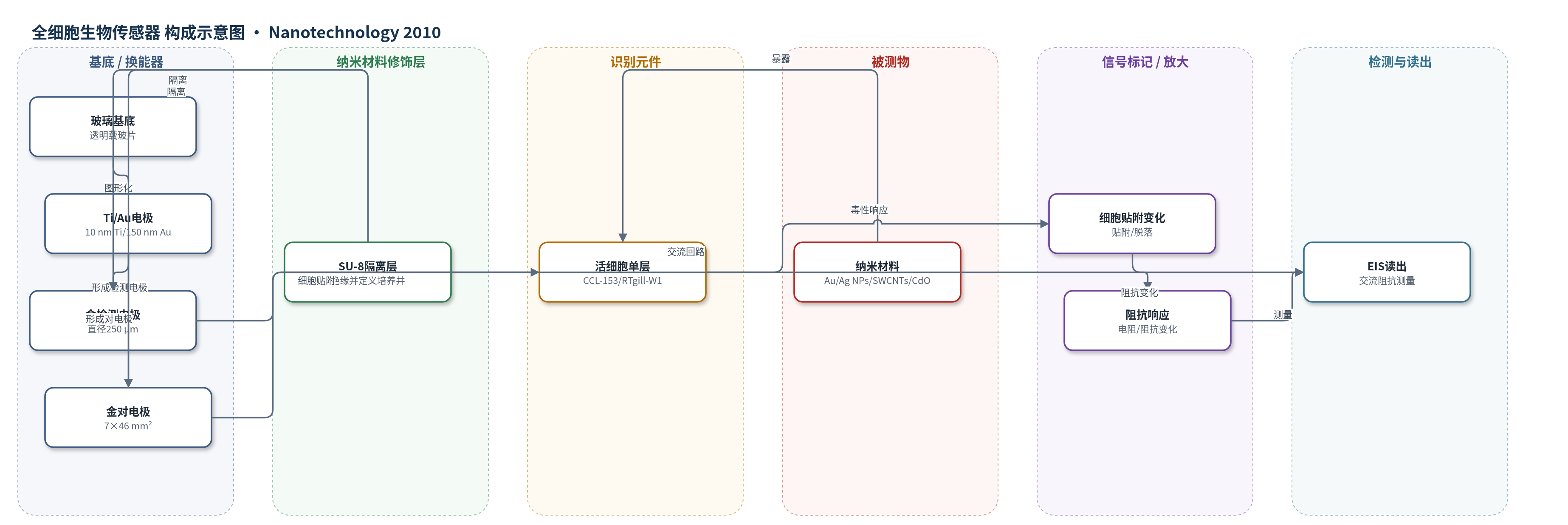
点击图片查看大图 · 依据论文自动绘制
传感器类型
全细胞生物传感器
检测对象
金纳米颗粒(AuNPs)、银纳米颗粒(AgNPs)、单壁碳纳米管(SWCNTs)、氧化镉(CdO);样品基质为细胞培养液/细胞单层暴露体系
检测原理
该传感器以活细胞单层作为识别与响应元件。CCL-153 或 RTgill-W1 细胞接种于金微电极表面并逐渐贴附,形成细胞层,使电极界面阻抗和电阻升高。向检测电极与对电极之间施加约 1 μA 交流电流,通过 1 MΩ 电阻测量电路阻抗。当纳米材料加入培养液后,若其具有细胞毒性,会引起细胞损伤、死亡和脱落,细胞层完整性下降,电极界面阻抗/电阻随之降低;无毒材料则阻抗变化接近细胞对照。CdO 可快速使电阻降至空白水平,体现实时动力学监测。阵列多通道设计允许同时比较不同纳米材料,无需化学标记或酶放大,信号来源于细胞层阻抗变化。
检测灵敏度
原文未报告LOD、线性范围、灵敏度斜率或相关系数。
效应效果
EIS 芯片在 Fe(CN)6^3-/4- 循环伏安测试中表现出可逆响应,ΔEp=64 mV,连续四次循环峰电流衰减 6%,说明电极电化学活性稳定、重现性好。40 h 阻抗监测中,CdO 暴露后电阻快速下降至接近空白,显示最强且最快的细胞毒性;AuNPs 与对照差异小,AgNPs 10 nm 毒性强于 100 nm,SWCNTs 使电阻较对照下降。SRB 比色法 OD 值(CCL-153)为:对照 2.7、CdO 0.6、AuNPs 10 nm 2.5、AuNPs 100 nm 2.6、AgNPs 10 nm 1.3、100 nm 金属纳米颗粒 1.6、SWCNTs 切断 2.2、未切断 2.1,与 EIS 趋势一致。作者认为该方法运行时间短、操作简便、可多样品实时分析,适合纳米材料毒性动力学评估。
传感器的构成
- 基底:透明玻璃载玻片(clear microscope slide),提供导电透明侧壁,支持电化学与光学监测。
- 电极层:Ti/Au 微电极(10 nm Ti 粘附层 + 150 nm Au,检测电极直径 250 μm,另设 7×46 mm² 金对电极),作为阻抗换能器。
- 隔离层:SU-8 绝缘聚合物,隔离电极并定义 9×9×10 mm³ 培养井。
- 识别元件:活细胞单层(CCL-153 或 RTgill-W1),贴附于金电极表面,作为全细胞响应元件。
- 刺激物:纳米材料(AuNPs、AgNPs、SWCNTs、CdO),加入培养液诱导细胞贴附/脱落变化。
- 读出层:交流阻抗/电阻测量电路(约 1 μA 交流电流、1 MΩ 电阻、电化学分析仪),输出阻抗/电阻变化。
中文摘要
本文报道了一种基于全细胞的生物传感器,用于快速实时检测纳米材料对人类和环境的安全性。传统体外纳米颗粒细胞毒性研究通常只给出培养终点的毒性结果,忽略了纳米颗粒在目标时间范围内持续发生的细胞毒性效应。为此,作者设计了一种可同时进行多种细胞毒性检测的阵列式生物传感器,以满足对毒性进行实时、一致评估的需求。该传感器通过阻抗法监测人肺成纤维细胞(CCL-153)和虹鳟鳃上皮细胞(RTgill-W1)暴露于金纳米颗粒(AuNPs)、银纳米颗粒(AgNPs)、单壁碳纳米管(SWCNTs)和氧化镉(CdO)时的响应。结果显示,CdO 暴露表现出最快的细胞毒性速率,证明了该传感器能够即时、实时监测毒性。该方法具有运行时间短、使用简便、可多样品分析等优点,可在设定时间范围内连续监测纳米颗粒毒性的动力学效应。
英文摘要
A whole cell based biosensor for rapid real-time testing of human and environmental toxicity of nanoscale materials is reported. Recent studies measuring nanoparticle cytotoxicity in vitro provide a final measurement of toxicity to a cell culture overlooking the ongoing cytotoxic effects of the nanoparticles over the desired timeframe. An array biosensor capable of performing multiple cytotoxicity assays simultaneously was designed to address the need for a consistent method to measure real-time assessments of toxicity. The impedimetric response of human lung fibroblasts (CCL-153) and rainbow trout gill epithelial cells (RTgill-W1) when exposed to gold and silver nanoparticles (AuNPs, AgNPs), single walled carbon nanotubes (SWCNTs) and cadmium oxide (CdO) was tested. Exposure to CdO particles exhibited the fastest rate of cytotoxicity and demonstrated the biosensor's ability to monitor toxicity instantaneously in real time. Advantages of the present method include shorter run times, easier usage, and multi-sample analysis leading to a method that can monitor the kinetic effects of nanoparticle toxicity continuously over a desired timeframe.