组成图示
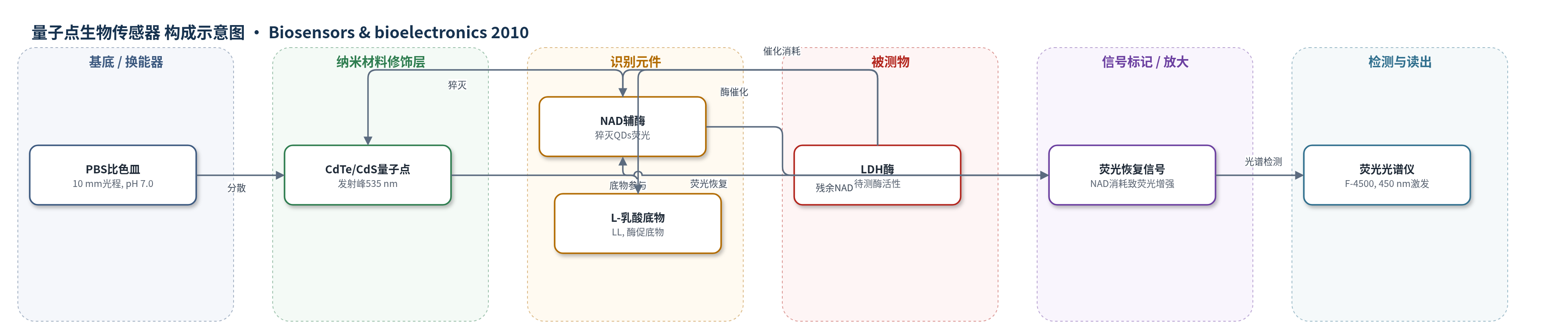
点击图片查看大图 · 依据论文自动绘制
传感器类型
量子点生物传感器
检测对象
乳酸脱氢酶活性(lactate dehydrogenase, LDH);样品基质为 PBS 缓冲液(文中提及人血清临床应用)
检测原理
该传感器以水溶性 CdTe/CdS 量子点(QDs)为荧光换能元件,发射峰位于 535 nm。NAD 作为 LDH 辅酶扩散至 QDs 表面,通过随机化学吸附或静电作用改变表面化学键,并发生电子转移(ET),使 QDs 荧光被猝灭。加入待测 LDH 和等摩尔 L-乳酸(LL)后,LDH 催化反应 L-乳酸 + NAD+ → 丙酮酸 + NADH + H+,消耗 NAD。LDH 活性越高,NAD 消耗越多,残余 NAD 越少,QDs 表面猝灭作用减弱,荧光强度随之恢复并增强。最终通过荧光光谱仪在 450 nm 激发下监测 535 nm 发射强度,实现 LDH 活性的定量检测。该过程无需额外标记或信号放大,酶促反应本身完成 NAD 消耗与荧光信号转换。
检测灵敏度
LOD: 75 U/L;线性范围: 150–1500 U/L;R^2 = 0.996
效应效果
该传感器在 PBS 体系中表现出良好选择性:0.5 mM 尿酸(UA)、0.5 mM 乳糖和 2.2 mM 葡萄糖单独或共同存在时,QDs 荧光无明显变化。CdTe/CdS QDs 为水溶性核壳结构,平均粒径约 3.0 nm,光致发光量子产率 30%,具有较好稳定性;但原文未报告 RSD、实际血清加标回收率及与 ELISA/HPLC/qPCR 的定量对比。作者认为相比 ELISA、比色、荧光或安培检测,该方法操作简便、检测限低、线性范围宽,可用于人血清中 LDH 生理水平检测,辅助充血性心脏病、肝炎及肝癌等疾病的早期诊断与术后监测,并推广至其他 NAD 依赖酶分析。
传感器的构成
- 荧光换能纳米材料:CdTe/CdS 量子点(QDs),水溶性核壳结构,发射峰 535 nm,作为荧光信号元件
- NAD 敏感响应物:NAD(烟酰胺腺嘌呤二核苷酸),LDH 辅酶,通过表面电子转移猝灭 QDs 荧光
- 酶催化识别元件:LDH(乳酸脱氢酶),催化 L-乳酸与 NAD+ 反应,消耗 NAD 使荧光恢复
- 酶促底物:L-乳酸(LL),与 NAD+ 共同参与 LDH 催化反应,决定 NAD 消耗量
- 反应介质:PBS 缓冲液(pH 7.0,含 0.1 M KCl),维持酶活性和光学测量环境
- 光学读出装置:Hitachi F-4500 荧光光谱仪,450 nm 激发,监测 535 nm 荧光强度
中文摘要
本文报道了一种基于量子点(QDs)的新型酶生物传感器,利用 QDs 荧光强度变化检测乳酸脱氢酶(LDH)活性。该体系以 LDH 的辅酶烟酰胺腺嘌呤二核苷酸(NAD)作为荧光响应物:NAD 首先与 QDs 作用并猝灭其荧光;当加入 LDH 后,LDH 催化生物反应消耗 NAD,使 QDs 荧光随 LDH 活性增加而恢复并增强。实验获得 LDH 活性在 150–1500 U/L 范围内的线性校准曲线,检出限为 75 U/L。此外,作者考察了尿酸(UA)、乳糖和葡萄糖等潜在干扰物质对该 QDs 生物传感器的影响。该酶生物传感器具有操作简便、检测快速的特点,在多种疾病临床诊断中检测生理水平生物分子方面具有较大应用潜力。
英文摘要
A novel quantum dots (QDs) based biosensor has been developed to detect the activity of lactate dehydrogenase (LDH) by the change of fluorescence intensities of the QDs. In this system, the fluorescence intensities of the QDs are quenched by nicotinamide adenine dinucleotide (NAD, the coenzyme of LDH) first and then intensified with increasing amounts of the LDH because of the consumption of the NAD in the biocatalyzed reaction. A linear calibration plot of the activity of LDH is obtained in the wide amounts range from 150 to 1500 U/L and the detection limit is 75 U/L. Furthermore, the effect of several possible interfering substances, such as uric acid (UA), lactose, and glucose on the QDs-based biosensor is also investigated. This enzyme biosensor is of considerable interest due to its promise for simple procedure and the established method has great potential in detection of the physiological level of some biomolecules in clinical diagnostics of various diseases.