组成图示
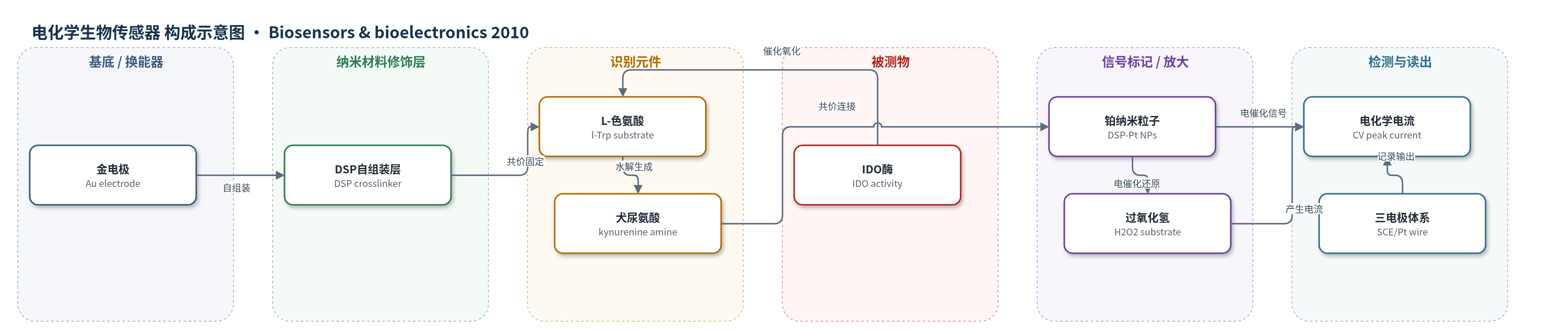
点击图片查看大图 · 依据论文自动绘制
传感器类型
电化学生物传感器
检测对象
吲哚胺2,3-双加氧酶活性(indoleamine 2,3-dioxygenase activity, IDO activity);样品基质:人血清(human serum)、PBS缓冲液
检测原理
金电极表面先自组装DSP交联剂,再通过NHS酯与L-色氨酸伯胺共价固定。加入IDO后,IDO催化色氨酸氧化生成N-甲酰犬尿氨酸,经乙酸水解生成犬尿氨酸,暴露新的伯胺基团。这些伯胺基团与DSP修饰铂纳米粒子上的NHS酯发生共价偶联,使Pt NPs选择性固定于电极表面。随后在含H2O2的PBS中,Pt NPs电催化还原H2O2,产生还原峰电流。IDO活性越高,转化色氨酸越多,固定Pt NPs越多,电催化电流越大,因此电流与IDO活性相关。该策略将酶催化事件转化为电催化信号,实现活性检测。
检测灵敏度
LOD: 6.84 U/mL;线性范围: 20–140 U/mL;测定范围: 20–400 U/mL
效应效果
该传感器具有良好选择性:抗坏血酸、尿酸和多巴胺在高于生物体系预期浓度两个数量级以上时,对H2O2电催化响应无明显干扰。重复性良好,各浓度IDO电化学测量至少3次独立重复,平均变异系数为2.59%。在人血清加标样品中,50、80和100 U/mL IDO的相对误差分别为6.82%、4.62%和7.37%,均小于8%。其检出限6.84 U/mL(0.077 μg/mL)低于荧光法0.36 μg/mL、分光光度法0.54 μg/mL和HPLC法0.48 μg/mL。传感器还可用于1-甲基-L-色氨酸对IDO的抑制研究,作者认为其可用于抑制剂筛选和血清等复杂基质中IDO活性检测,具有临床应用潜力。
传感器的构成
- 基底电极:金电极(Au electrode),作为工作电极与信号换能基底。
- 交联修饰层:DSP(dithiobis[succinimidylpropionate])自组装单层,提供NHS酯用于共价偶联。
- 底物固定层:L-色氨酸(l-tryptophan, l-Trp),IDO底物,共价固定于DSP/Au表面。
- 酶催化识别层:IDO催化l-Trp氧化生成N-甲酰犬尿氨酸,经乙酸水解生成犬尿氨酸(kynurenine),暴露伯胺基团。
- 信号标记层:DSP修饰铂纳米粒子(DSP-modified Pt NPs,约4.0 nm),通过NHS酯与犬尿氨酸伯胺连接,电催化还原H2O2。
- 电催化底物:H2O2,在Pt NPs表面被还原,产生与IDO活性相关的电化学电流。
中文摘要
本文报道了一种基于酶催化与电催化选择性结合的电化学生物传感器构建新策略,并提出一种检测吲哚胺2,3-双加氧酶(IDO)活性的电化学方法。首先将IDO的底物色氨酸共价固定于金电极表面;在IDO催化下,色氨酸残基被氧化,其产物经乙酸水解可生成犬尿氨酸,从而诱导二硫代双[琥珀酰亚胺基丙酸酯](DSP)修饰的铂纳米粒子(Pt NPs)固定到金电极表面。由于Pt NPs可电催化还原H2O2产生电化学信号,且电化学峰与酶活性相关,因此可实现IDO活性的电化学检测。在优化条件下,IDO活性可在20–400 U/mL范围内测定,检出限为6.84 U/mL。该传感器灵敏度高、可靠性可接受,可用于研究抑制剂对酶活性的抑制以及血清等复杂基质中酶活性的筛查。
英文摘要
A new strategy to fabricate electrochemical biosensor is reported in this paper based on the selective combination of enzyme catalysis and electorcatalysis, thus an electrochemical method to assay the activity of indoleamine 2,3-dioxygensae (IDO) is proposed. Tryptophan, the substrate of IDO, is firstly covalently immobilized on a gold electrode surface. Oxidation of the tryptophan residue catalyzed by IDO and the subsequent hydrolyzation of the product by acetic acid may yield kynurenine, which may induce the immobilization of dithiobis [succinimidylpropionate] (DSP)-modified platinum nanoparticles (Pt NPs) onto the surface of the gold electrode. Since Pt NPs can electrochemically catalyze the reduction of H(2)O(2) to produce electrochemical signals and the electrochemical wave can be correlated with the enzyme activity, electrochemical method to detect IDO activity is thus achieved. Under optimized conditions, IDO activity can be assayed in the range of 20-400 U/mL with a detection limit of 6.84 U/mL. The proposed biosensor shows high sensitivity, acceptable reliability, and can be used for the investigation of the enzymatic inhibition by inhibitors as well as the screen of the enzymatic activity in complex matrix such as serum samples.