组成图示
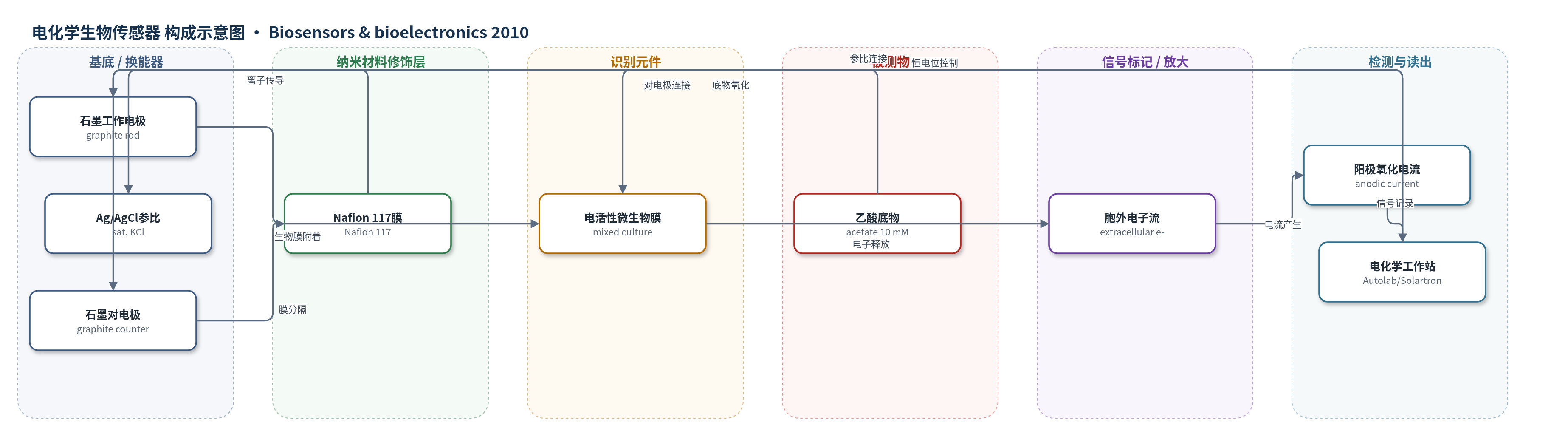
点击图片查看大图 · 依据论文自动绘制
传感器类型
电化学生物传感器
检测对象
乙酸(acetate)/微生物电活性(microbial electroactivity);样品基质:人工厌氧缓冲液(10 mM乙酸)、废水来源接种物(waste water)
检测原理
废水来源混合培养微生物在石墨阳极表面形成电活性生物膜。在恒电位0.2 V(vs. Ag/AgCl)下,生物膜细胞氧化乙酸等底物,并通过胞外电子传递机制将电子直接/经电子载体传递至石墨电极,产生阳极生物电催化氧化电流。电流密度反映微生物代谢速率和底物氧化速率,因此可作为微生物活性或底物可利用性的电化学信号。温度通过改变酶促反应速率、生物膜形成动力学和膜结构影响电子传递效率:5–45 °C内电流随温度变化可逆,>45 °C发生不可逆失活。该体系无额外化学放大,信号直接来自全细胞生物电催化。
检测灵敏度
—
效应效果
该生物膜在5–45 °C保持活性,操作窗口约0–50 °C;35 °C平台电流偏离初始值仅3%,短期温度波动可逆。成膜滞后时间随培养温度升高缩短:15 °C超过40天,22 °C为290 h(约12天),35 °C为85 h(3.5天),5 °C超过2个月未成膜。30 °C下,22、27、35 °C培养生物膜电流密度分别为520、560和881 μA cm−2,高温培养较22 °C提高约70%;低于10 °C时低温培养者更优。电流密度标准偏差在>140 μA cm−2时低于5%,<140 μA cm−2时低于15%。24 h冻结暴露使35 °C性能下降42–50%,>45 °C不可逆失活。作者认为该结果对微生物燃料电池、电解池及电化学微生物生物传感器的低温废水处理应用有价值。
传感器的构成
- 换能器/工作电极:石墨棒(graphite rod),作为阳极电子收集与生物电催化界面
- 参比电极:Ag/AgCl(饱和KCl),提供恒电位控制基准
- 对电极:石墨棒(graphite rod),完成电化学回路
- 离子隔膜:Nafion 117全氟磺酸膜,分隔对电极与细菌溶液并允许离子传导
- 识别/生物催化元件:废水来源混合培养电活性微生物生物膜(mixed culture electroactive biofilm),附着于工作电极并氧化底物传递电子
- 电子供体:乙酸(acetate, 10 mM),作为微生物碳源和电子供体
- 培养介质:含NH4Cl、KCl、NaH2PO4·H2O、Na2HPO4、微量元素和维生素的厌氧缓冲液,维持微生物生长
- 信号读出:PGSTAT 30 Autolab与Solartron 1286电化学工作站,记录生物电催化氧化电流密度
中文摘要
本文研究废水来源阳极混合培养微生物生物膜的温度依赖性与温度极限。作者证明这些电活性生物膜在5–45 °C范围内具有生物电催化活性。初始生物膜生长阶段的高温不仅缩短成膜时间,还会影响其在相同操作温度下的电化学性能:15 °C下成膜时间超过40天,而35 °C下缩短至3.5天。在30 °C操作时,22 °C培养的生物膜电流密度为520 μA cm−2,35 °C培养的生物膜达到881 μA cm−2。相反,在较低操作温度下,低温培养的生物膜表现优于高温培养者。所有生物膜均具有相似的下限(0 °C)和上限(50 °C),并表现出相似的电化学电子转移特性,从而定义了相应微生物燃料电池或微生物生物传感器的操作温度窗口。
英文摘要
In this paper we investigate the temperature dependence and temperature limits of waste water derived anodic microbial biofilms. We demonstrate that these biofilms are active in a temperature range between 5°C and 45°C. Elevated temperatures during initial biofilm growth not only accelerate the biofilm formation process, they also influence the bioelectrocatalytic performance of these biofilms when measured at identical operation temperatures. For example, the time required for biofilm formation decreases from above 40 days at 15°C to 3.5 days at 35°C. Biofilms grown at elevated temperatures are more electrochemically active at these temperatures than those grown at lower incubation temperature. Thus, at 30°C current densities of 520 μA cm(-2) and 881 μA cm(-2) are achieved by biofilms grown at 22°C and 35°C, respectively. Vice versa, and of great practical relevance for waste water treatment plants in areas of moderate climate, at low operation temperatures, biofilms grown at lower temperatures outperform those grown at higher temperatures. We further demonstrate that all biofilms possess similar lower (0°C) and upper (50°C) temperature limits--defining the operational limits of a respective microbial fuel cell or microbial biosensor--as well as similar electrochemical electron transfer characteristics.