组成图示
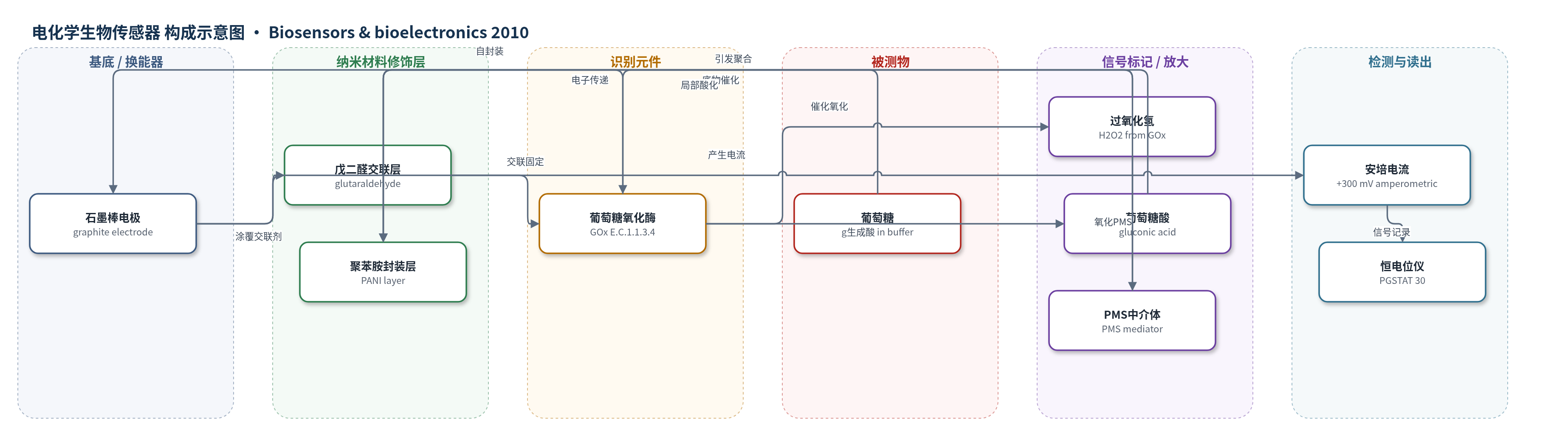
点击图片查看大图 · 依据论文自动绘制
传感器类型
电化学生物传感器
检测对象
葡萄糖(glucose);样品基质:0.05 M 醋酸钠/磷酸钠钾缓冲液(pH 6.0,含 0.1 M KCl),文中亦提及食品与饮料样品。
检测原理
葡萄糖在固定化葡萄糖氧化酶(GOx)催化下被氧气氧化,生成葡萄糖酸内酯和过氧化氢(H2O2),内酯水解为葡萄糖酸并使酶层局部 pH 降低。在制备阶段,H2O2 与酸性微环境引发苯胺聚合,形成聚苯胺(PANI)层并将 GOx 自封装其中。检测时,葡萄糖扩散进入 GOx/PANI 层并被 GOx 催化,产生的 H2O2 与可溶性氧化还原中介体吩嗪甲磺酸(PMS)发生氧化还原作用;PMS 在石墨电极表面传递电子,在 +300 mV 恒电位下产生安培电流。PANI 层增加葡萄糖和 PMS 的扩散阻力,使表观 Michaelis 常数增大、最大电流降低,从而扩展高浓度线性检测区。
检测灵敏度
线性范围: 0–50 mM;斜率: 0.32 ± 0.01;R^2 = 0.9934
效应效果
与仅交联 GOx 电极相比,GOx/PANI 电极的表观 Michaelis 常数由 5.75±0.13 mM 增至 134.90±8.84 mM(4℃、272 h)或 356.00 mM(18℃),最大电流由 51.72±1.81 μA 降至 3.06±0.01 μA 或 0.42 μA,说明 PANI 层引入扩散限制并扩展高浓度检测区。48 h 聚合电极在 0–50 mM 葡萄糖范围内线性良好,r2=0.9934。pH 最优点由 6.0 移至 6.5,活性剖面更宽。86 天稳定性中,GOx 电极保留约 44% 活性,GOx/PANI 电极分别保留 54.31%、59.2% 和 68.5%(聚合 22、48、69 h)。作者认为该策略适用于食品/饮料葡萄糖检测及氧化酶生物燃料电池阳极。
传感器的构成
- 基底/换能器电极:石墨棒电极(graphite rod electrode,99.999% 纯,工作面积 0.7 mm2),作为工作电极并承载修饰层。
- 交联固定层:戊二醛(glutaraldehyde),用于交联固定 GOx 并稳定酶构象。
- 识别/催化元件:葡萄糖氧化酶(GOx,E.C. 1.1.3.4,Penicillium vitale),催化葡萄糖氧化生成 H2O2 和葡萄糖酸。
- 修饰/封装层:聚苯胺(PANI),由苯胺(aniline)在 GOx 催化产生的 H2O2 与局部酸化条件下酶促聚合形成,自封装 GOx 并改变扩散限制。
- 信号中介体:吩嗪甲磺酸(PMS,phenazine methosulfate),在检测液中作为可溶性氧化还原中介体传递电子并产生安培信号。
- 检测介质/电解质:0.05 M 醋酸钠或磷酸钠钾缓冲液(pH 6.0)含 0.1 M KCl,提供离子导电与稳定 pH。
中文摘要
本文报道了一种用于构建安培葡萄糖生物传感器和/或葡萄糖驱动生物燃料电池阳极的酶电极新方法。将来源于 Penicillium vitale 的葡萄糖氧化酶(GOx,E.C. 1.1.3.4)沉积于石墨棒电极表面,并用戊二醛交联固定,形成 GOx 电极。利用固定化 GOx 的催化活性,在含葡萄糖和苯胺的缓冲液中,GOx 催化葡萄糖氧化产生高浓度过氧化氢,同时生成葡萄糖酸并使局部 pH 降低,从而在电极表面引发苯胺聚合。形成的聚苯胺(PANI)层将 GOx 自封装其中,得到 GOx/PANI 电极。与未修饰的 GOx 电极相比,PANI 层的形成显著提高了葡萄糖检测上限、拓宽了适宜工作 pH 范围并改善了电极稳定性,说明该酶促自封装策略可用于扩展安培葡萄糖传感器的线性检测区间。
英文摘要
In this article a new method for fabrication of enzymatic electrodes suitable for design of amperometric glucose biosensor and/or anode of biofuel cell powered by glucose is presented. Glucose oxidase (GOx) E.C. 1.1.3.4. from Penicillium vitale was immobilized on the carbon rod electrode by cross-linking it with glutaraldehyde (GOx-electrode). Catalytic activity of immobilized GOx was exploited for polymerisation of aniline by taking a high concentration of hydrogen peroxide produced during the catalytic action of immobilized GOx and locally lowered pH due to the formation of gluconic acid; it created optimal conditions for the polymerisation of aniline. The GOx layer was self-encapsulated within formed polyaniline (PANI) matrix (GOx/PANI-electrode). Properties of the GOx/PANI-electrode have been studied and results were compared with GOx-electrode. The results show that the upper detection limit of glucose using GOx-electrode was dramatically changed by the formation of PANI layer. An increase in the upper detection limit, optimal pH region for operation and stability of GOx based electrode modified by PANI was detected when comparing that of an unmodified GOx-electrode.