组成图示
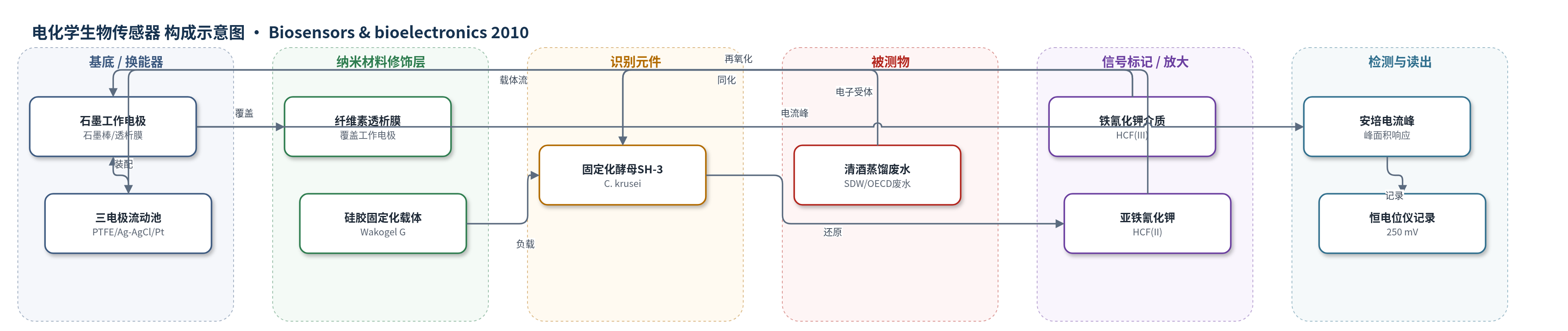
点击图片查看大图 · 依据论文自动绘制
传感器类型
电化学生物传感器
检测对象
生化需氧量(BOD, biochemical oxygen demand);样品基质:清酒蒸馏废水(SDW)、OECD合成废水
检测原理
样品与含10 mM HCF(III)的磷酸盐缓冲载体经流动注射进入固定化酵母反应器。酵母Candida krusei SH-3将废水中的可生物氧化有机物作为电子供体进行代谢,同时以HCF(III)替代氧气作为电子受体,将其还原为HCF(II)。还原介质随载体进入三电极流动池,在施加250 mV(vs. Ag/AgCl)的石墨工作电极上发生再氧化,产生阳极电流峰。峰面积与反应器内被同化的有机物量成正比,因此可反映样品BOD。透析膜阻挡样品有机物直接到达电极,仅允许介质通过,提高基线稳定性。流速决定反应器停留时间,pH影响酵母代谢活性,二者共同影响响应大小。
检测灵敏度
原文未报告LOD、线性范围、灵敏度斜率或相关系数。
效应效果
灭菌固定化细胞响应仅为活细胞的1–2%,证明信号来自微生物代谢。覆盖纤维素透析膜后,废水直接电化学信号可忽略,1 mM HCF(II)信号降至裸电极约10%,基线更稳定。流速降低灵敏度提高,但基线恢复变慢;1.5 mL/min时单次测量约30 min。pH 7.0响应最高,pH 4.0下降。SH-3灵敏度高于NBRC 1664,T. cutaneum重复性差。由校准斜率估算SDW BOD为102,000和156,000 mg/L,BOD5为120,000 mg/L,SH-3更接近。系统至少1周重复性良好。
传感器的构成
- 工作电极:石墨棒(graphite rod)表面覆盖纤维素透析膜(cellulose dialysis membrane),用于安培检测HCF(II)再氧化电流
- 参比电极:Ag/AgCl电极(Ag/AgCl),提供稳定电位参考
- 辅助电极:铂丝(Pt wire),与参比电极构成三电极电化学流动池
- 流动池:PTFE片与硅胶垫(silicone gasket)构成约0.7 mL内腔,容纳三电极
- 微生物反应器:PTFE固定化细胞支架(PTFE immobilized cell holder)内装固定化微生物颗粒,玻璃珠(glass beads)和不锈钢网(SUS mesh screen)支撑
- 识别元件:固定化酵母Candida krusei(Issatchenkia orientalis)菌株SH-3,负载于硅胶颗粒(silica gel, Wakogel G),同化有机物并还原HCF(III)
- 电子受体/介质:磷酸盐缓冲液(0.1 M phosphate buffer, pH 7.0)含10 mM钾六氰合铁酸盐(HCF(III))和0.1 M NaCl,作为载体与电子穿梭体
- 流动注射模块:活塞泵、500 μL进样环、六通切换阀和PTFE管,实现样品注入与流路切换
中文摘要
虽然利用氧化还原介体的微生物生化需氧量(BOD)传感器作为快速BOD测定方法受到广泛关注,但将其应用于流动注射分析系统的研究仍较少。本文开发了一种流动注射模式的介导BOD传感器系统,该系统由固定化微生物反应器和三电极构型的电化学流动池组合而成,用于估算清酒蒸馏废水(SDW)的BOD。研究证明,采用含钾六氰合铁酸盐(HCF(III))的磷酸盐缓冲液作为载体可实现介导传感。样品注入时,输出电流出现阳极峰,该峰来源于电极上被微生物代谢还原的介质HCF(II)的再氧化。以峰面积作为传感器响应,考察了载体流速和pH对灵敏度的影响。结果表明,使用具有较高SDW同化能力的微生物的传感器系统表现出良好性能,可用于SDW的BOD快速估算。
英文摘要
Although microbial biochemical oxygen demand (BOD) sensors utilizing redox mediators have attracted much attention as a rapid BOD measurement method, little attempts have been made to apply the mediated BOD biosensors to the flow injection analysis system. In this work, a mediated BOD sensor system of flow injection mode, constructed by combining an immobilized microbial reactor with an electrochemical flow cell of three electrodes configuration, has been developed to estimate BOD of shochu distillery wastewater (SDW). It was demonstrated consequently that the mediated sensing was realized by employing phosphate buffer containing potassium hexacyanoferrate as the carrier. The output current was found to yield a peak with a sample injection, and to result from reoxidation of reduced mediator at the electrode. By employing the peak area as the sensor response, the effects of flow rate and pH of the carrier on the sensitivity were investigated. The sensor system using a microorganism of high SDW-assimilation capacity showed good performance and proved to be available for estimation of BOD of SDW.