组成图示
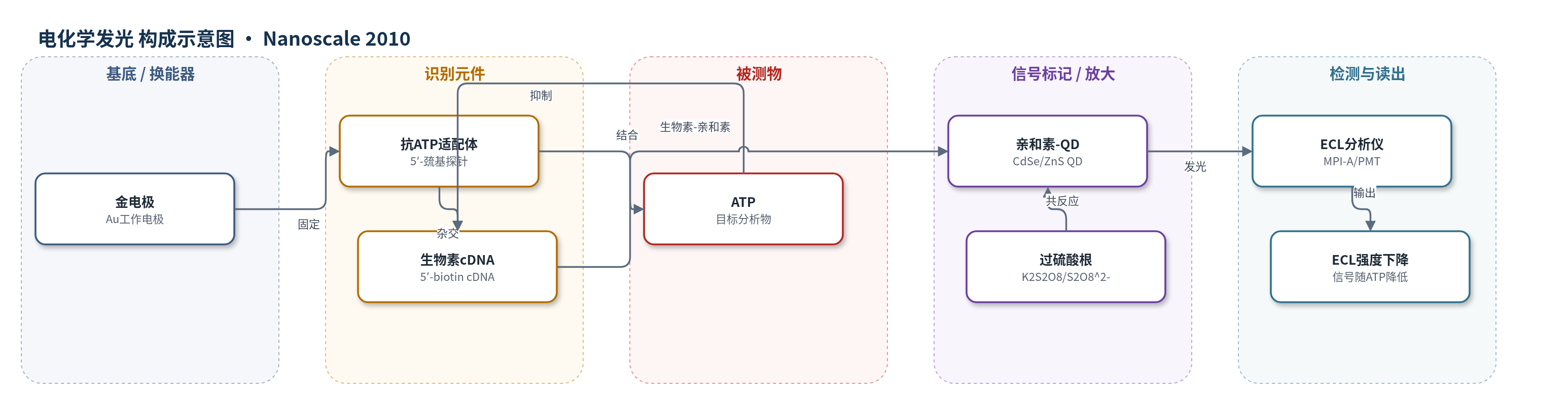
点击图片查看大图 · 依据论文自动绘制
传感器类型
电化学发光(ECL)生物传感器
检测对象
三磷酸腺苷(ATP,adenosine 5′-triphosphate);样品基质:PBS+缓冲液/ATP溶液(未报道实际生物样品)
检测原理
巯基抗ATP适配体通过Au–S键固定于金电极。ATP与适配体特异性结合后引起适配体构象压缩,阻止其与5′-生物素cDNA杂交;未结合ATP的游离适配体则与cDNA按Watson–Crick规则形成ds-DNA。亲和素-QD经生物素–亲和素结合到cDNA上,因此ATP浓度越高,电极上QD负载越少。ECL产生时,QD在阴极电位下被还原为QD•−,过硫酸根S2O8^2−被还原为SO4^2−和SO4•−,QD•−与SO4•−湮灭生成激发态QD*,退激发出光子。PMT检测ECL强度,强度与ATP浓度对数呈负相关。该体系未采用HCR/RCA等核酸放大,但利用QD高发光和生物素–亲和素高亲和实现信号转换。
检测灵敏度
LOD: around 6 nM;线性范围: 0.018–90.72 mM
效应效果
该传感器对ATP具有良好选择性:在50 mg mL−1浓度下,CTP、GTP和UTP孵育后ECL强度约为18000,而ATP使强度降至4500,表明27碱基抗ATP适配体对ATP有较高特异性。pH 7.4–8.0时ECL响应最佳;亲和素-QD孵育1–3 h无明显波动;K2S2O8浓度0.05、0.1、0.2 M时峰强基本不变,仅达峰时间缩短。连续循环伏安扫描22圈仍保持稳定高ECL信号,显示良好电位循环稳定性。LOD约6 nM,作者认为优于电化学检测。未报道RSD、实际样品回收率或ELISA/HPLC/qPCR对比。作者主张该方法为QD ECL在适配体传感器领域提供通用、低成本途径,可拓展至其他适配体蛋白和DNA序列检测。
传感器的构成
- 基底/换能器电极:金电极(Au electrode),经piranha溶液预处理,作为工作电极承载修饰层并传导ECL信号。
- 识别元件:5′-巯基修饰抗ATP适配体探针(5′-thiol-modified anti-ATP aptamer probe),通过Au–S键固定于Au表面,特异性结合ATP。
- 封闭/清洗层:6-巯基-1-己醇(MCH)与BSA(1 mg mL−1,PBS+),MCH去除非特异DNA吸附,BSA封闭QD活性位点。
- 杂交链:5′-生物素修饰互补DNA(5′-biotin-modified cDNA oligonucleotide),与游离适配体探针杂交形成ds-DNA,提供生物素结合位点。
- 信号标记/纳米材料:亲和素修饰量子点(avidin-QDs,CdSe/ZnS core–shell,约10 nm),经生物素–亲和素结合,作为ECL发光体。
- 共反应物/电解质:PBS+(100 mM Na2HPO4/NaH2PO4,5 mM MgCl2,pH 7.4)及0.1 M K2S2O8、0.1 M KCl,维持孵育环境并提供ECL共反应物S2O8^2−。
中文摘要
本文报道了一种基于量子点(QD)电化学发光(ECL)技术构建适配体ATP生物传感器的简便策略。与传统基于电化学、荧光或其他方法的适配体传感器不同,该策略主要利用适配体与ATP的特异性亲和作用以及Watson–Crick碱基配对规则。首先将巯基修饰的抗ATP适配体探针固定于预处理金电极表面,随后将电极浸入ATP溶液孵育,形成适配体–ATP生物亲和复合物;接着使5′-生物素修饰的互补DNA(cDNA)寡核苷酸与未结合ATP的游离探针杂交,形成双链DNA结构。在生物素–亲和素系统作用下,亲和素修饰的QDs结合到cDNA上。传感器ECL信号取决于结合到cDNA上的QD数量,并与结合的目标ATP量呈反比。QDs经高分辨透射电镜、紫外吸收和光致发光光谱表征;传感器制备过程用电化学阻抗谱和循环伏安法监测。研究考察了电解质pH、孵育时间及共反应物K2S2O8浓度对ECL响应的影响。通过ECL强度下降测定ATP浓度,ECL强度随ATP浓度对数增加在0.018–90.72 mM范围内线性下降,且传感器对ATP具有良好选择性。该工作为QD ECL在适配体传感器领域的应用提供了新途径。
英文摘要
A novel and facile strategy for the fabrication of aptamer-based adenosine 5'-triphosphate (ATP) biosensor was developed by a quantum dot (QD) electrochemiluminescence (ECL) technique. Different from the existing strategies for the development of aptasensors based on electrochemical, fluorescent or other methods, the strategy proposed here is essentially based on the aptamer-ATP specific affinity and the rules of Watson-Crick base pairing. After the thiol modified anti-ATP probes were immobilized onto the pretreated Au electrode, the electrode was incubated in ATP solution to form aptamer-ATP bioaffinity complexes. The complementary DNA (cDNA) oligonucleotides were hybridized with the free probes. As a result, the avidin-modified QDs were bound to the aptasensor through the biotin-avidin system in the existence of biotin-modified cDNA. The ECL signal of the aptasensor was responsive to the amount of QDs bound to the cDNA oligonucleotides, which was inversely proportional to the combined target analyte ATP. The QDs were characterized by high resolution transmission electron microscopy (HRTEM), ultraviolet (UV) and photoluminescence (PL) spectra. The preparation process for the aptasensor was monitored by electrochemical impedance spectroscopy (EIS) and cyclic voltammetry (CV). Possible interference, such as from the pH value of the electrolyte, the incubation time and the concentration of coreactant K(2)S(2)O(8), on the aptasensor ECL response were investigated. The ATP concentration was measured through the decrease of ECL intensity. The ECL intensity of the aptasensor decreased with the increase of the logarithm of the ATP concentration over the 0.018-90.72 microM range. In addition, the aptasensor exhibited excellent selectivity responses toward the target analyte. This study may offer a new and relatively general approach to expand the application of QD ECL in the aptasensor field.