组成图示
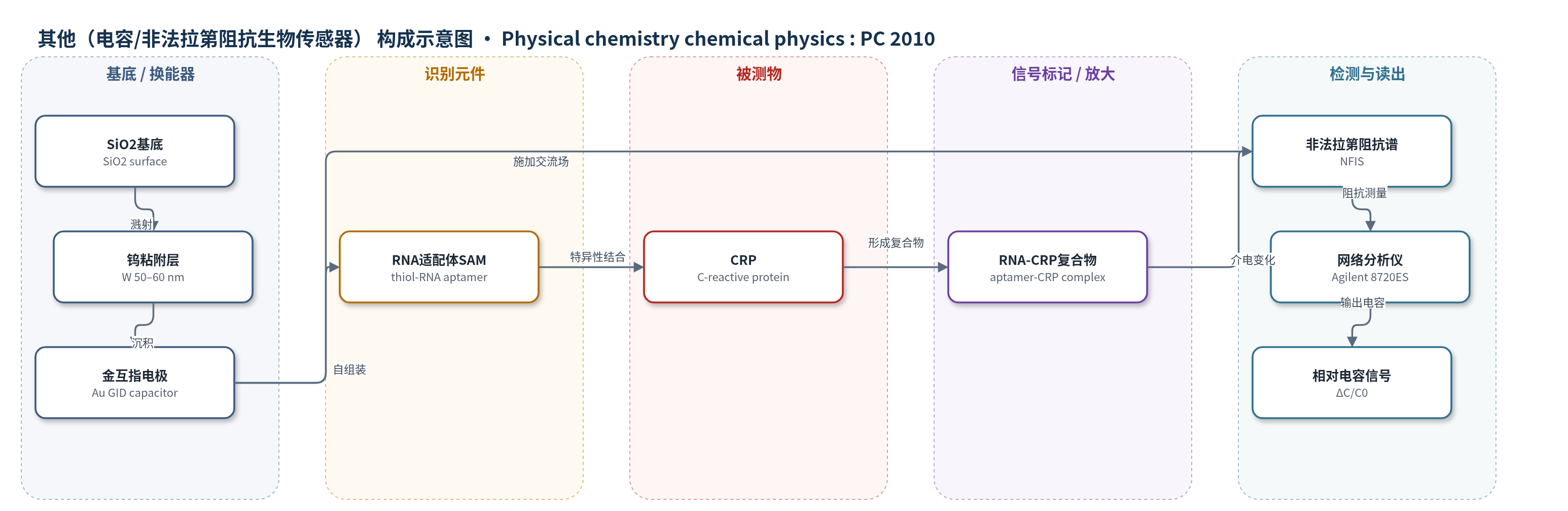
点击图片查看大图 · 依据论文自动绘制
传感器类型
其他(电容/非法拉第阻抗生物传感器)
检测对象
C反应蛋白(C-reactive protein, CRP);样品基质:磷酸盐缓冲液(PBS, pH 7.2),文中面向血清/心血管疾病风险检测
检测原理
金互指电容阵列上通过硫醇自组装固定 RNA 适配体。CRP 与适配体特异性结合后形成 RNA–CRP 复合物,使电极间介电环境、电荷分布和偶极矩改变;复合物尺寸增大导致分子旋转弛豫时间增加,电容分散峰向低频移动。在 50–350 MHz 交流场下,采用非法拉第阻抗谱测量 GID 电容的相对电容变化 ΔC/C0。CRP 浓度升高时,结合位点占据增加,相对电容响应增强,约 500 pg ml^-1 时趋于饱和;超过后自由与结合 CRP 竞争有限结合位点,响应下降。该过程无需酶、荧光或电子转移介质,信号直接来自界面介电/电容变化。
检测灵敏度
LOD: 100–500 pg ml^-1;动态检测范围: 100–500 pg ml^-1
效应效果
传感器对非特异蛋白 BSA 无响应,显示对 CRP 的选择性。实验重复性较好,批内与批间相对标准偏差均在 13% 以内。在 50–350 MHz 范围内,CRP 动态检测范围为 100–500 pg ml^-1,与文献 SPR 方法相当;超过 500 pg ml^-1 后因结合位点竞争响应下降。摘要给出 208 MHz 下 Kd=1.6 mM,结果部分给出 180 pg ml^-1,表明频率影响表观结合亲和力。作者认为该无标记、无试剂电容传感器具有快速、简单、灵敏、可微型化及兼容微电子信号处理的优势,可用于心血管疾病风险标志物检测和早期诊断。
传感器的构成
- 基底/换能器:SiO2 表面图案化金互指(GID)电容阵列,含 50–60 nm 钨(W)粘附层和 200–210 nm 金(Au)层,24 指、面积 3 mm2,用于形成电容换能器
- 识别元件:5'端烷硫基修饰的 44-mer RNA 适配体(thiolated RNA aptamer),以 10 μM 在 PBS pH 7.2 中自组装单分子层(SAM)固定,密度约 150 ng mm^-3,用于特异性结合 CRP
- 被测物:C反应蛋白(C-reactive protein, CRP),PBS pH 7.2 中 0–600 pg ml^-1
- 信号标记物:无(label-free、reagent-less,未使用酶、荧光、纳米颗粒或电子转移介质)
- 读出系统:Karl-Suss PM-5 RF Probe Station 与 Agilent 8720ES 网络分析仪,SOLT 校准,50 MHz–1 GHz 测量并提取 50–400 MHz 相对电容变化
中文摘要
本研究报道一种新型无标记、无试剂的 RNA 适配体电容生物传感器,用于监测适配体与蛋白识别事件。该传感器基于非法拉第阻抗谱(NFIS),通过施加交流频率下电极间电荷分布变化来检测结合事件,并首次将电容式生物传感方法用于适配体识别。器件采用金互指(GID)电容阵列,表面固定合成 RNA 适配体作为生物识别元件,用于检测心血管疾病风险标志物 C 反应蛋白(CRP)。当 CRP 与适配体结合形成 RNA–CRP 复合物时,GID 电容的相对电容发生变化;在 50–350 MHz 频率范围内,电容分散峰随 CRP 浓度升高向低频移动,并伴随复合物尺寸增大导致的弛豫时间增加。非线性回归分析给出不同频率下的解离常数,其中 208 MHz 时结合较强(Kd=1.6 mM),150 MHz 和 306 MHz 分别为 4.2 mM 和 3.4 mM。CRP 动态检测范围为 100–500 pg ml^-1。该结果展示了 RNA–蛋白复合物在 GID 电容外加电场中的行为,可扩展至其他亲和生物分子对及疾病早期诊断的电学生物传感器系统。
英文摘要
In this study, we report a novel aptamer-based capacitive label-free biosensor for monitoring transducing aptamer-protein recognition events, based on charge distribution under the applied frequency by non-Faradaic impedance spectroscopy (NFIS). This approach to capacitive biosensors is reported for the first time in this study, is reagent-less in processing and is developed using gold interdigitated (GID) capacitor arrays functionalized with synthetic RNA aptamers. The RNA atpamers served as biorecognition elements for C-reactive protein (CRP), a biomarker for cardiovascular disease risk (CVR). The signal is generated as a result of the change in relative capacitance occurring as a result of the formation of an RNA-CRP complex on GID capacitors with the applied AC electrical frequency (50-350 MHz). The dispersion peak of the capacitance curve was dependent on the CRP concentration and tends to shift toward lower frequencies, accompanied by the increase in relaxation time due to the increased size of the aptamer-CRP complex. The dissociation constant (K(d)) calculated from the non-linear regression analysis of the relative capacitance change with the applied frequency showed that strong binding of CRP occurred at 208 MHz (K(d) = 1.6 microM) followed by 150 MHz (K(d) = 4.2 microM) and 306 MHz (K(d) = 3.4 microM) frequencies. The dynamic detection range for CRP is determined to be within 100-500 pg ml(-1). Our results demonstrates the behavior of an RNA-protein complex on GID capacitors under an applied electric field, which can be extended to other pairs of affinity biomolecules as well as for the development of electrical biosensor systems for different applications, including the early diagnosis of diseases.