组成图示
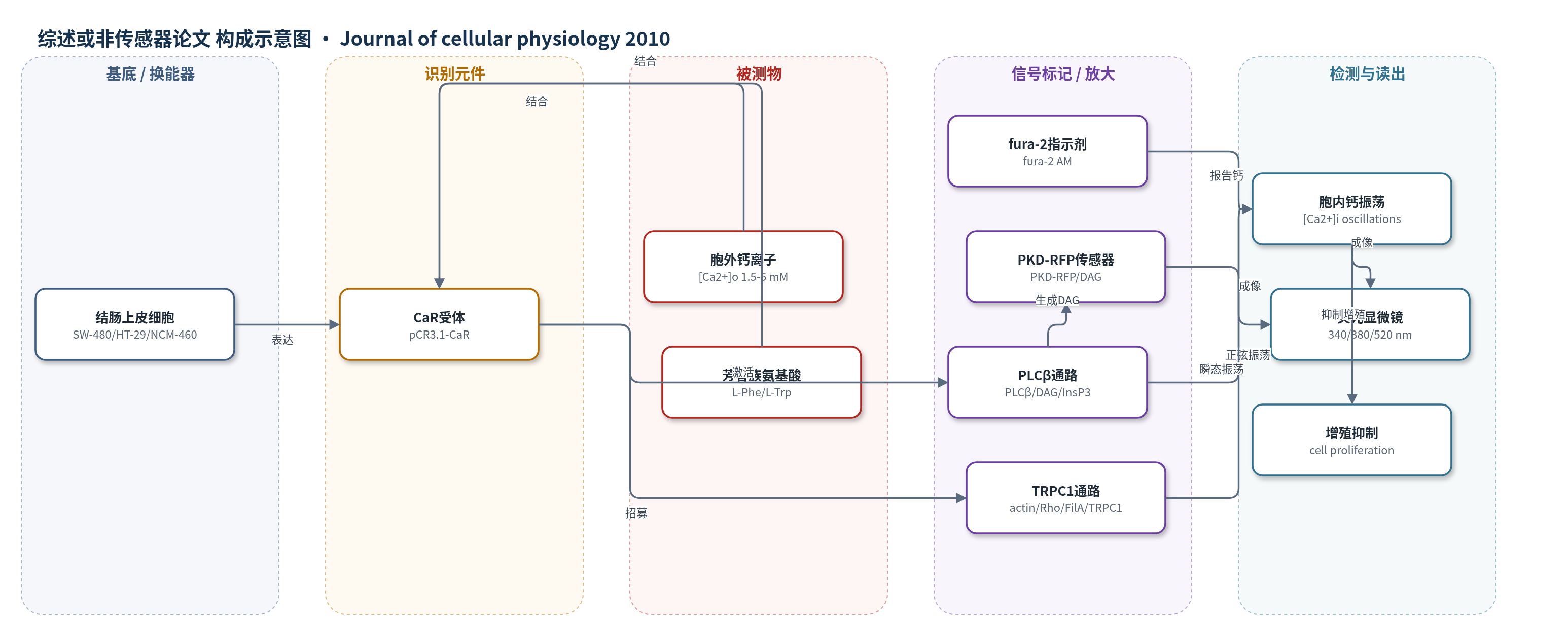
点击图片查看大图 · 依据论文自动绘制
传感器类型
综述或非传感器论文
检测对象
胞外钙离子(extracellular Ca2+,[Ca2+]o)、芳香族氨基酸(L-苯丙氨酸 L-Phe、L-色氨酸 L-Trp);样品基质:人结肠上皮细胞(SW-480、HT-29、NCM-460)培养液/生理盐水
检测原理
CaR 作为 G 蛋白偶联受体识别胞外 Ca2+ 或芳香族氨基酸。胞外 Ca2+ 结合后激活 PLCβ,水解 PIP2 生成 DAG 和 InsP3;InsP3 促使内质网释放 Ca2+,DAG 激活 PKC,PKC 再负反馈磷酸化 CaR,形成随胞外钙浓度升高的正弦型 [Ca2+]i 振荡。fura-2 的 340/380 nm 比值荧光随 [Ca2+]i 改变,由显微镜成像读出。芳香族氨基酸结合 CaR 的另一位点,不激活 PLCβ/DAG,而通过胞内尾部招募 Rho、Filamin A 和 TRPC1,依赖肌动蛋白骨架打开 TRPC1 通道,使胞外 Ca2+ 内流,产生回到基线的瞬态钙峰。PKD-RFP 因 DAG 生成从胞质转位至质膜,报告该通路激活。
检测灵敏度
原文未报告 LOD、线性范围、灵敏度斜率或相关系数。
效应效果
研究在 SW-480、HT-29、NCM-460 中验证 CaR 双模式信号。胞外钙使 84%、75%、90% 细胞出现正弦振荡;L-Phe 使 28%、25%、35% 细胞出现钙升高,L-Trp 为 26%。Ro-31-8220 将振荡振幅从 95.2±14.0 nM 降至 3.5±2.0 nM;GFI 后 3.8% 细胞仍响应 L-Phe。肌动蛋白破坏、Rho 失活、Filamin A 干扰和 anti-TRPC1 分别消除最多 100%、90%、85%、90% 瞬态振荡。5 mM 胞外钙显著抑制表达 CaR 细胞增殖,L-Phe 无此效应。作者认为该机制连接膳食代谢与结肠癌进展。
传感器的构成
- 细胞基底:SW-480、HT-29、NCM-460 人结肠上皮细胞,作为 CaR 表达与钙信号发生平台
- 识别元件:人细胞外钙敏感受体 CaR(pCR3.1-CaR 转染或稳定表达),识别胞外 Ca2+ 或芳香族氨基酸
- 转染标记:pDsRed-Express 红色荧光蛋白,标记转染细胞以便单细胞成像识别
- 钙信号标记物:fura-2 AM 荧光钙指示剂,报告胞内 Ca2+ 浓度变化
- DAG 信号标记物:PKD-RFP 融合蛋白(蛋白激酶D-红色荧光蛋白),作为二酰甘油 DAG 荧光生物传感器
- 换能/读出装置:倒置显微镜连接数字成像系统,340/380 nm 激发、520 nm 发射,采集 fura-2 比值图像
- 样品基质:含 1.5 mM CaCl2 的生理盐水/HEPES 缓冲液,用于灌注并改变胞外 Ca2+ 浓度
中文摘要
细胞外钙敏感受体(CaR)参与胃肠道多种细胞功能,但相关信号机制仍不清楚。本文检测 CaR 激活后的人结肠上皮细胞信号通路,包括胞内钙振荡。对表达 CaR 的结肠来源细胞 SW-480、HT-29 和 NCM-460 进行单细胞成像,发现加入芳香族氨基酸或升高胞外钙浓度可诱导显著的胞内钙振荡。胞外钙诱导的振荡呈正弦型,经磷脂酶C/二酰甘油/肌醇1,4,5-三磷酸通路介导,并由检测质膜上二酰甘油积累的荧光生物传感器揭示。芳香族氨基酸诱导的振荡为瞬态型,即回到基线的钙峰,需要完整肌动蛋白骨架、功能性 Rho、Filamin A 和离子通道 TRPC1。进一步分析显示,在正常结肠来源和结直肠腺癌来源的人上皮细胞中重新表达并刺激 CaR 可抑制细胞增殖,该抑制与介导正弦型而非瞬态型胞内钙振荡的信号通路激活相关。结果表明,CaR 可在人结肠上皮细胞中以两种信号模式工作,为胃肠道反应与食物/营养摄取和代谢之间提供潜在联系。
英文摘要
The extracellular Ca(2+)-sensing receptor (CaR) is increasingly implicated in the regulation of multiple cellular functions in the gastrointestinal tract, including secretion, proliferation and differentiation of intestinal epithelial cells. However, the signaling mechanisms involved remain poorly defined. Here we examined signaling pathways activated by the CaR, including Ca(2+) oscillations, in individual human colon epithelial cells. Single cell imaging of colon-derived cells expressing the CaR, including SW-480, HT-29, and NCM-460 cells, shows that stimulation of this receptor by addition of aromatic amino acids or by an elevation of the extracellular Ca(2+) concentration promoted striking intracellular Ca(2+) oscillations. The intracellular calcium oscillations in response to extracellular Ca(2+) were of sinusoidal pattern and mediated by the phospholipase C/diacylglycerol/inositol 1,4,5-trisphosphate pathway as revealed by a biosensor that detects the accumulation of diacylglycerol in the plasma membrane. The intracellular calcium oscillations in response to aromatic amino acids were of transient type, that is, Ca(2+) spikes that returned to baseline levels, and required an intact actin cytoskeleton, a functional Rho, Filamin A and the ion channel TRPC1. Further analysis showed that re-expression and stimulation of the CaR in human epithelial cells derived from normal colon and from colorectal adenocarcinoma inhibits their proliferation. This inhibition was associated with the activation of the signaling pathway that mediates the generation of sinusoidal, but not transient, intracellular Ca(2+) oscillations. Thus, these results indicate that the CaR can function in two signaling modes in human colonic epithelial cells offering a potential link between gastrointestinal responses and food/nutrients uptake and metabolism.