组成图示
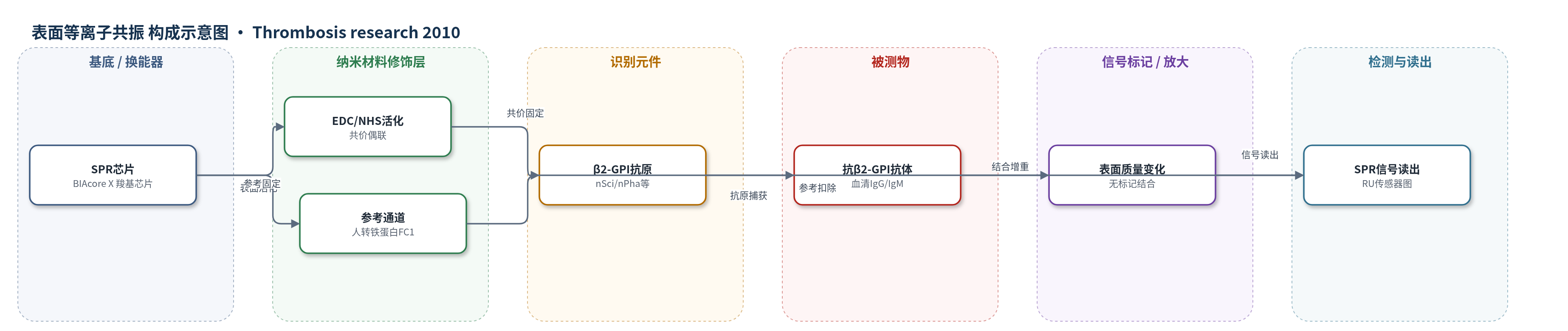
点击图片查看大图 · 依据论文自动绘制
传感器类型
表面等离子共振(SPR)生物传感器
检测对象
抗β2-糖蛋白I抗体(anti-β2-GPI IgG/IgM);样品基质:人血清(APS患者与健康对照)
检测原理
SPR 芯片表面羧基经 EDC/NHS 活化后,与 β2-GPI 的赖氨酸残基形成酰胺键,将不同制备的 β2-GPI 共价固定于 FC2;FC1 固定人转铁蛋白作为参考。稀释后的血清在运行缓冲液中流过芯片,血清中的 anti-β2-GPI IgG/IgM 与固定抗原特异性结合,使界面质量增加并改变局部折射率,BIAcore X 实时记录共振单位 RU 随时间变化。随后切换运行缓冲液观察解离,得到结合/解离曲线。对 HCAL 和 EY2C9 单克隆标准进行浓度系列测量,用 1:1 Langmuir 模型拟合计算 KA 和 KD;对患者与对照血清则比较最大结合或 ROC/AUC。该法无标记、无酶放大,信号直接反映结合抗体质量,不同 β2-GPI 制备因表位暴露、糖基化和纯度差异导致信号差异。
检测灵敏度
未报告 LOD、线性范围、灵敏度斜率或相关系数。
效应效果
21例APS患者与21例对照中,各β2-GPI制备ELISA的AUC均显著大于0.5,病/健康区分良好;IgG-ELISA AUC最高为nSci 0.974、rPha 0.961、nPha 0.957,最低nCal 0.837;IgM-ELISA最高nPha 0.882、nCal 0.869,最低bPha 0.785。但不同制备间定量可比性差,仅约1/3血清滴度分类一致。SPR中nPha AUC 0.985、nSci 0.906最佳,nCal 0.535、rDia 0.501最差。免疫球蛋白耗竭后结合消失,证明信号来自anti-β2-GPI抗体。作者主张统一一种β2-GPI制备以提高ELISA可比性,nSci和nPha较适合。
传感器的构成
- 基底/换能器:BIAcore X SPR 芯片,表面羧基,通过表面等离子共振实时监测结合质量变化(RU)
- 活化层:EDC/NHS 活化羧基,使 β2-GPI 赖氨酸与芯片形成酰胺键共价固定
- 识别元件:不同来源 β2-GPI(nSci、nCal、nPha、rDia、rPha、bPha)固定于 FC2,捕获血清中 anti-β2-GPI 抗体
- 参考通道:FC1 固定人转铁蛋白(human transferrin),用于扣除折射、非特异结合和基线漂移
- 样品/缓冲液:HBS 运行缓冲液(20 mM HEPES、300 mM NaCl、0.2% Tween-20、0.1% HSA),稀释血清并降低非特异吸附
- 信号标记物:无标记(label-free),被测抗体直接结合固定抗原,不依赖酶或荧光标记
- 信号读出:BIAcore X 记录结合/解离传感器图,用 1:1 Langmuir 模型计算 KA/KD
中文摘要
悉尼分类将血清抗β2-糖蛋白I(anti-β2-GPI)抗体纳入抗磷脂综合征(APS)实验室诊断标准,但不同 anti-β2-GPI 检测系统结果差异大。本研究评估不同 β2-GPI 抗原制备对 ELISA 区分 APS 患者与健康对照能力及检测间可比性的影响。将多种 β2-GPI 包被微孔板,用单克隆校准物 HCAL 和 EY2C9 对 21 例 APS 患者和 21 例对照进行 anti-β2-GPI IgG/IgM ELISA;随后用表面等离子共振(SPR)生物传感器测定 HCAL 和 EY2C9 与各 β2-GPI 制备的亲和常数,并研究患者和对照血清的抗原结合。结果显示,所有 β2-GPI 制备在 ELISA 中均能较好区分病人与健康人,但检测间可比性差。HCAL 和 EY2C9 的亲和常数基本不随 β2-GPI 变体改变(KA 0.105–0.200 和 0.449–1.04×10^10 M^-1;KD 50.0–95.5 和 9.61–22.3×10^-11 M)。SPR 中对照反应可忽略,患者反应差异明显。结论:anti-β2-GPI ELISA 的间法可比性高度依赖 β2-GPI 制备,只有统一一种抗原制备才能改善可比性。
英文摘要
INTRODUCTION: The Sydney classification for diagnosis of the antiphospholipid syndrome (APS) first introduced the determination of anti-beta2-glycoprotein I (anti-beta2-GPI)-antibodies in serum as laboratory criteria. In this context, widely differing results of anti-beta2-GPI assays are a concerning issue. Considerable efforts have been made to optimize ELISAs, however little attention was hitherto spent to the antigen preparation. We evaluated the influence of different beta2-GPI preparations on the ability to separate ill and healthy patients and on the comparability of anti-beta2-GPI-assays.
MATERIALS AND METHODS: Microplates were coated with various beta2-GPI preparations and anti-beta2-GPI IgG- and IgM-ELISAs were performed for 21 APS patients and 21 controls using the monoclonal calibrators HCAL and EY2C9. Subsequently, by use of a surface plasmon resonance (SPR) biosensor, affinity constants for the HCAL- and EY2C9-interaction with each beta2-GPI preparation were determined and antigen binding of sera of APS patients and controls was studied.
RESULTS: All ss2-GPI preparations showed good discrimination ability ill vs. healthy but poor inter-assay comparability in the ELISAs. Affinity constants for HCAL and EY2C9 were independent of the beta2-GPI variant (K(A) 0.105 - 0.200 and 0.449 - 1.04 x 10(10)M(-1); K(D) 50.0 - 95.5 and 9.61 - 22.3 x 10(-11)M, respectively). In the biosensor, reactivity to the different beta2-GPIs was negligible for the controls and varied considerably for patients.
CONCLUSION: Inter-assay comparability of anti-beta2-GPI ELISAs is highly dependent upon the beta2-GPI preparation. Only agreement on one common beta2-GPI preparation will improve the requested inter-assay comparability.