组成图示
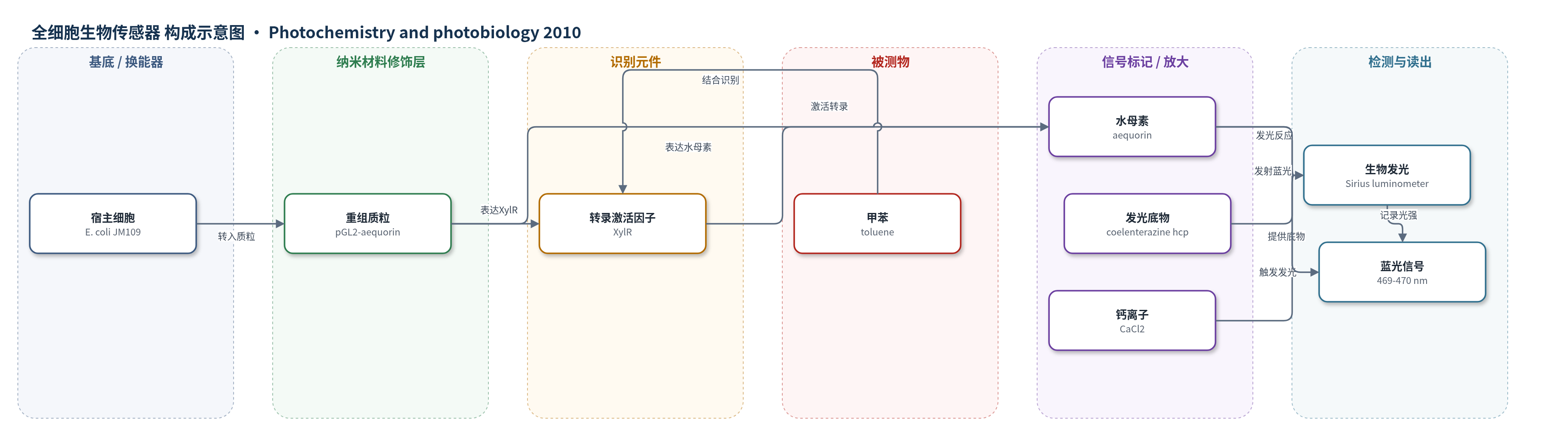
点击图片查看大图 · 依据论文自动绘制
传感器类型
全细胞生物传感器
检测对象
甲苯(toluene)、苯(benzene)、二甲苯(xylene)等甲苯相关芳香化合物;样品基质为水溶液/环境样品
检测原理
甲苯等芳香化合物进入 E. coli JM109 全细胞后,与质粒表达的 XylR 转录激活因子结合,XylR 构象改变并作用于 Pu 启动子,激活下游 aequorin 基因转录和翻译,使细胞内水母素蛋白积累。水母素与 coelenterazine hcp 结合形成发光复合物;加入 Ca2+ 后,水母素发生构象变化,coelenterazine 被氧化生成 coelentramide 和 CO2,同时发射 469–470 nm 蓝色闪光。甲苯浓度越高,XylR 对 Pu 的激活越强,aequorin 表达量越高,最终生物发光相对发光单位(RLU)越高。SD 序列增强翻译,T2 rrnB 终止子降低背景,提高信噪比;该过程无需光学激发,避免自荧光干扰。
检测灵敏度
LOD: <1 μM;线性范围: 1–500 μM
效应效果
该传感器对甲苯、苯和二甲苯均产生生物发光响应,其中二甲苯诱导效果更强,显示对甲苯相关芳香化合物具有选择性。JM109 宿主优于 DH5a,SD+/rrnB+ 质粒信号最高。与 HPLC 比较,标准样 10 μM 时生物传感器测得 9.8 μM、HPLC 为 10.3 μM;400 μM 时分别为 394.0 μM 和 412.0 μM;未知样 0.6 μM 对 0.6 μM、293.5 μM 对 302.4 μM,两者无显著差异。作者认为该全细胞生物发光传感器简单、快速、低成本且操作简便,可作为 HPLC 检测芳香化合物的替代方法。
传感器的构成
- 宿主细胞/换能器:E. coli JM109 全细胞,作为传感器细胞承载重组质粒并产生生物发光信号
- 质粒/遗传元件:pGL2-aequorin,携带 Pu 启动子、xylR 基因、aequorin cDNA、SD 序列、T2 rrnB 终止子和 Amp 抗性基因
- 识别元件:XylR 转录激活蛋白,识别并结合甲苯及相关芳香化合物,激活 Pu 启动子
- 报告基因/信号元件:aequorin(水母素)基因,表达水母素蛋白,在 Ca2+ 和 coelenterazine hcp 存在下发光
- 信号底物:coelenterazine hcp(海肾素 hcp),作为水母素发光反应的底物
- 触发离子:CaCl2/Ca2+,加入后触发水母素构象变化并产生蓝色闪光
- 检测缓冲液:Buffer 1(50 mM Tris、10 mM DTT、5 mM EDTA,pH 8)和 Buffer 2(50 mM Tris、15 mM CaCl2、5 mM EDTA,pH 8),用于细胞重悬和发光触发
中文摘要
本研究构建并表征了一种基于水母素(aequorin)的大肠杆菌 JM109 全细胞生物传感器,用于检测水溶液中的甲苯及其相关化合物。该传感器以 pGL2 质粒为基础,携带假单胞菌 mt-2 xyl 操纵子下路启动子 Pu、转录激活因子 xylR 以及融合的水母素 cDNA,命名为 pGL2-aequorin。当 XylR 蛋白结合甲苯样化合物后,激活 Pu 启动子转录,从而控制水母素表达。研究比较了 Shine-Dalgarno(SD)序列和 T2 rrnB 终止子序列对水母素表达的影响,结果显示同时存在 SD 和 T2 rrnB 时表达更高,信噪比更好。重组全细胞传感器中,水母素活性在 1–500 μM 甲苯范围内呈线性响应,且生物发光响应主要特异于甲苯样分子。因此,该传感器可准确检测环境样品中甲苯衍生物污染。
英文摘要
An aequorin-based Escherichia coli strain JM109 biosensor was constructed and characterized for its potential to detect toluene and related compounds in aqueous solutions. The biosensor was constructed based on a PGL2 plasmid carrying the lower pathway promoter (Pu) of the xyl operon of Pseudomonas putida mt-2, which was incorporated with transcriptional activator xylR and fused to aequorin cDNA named pGL2-aequorin. Binding of xylR protein to a subset of toluene-like compounds activates transcription at the Pu promoter, thus expression of aequorin is controlled by xylR and Pu. In this work we have compared the effect of Shine-Dalgarno (SD) and T2 rrnβ terminator sequence in the expression of aequorin. According to the sensitivity of aequorin and increase in the signal-to-noise ratio, this reporter enzyme has reasonable sensitivity compared with other reporter systems. The results indicate higher expression of aequorin in the presence of SD and T2 rrnβ. The activity of aequorin in recombinant whole-cell biosensor was linear from 1 to 500 μm of toluene. The bioluminescence response was specific for toluene-like molecules, so this biosensor cells would be able to detect toluene derivative contamination in environmental samples, accurately.