组成图示
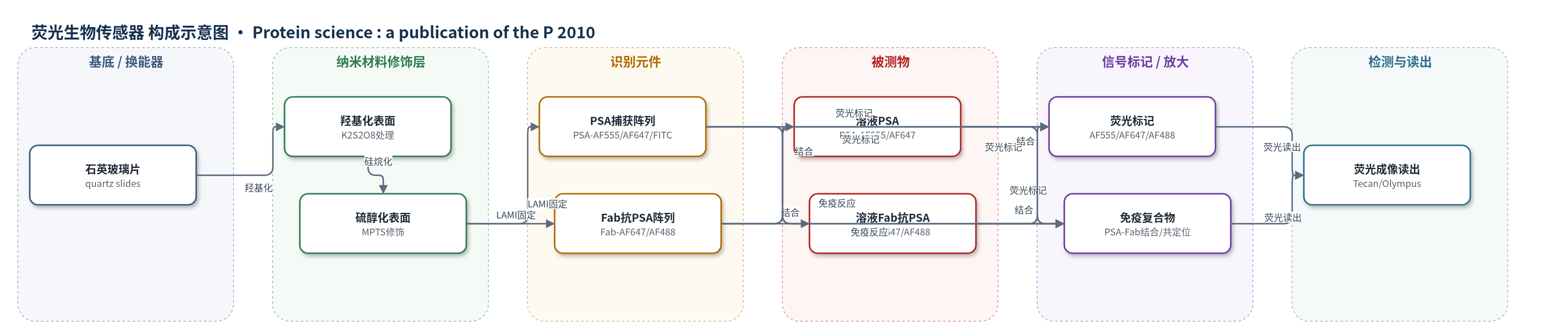
点击图片查看大图 · 依据论文自动绘制
传感器类型
荧光生物传感器
检测对象
前列腺特异性抗原(PSA,prostate specific antigen);样品基质:血清/血液(临床背景;实验为纯蛋白溶液)
检测原理
LAMI利用280 nm紫外光激发PSA或Fab中靠近二硫键的芳香残基(如Trp/Tyr),诱导邻近二硫键断裂并生成自由巯基。这些巯基与硫醇反应性玻璃表面发生共价结合,使蛋白以较一致取向固定成阵列。检测时,溶液中的PSA与固定化Fab anti-PSA结合,或溶液中的Fab anti-PSA与固定化PSA结合;结合事件使荧光标记(AF555、AF647、AF488或FITC)富集于斑点区域。目标物浓度越高,结合量越多,荧光强度越强,通过扫描仪或显微镜成像读出。该体系无酶催化放大,主要依靠荧光标记、免疫识别和聚焦UV提高信噪比。
检测灵敏度
LOD: 7 pM (0.23 ng/mL)(原文表述为 able to detect);固定PSA-AF555可检测: 7.1 pM;Fab-AF647最低可视化: 0.9 nM;PSA-FITC散射模式最低: 0.53 μM
效应效果
阵列斑点均匀、重现性好,斑点尺寸约25–30 μm,聚焦后可达5–6 μm,斑点厚度上限约1 μm。阴性对照中固定化BSA未与PSA或Fab发生可检测反应,说明识别具有特异性;荧光共定位分析显示PSA与Fab结合,并提示AF555与AF647间可能存在能量转移。作者称当前可检测7 pM(0.23 ng/mL)PSA,认为LAMI在灵敏度、特异性、密度、信噪比和重现性方面具有竞争力。原文未报告RSD、实际血清加标回收率,也未与ELISA、HPLC或qPCR进行定量对比。
传感器的构成
- 基底/换能器:光学平石英玻璃片(optical flat quartz slides,平均平整度2 nm),作为阵列载体与光学成像基底
- 表面活化层:硫酸处理及5% K2S2O8羟基化,生成表面羟基以连接硅烷
- 硫醇反应性修饰层:3-巯基丙基三甲氧基硅烷(3-mercaptopropyl-trimethoxysilane,MPTS),提供硫醇反应位点
- 识别元件:PSA(前列腺特异性抗原)或Fab anti-PSA(抗PSA Fab片段,5A10/自纯化Fab),经LAMI定向共价固定
- 信号标记物:Alexa Fluor(AF555、AF647、AF488)或FITC,标记PSA/Fab用于荧光成像
- 孵育/封闭液:5% milk/PBS 1X用于免疫孵育,CHAPS 0.5%用于洗涤去除非结合蛋白
- 读出系统:Tecan LS 200扫描仪、Olympus IX71荧光显微镜、Olympus FV1000共聚焦显微镜,检测荧光信号
中文摘要
本文首次报道利用紫外光辅助分子固定化(LAMI)技术构建前列腺特异性抗原(PSA)和抗PSA Fab片段生物传感器阵列,用于癌症标志物PSA的检测与定量。该技术通过紫外光激发位于二硫键空间邻近的蛋白芳香残基,使保守结构中的二硫键发生光致断裂,产生自由且反应性巯基;这些巯基与硫醇反应性表面结合,实现蛋白的定向共价固定。作者通过免疫分析验证固定化蛋白活性:固定化PSA可被溶液中的抗PSA Fab识别,固定化抗PSA Fab也可与溶液中的PSA发生交叉反应。结果表明,LAMI能在保持生物医学相关分子活性的同时实现高效固定,说明理解光与生物分子相互作用可催生新的生物光子传感技术。研究聚焦于将新的工程原理应用于生物系统的设计、分析、构建与操控,并发现受生物系统特性启发的新工程原理。
英文摘要
We here report for the first time the creation of prostate specific antigen (PSA) and Fab anti-PSA biosensor arrays using UV light-assisted molecular immobilization (LAMI), aiming at the detection and quantification of PSA, a cancer marker. The technology involves formation of free, reactive thiol groups upon UV excitation of protein aromatic residues located in spatial proximity of disulphide bridges, a conserved structural feature in both PSA and Fab molecules. The created thiol groups bind onto thiol reactive surfaces leading to oriented covalent protein immobilization. Protein activity was confirmed carrying out immunoassays: immobilized PSA was recognized by Fab anti-PSA in solution and immobilized Fab anti-PSA cross-reacted with PSA in solution. LAMI technology proved successful in immobilizing biomedically relevant molecules while preserving their activity, highlighting that insight into how light interacts with biomolecules may lead to new biophotonic technologies. Our work focused on the application of our new engineering principles to the design, analysis, construction, and manipulation of biological systems, and on the discovery and application of new engineering principles inspired by the properties of biological systems.