组成图示
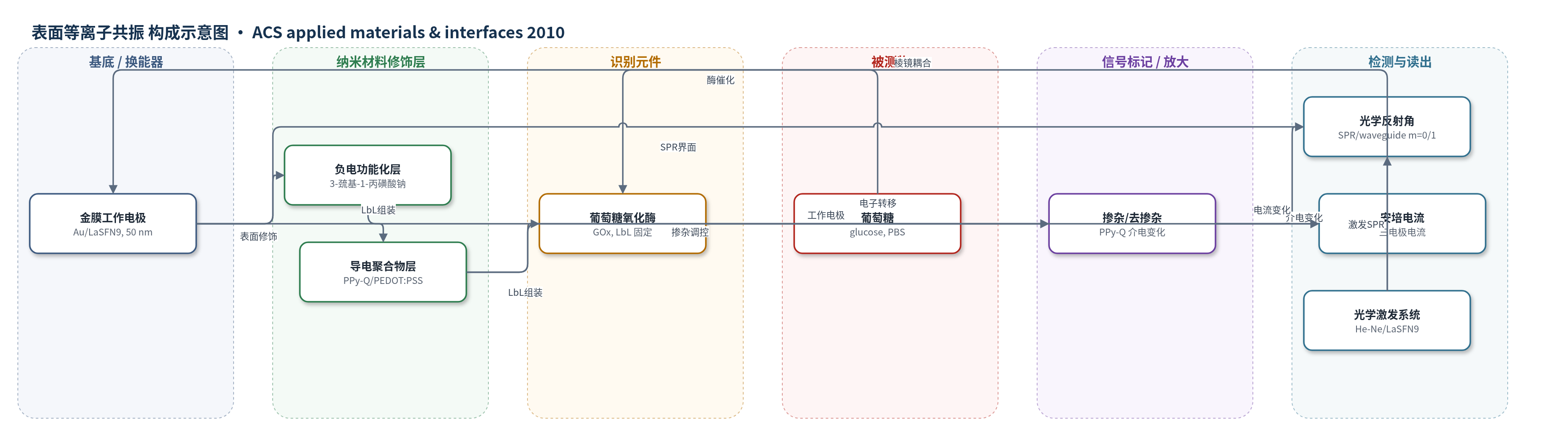
点击图片查看大图 · 依据论文自动绘制
传感器类型
表面等离子共振(SPR)生物传感器
检测对象
葡萄糖(glucose);样品基质:PBS 缓冲液(文中提及可适用于血液、尿液/血浆等实际样品)
检测原理
GOx 催化葡萄糖氧化为葡萄糖酸/葡萄糖内酯,同时 GOx 被还原;在导电聚合物 PPy-Q/PEDOT:PSS 存在下,电子经聚合物传递到金电极,使 PPy-Q 发生掺杂/去掺杂(氧化态增加),改变其介电常数和电致变色状态。SPR 倏逝场(约150 nm)主要响应酶层介电常数变化,而波导 m=1 模式对膜厚/折射率变化敏感;通过 SPR m=0 与 waveguide m=1 模式关联,可区分酶促介电变化与葡萄糖吸附、溶液折射率变化等非酶事件。葡萄糖浓度增加导致氧化态/掺杂程度增加,SPR 共振角和安培电流逐步增大。低电位(<0.3 V)避免葡萄糖及干扰物非酶氧化。
检测灵敏度
灵敏度: 0.3 µA/10 mM(doped state);2.8 nA/10 mM(as-deposited state)
效应效果
该传感器在 0.3 V 低电位工作,可避免葡萄糖及乙酰氨基酚、抗坏血酸、尿酸等非酶氧化,且不受残余 H2O2 影响。SPR/waveguide 双模式能区分酶层介电常数变化与葡萄糖吸附、溶液折射率变化及膜厚变化,提高选择性。25 双分子层厚膜(>500 nm)表面均匀,可同时获得 SPR m=0 与 waveguide m=1 模式;加入 10 mM 葡萄糖后两模式共振角略升高,模型估算膜厚增加约 5 nm。逐步加入 10 mM 葡萄糖时电流与 SPR 反射率逐步增加,未出现明显阻塞或非特异吸附,膜在实验期间较稳健;作者认为可用于其他酶促生物光电检测,但长期稳定性仍需研究。
传感器的构成
- 基底/换能器电极:LaSFN9 玻璃上约 50 nm 金膜(Au),作为工作电极与 SPR 金属-介质界面
- 表面功能化层:3-巯基-1-丙磺酸钠自组装单层,提供负电荷表面以启动 LbL 组装
- 导电聚合物修饰层:PPy-Q(N-烷基氨基化聚吡罗)与 PEDOT:PSS 交替 LbL 沉积,增强电子转移并作为电致变色介体
- 识别元件层:GOx(葡萄糖氧化酶)与 PPy-Q 交替 LbL 固定,催化葡萄糖氧化
- 信号放大/换能层:PPy-Q 的掺杂/去掺杂状态改变介电常数与电流,实现 SPR 和安培信号放大
- 样品/电解液:PBS(pH≈7)缓冲液,加入葡萄糖;文中提及可适用于血液、尿液/血浆等实际样品
- 读出系统:Kretschmann ATR 配置、LaSFN9 棱镜、He-Ne 激光(632.8 nm)与三电极电化学池,同时读取 SPR/waveguide 反射角和电流
中文摘要
本文报道了一种电化学表面等离子共振/波导(EC-SPR/waveguide)葡萄糖生物传感器,用于检测导电聚合物/葡萄糖氧化酶(GOx)多层薄膜中的酶促反应。为实现可控酶电极和波导模式,采用逐层(LbL)静电自组装技术,将带负电的 GOx 与带正电、水溶性导电 N-烷基氨基化聚吡罗(PPy-Q)交替固定。加入葡萄糖后,复合 LbL 酶电极同时产生电化学和光学信号,该信号由聚吡罗层的电活性与电致变色特性介导。通过监测聚吡罗的掺杂/去掺杂过程,可实现 EC-SPR 检测的信号增强。利用 SPR 模式与波导 m=0 和 m=1 模式的关联分析,可区分酶层介电常数变化与葡萄糖吸附、溶液折射率变化等非酶反应事件,从而获得实时光学信号。
英文摘要
In this work, we report an electrochemical surface plasmon resonance/waveguide (EC-SPR/waveguide) glucose biosensor that could detect enzymatic reactions in a conducting polymer/glucose oxidase (GO(x)) multilayer thin film. In order to achieve a controlled enzyme electrode and waveguide mode, GO(x) (negatively charged) was immobilized with a water-soluble, conducting N-alkylaminated polypyrrole (positively charged) using the layer-by-layer (LbL) electrostatic self-assembly technique. The electrochemical and optical signals were simultaneously obtained from the composite LbL enzyme electrode upon the addition of glucose as mediated by the electroactivity and electrochromic property of the polypyrrole layers. Signal enhancement in EC-SPR detection is obtained by monitoring the doping-dedoping events on the polypyrrole. The real-time optical signal could be distinguished between the change in the dielectric constant of the enzyme layer and other nonenzymatic reaction events such as adsorption of glucose and the change of the refractive index of the solution. This was possible by correlation of both the SPR mode and the m = 0 and 1 modes of the waveguide in an SPR/waveguide spectroscopy experiment.