组成图示
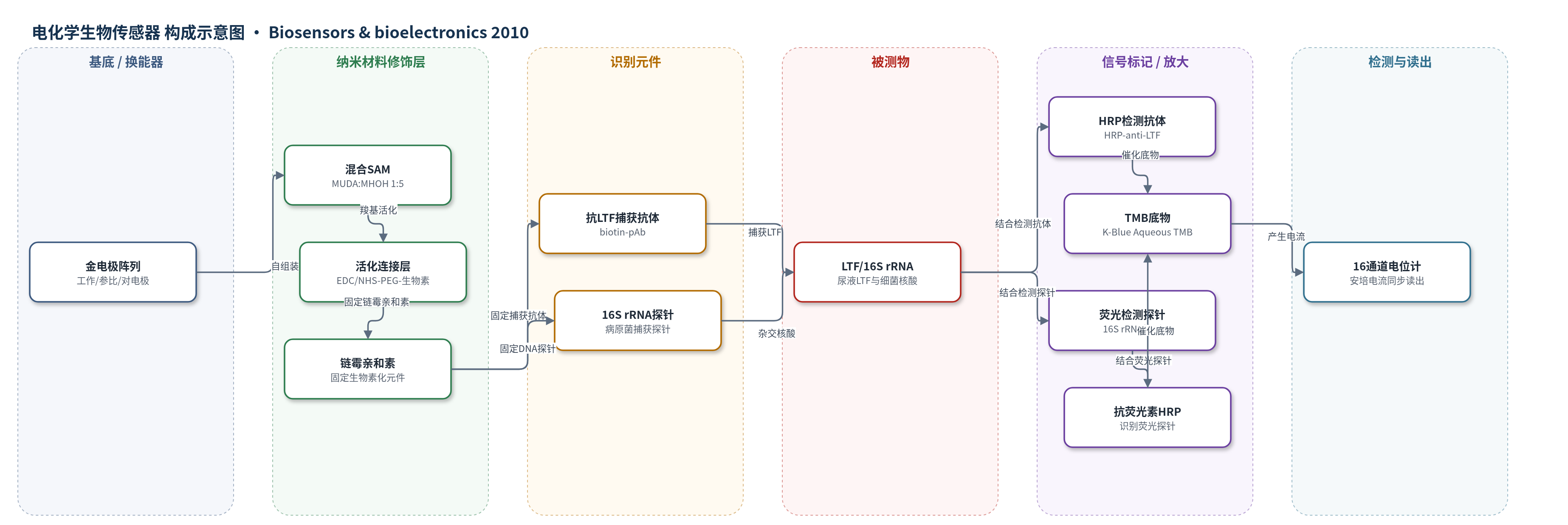
点击图片查看大图 · 依据论文自动绘制
传感器类型
电化学生物传感器
检测对象
乳铁蛋白(lactoferrin, LTF)、细菌16S rRNA;样品基质:临床尿液(健康加标尿、感染尿)
检测原理
传感器表面金电极经MUDA/MHOH混合SAM修饰,EDC/NHS活化后通过PEG-生物素和链霉亲和素固定生物素化抗LTF捕获抗体。尿液中的LTF与捕获抗体结合后,再与HRP偶联抗LTF检测抗体形成夹心复合物。加入TMB底物后,HRP催化TMB发生氧化还原反应,在固定电位-200 mV下产生与LTF浓度成正比的安培电流。LTF浓度越高,结合的检测抗体越多,催化产生的电流越大。对于病原菌检测,同一SAM阵列固定16S rRNA DNA捕获探针,细菌核酸杂交后由荧光标记检测探针和抗荧光素HRP识别,同样经TMB催化产生安培信号,实现蛋白与核酸多路同步检测。
检测灵敏度
LOD: 145 pg/ml;动态范围: 3-orders of magnitude;线性检测上限: 100 ng/ml;相关系数: 0.90 (95% CI, 0.82–0.95)
效应效果
该传感器在缓冲液中LTF检出限为145 pg/ml,优于商品ELISA的1 ng/ml,动态范围达3个数量级。111份临床尿液中,99份与ELISA呈良好相关(r=0.90,95% CI 0.82–0.95),LTF水平随尿白细胞计数和酯酶活性升高而升高(P<0.001)。健康尿加标50 ng/ml LTF时,2倍稀释使回收率从66.4%升至88.6%,提示存在尿基质抑制。多路检测中,单个16通道阵列在2 h内同时鉴定大肠杆菌并测得LTF 1208 ng/ml,传感器整体变异系数为0.13。作者认为该平台可替代或补充培养,实现更快、信息更丰富的UTI诊断。
传感器的构成
- 基底电极:16通道平面金电极阵列(工作、参比、对电极,GeneFluidics),作为电化学换能器
- 修饰层:MUDA与MHOH 1:5混合自组装单分子层(SAM),提供羧基并降低空间位阻
- 活化连接层:EDC/NHS活化羧基后连接EZ-link Amine-PEG2-Biotin生物素接头,用于固定生物素化识别元件
- 封闭层:0.5% casein和1 M ethanolamine(pH 8.5)封闭剩余活化羧基,减少非特异结合
- 识别元件:链霉亲和素固定生物素化多克隆抗乳铁蛋白捕获抗体(biotin-pAb),特异性捕获LTF
- 信号标记物:HRP偶联多克隆抗乳铁蛋白检测抗体(HRP-anti-LTF),提供辣根过氧化物酶催化位点
- 底物:K-Blue Aqueous TMB底物,在-200 mV下经HRP催化产生安培电流
- 多路核酸识别:16S rRNA DNA捕获探针(UNI、EC、EF、KE、PA、PM、EB、AB)与荧光标记检测探针/抗荧光素HRP,用于病原菌同步检测
中文摘要
尿液是人体最丰富且易获取的体液,适合用于无创诊断,尤其适用于泌尿系统疾病。电化学生物传感器因灵敏度高、成本低、可检测核酸和蛋白标志物而适合尿液诊断。本文报道了一种用于直接从感染临床尿液样本中检测尿路感染(UTI)生物标志物乳铁蛋白(lactoferrin, LTF)的电化学免疫传感器。该传感器采用烷硫醇自组装单分子层(SAM)修饰的金电极阵列,混合SAM由11-巯基十一烷酸(MUDA)和6-巯基-1-己醇(MHOH)组成,并通过电化学阻抗谱表征。作者建立了夹心式安培免疫分析,检测尿液LTF,检出限为145 pg/ml。在111份患者尿液样本中验证LTF作为脓尿(尿中白细胞增多)标志物的价值,脓尿是UTI的重要特征。最后,在同一传感器阵列上同时检测细菌核酸(16S rRNA)和宿主免疫反应蛋白LTF,实现病原菌鉴定与宿主免疫应答的联合检测。该平台有望提供比现有标准更快且信息更丰富的临床诊断。
英文摘要
Urine is the most abundant and easily accessible of all body fluids and provides an ideal route for non-invasive diagnosis of human diseases, particularly of the urinary tract. Electrochemical biosensors are well suited for urinary diagnostics due to their excellent sensitivity, low-cost, and ability to detect a wide variety of target molecules including nucleic acids and protein biomarkers. We report the development of an electrochemical immunosensor for direct detection of the urinary tract infection (UTI) biomarker lactoferrin from infected clinical samples. An electrochemical biosensor array with alkanethiolate self-assembled monolayer (SAM) was used. Electrochemical impedance spectroscopy was used to characterize the mixed SAM, consisted of 11-mercaptoundecanoic acid and 6-mercapto-1-hexanol. A sandwich amperometric immunoassay was developed for detection of lactoferrin from urine, with a detection limit of 145 pg/ml. We validated lactoferrin as a biomarker of pyuria (presence of white blood cells in urine), an important hallmark of UTI, in 111 patient-derived urine samples. Finally, we demonstrated multiplex detection of urinary pathogens and lactoferrin through simultaneous detection of bacterial nucleic acid (16S rRNA) and host immune response protein (lactoferrin) on a single sensor array. Our results represent first integrated sensor platform capable of quantitative pathogen identification and measurement of host immune response, potentially providing clinical diagnosis that is not only more expeditious but also more informative than the current standard.