组成图示
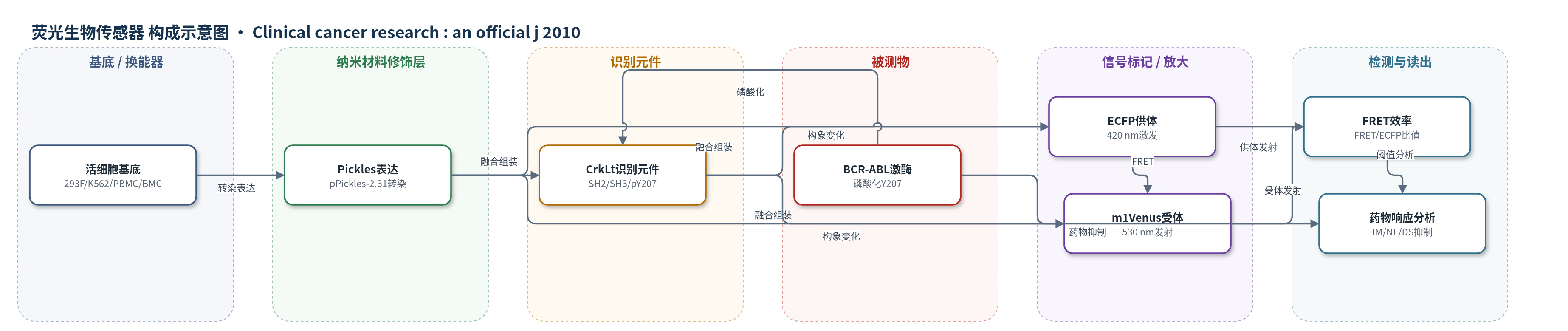
点击图片查看大图 · 依据论文自动绘制
传感器类型
荧光生物传感器
检测对象
BCR-ABL激酶活性(BCR-ABL kinase activity)及其药物抑制(imatinib/nilotinib/dasatinib response);样品基质:活细胞(CML细胞系K562/KU812、HL60/U937、293F表达细胞、CML患者PBMC/BMC)
检测原理
Pickles是由ECFP、CrkLt和m1Venus组成的基因编码FRET报告蛋白。BCR-ABL激酶磷酸化CrkLt的Y207后,CrkLt的SH2结构域与磷酸化酪氨酸发生分子内结合,使ECFP与m1Venus之间的距离和取向改变,FRET效率升高。用420 nm激发ECFP时,能量转移至m1Venus,530 nm发射增强,FRET/ECFP比值升高。BCR-ABL活性越高或TKI抑制越弱,FRET信号越高;伊马替尼、尼洛替尼或达沙替尼抑制BCR-ABL后,磷酸化减少,FRET下降。方法还以D-FRET=2.04为阈值区分FREThi和FRETlo,用于单细胞水平识别耐药小群体。
检测灵敏度
未报告LOD、线性范围、灵敏度斜率或相关系数;报告阈值D-FRET = 2.04,可检测<1%耐药细胞,FRET效率增加约80%,IM显著抑制浓度≥0.1 μM。
效应效果
Pickles对BCR-ABL具有较高特异性,其他非受体酪氨酸激酶除c-Abl外基本不引起FRET升高;SH2或Y207突变后响应消失。其灵敏度较Western blot约高1000倍,动态范围更宽;伊马替尼在≥0.1 μM即显著降低FRET,而Western blot和流式分别需≥1 μM和≥0.5 μM。单细胞分析可识别混合群体中约1%的耐药细胞,与流式结果相当;D-FRET=2.04阈值下,500个无BCR-ABL的293F细胞未出现FREThi。在11例患者样本中,方法可区分敏感与耐药,并预测后续疗效,作者认为其可用于个体化CML治疗监测。
传感器的构成
- 细胞基底:活细胞(293F、K562、KU812、HL60、U937或CML患者PBMC/BMC),承载Pickles表达并提供BCR-ABL激酶环境
- 供体荧光蛋白:ECFP(enhanced cyan fluorescent protein),位于Pickles N端,420 nm激发,作为FRET供体
- 识别元件:CrkLt(CrkL 1-222截短体),含SH2和SH3结构域,被BCR-ABL磷酸化Y207,SH2结合pY207引起构象变化
- 受体荧光蛋白:m1Venus(monomeric Venus, L222K/F224R),位于Pickles C端,作为FRET受体,530 nm发射
- 表达载体:pPickles-2.31,用于将Pickles基因转染至细胞
- 信号读出:双发射荧光显微镜或FP-6500荧光分光计,计算FRET/ECFP比值
中文摘要
为开发可个体化评估慢性髓系白血病(CML)患者药效的诊断方法,作者基于荧光共振能量转移(FRET)原理构建了一种可在活细胞中评价BCR-ABL激酶活性的生物传感器。该传感器利用BCR-ABL的特征底物CrkL,将CrkL夹在黄荧光蛋白变体Venus与增强型青荧光蛋白(ECFP)之间,使CrkL的SH2结构域与磷酸化酪氨酸Y207发生分子内结合后FRET效率升高。作者通过与Western blot和流式细胞术等成熟方法比较评估其性能,并在CML患者细胞中检测BCR-ABL活性及药物反应。优化后的传感器对BCR-ABL活性及其被伊马替尼抑制的测量灵敏度高于既有技术,可在相对少量细胞中准确测量,并能检测异质群体中低于1%的耐药小群体。该方法还可预测未来耐药发生并监测伊马替尼治疗期间的疾病状态。鉴于其快速、实用,作者认为该传感器有望成为预测个体CML患者当前和未来治疗反应的有用工具。
英文摘要
PURPOSE: To develop a novel diagnostic method for the assessment of drug efficacy in chronic myeloid leukemia (CML) patients individually, we generated a biosensor that enables the evaluation of BCR-ABL kinase activity in living cells using the principle of fluorescence resonance energy transfer (FRET).
EXPERIMENTAL DESIGN: To develop FRET-based biosensors, we used CrkL, the most characteristic substrate of BCR-ABL, and designed a protein in which CrkL is sandwiched between Venus, a variant of YFP, and enhanced cyan fluorescent protein, so that CrkL intramolecular binding of the SH2 domain to phosphorylated tyrosine (Y207) increases FRET efficiency. After evaluation of the properties of this biosensor by comparison with established methods including Western blotting and flow cytometry, BCR-ABL activity and its response to drugs were examined in CML patient cells.
RESULTS: After optimization, we obtained a biosensor that possesses higher sensitivity than that of established techniques with respect to measuring BCR-ABL activity and its suppression by imatinib. Thanks to its high sensitivity, this biosensor accurately gauges BCR-ABL activity in relatively small cell numbers and can also detect <1% minor drug-resistant populations within heterogeneous ones. We also noticed that this method enabled us to predict future onset of drug resistance as well as to monitor the disease status during imatinib therapy, using patient cells.
CONCLUSION: In consideration of its quick and practical nature, this method is potentially a promising tool for the prediction of both current and future therapeutic responses in individual CML patients, which will be surely beneficial for both patients and clinicians.