组成图示
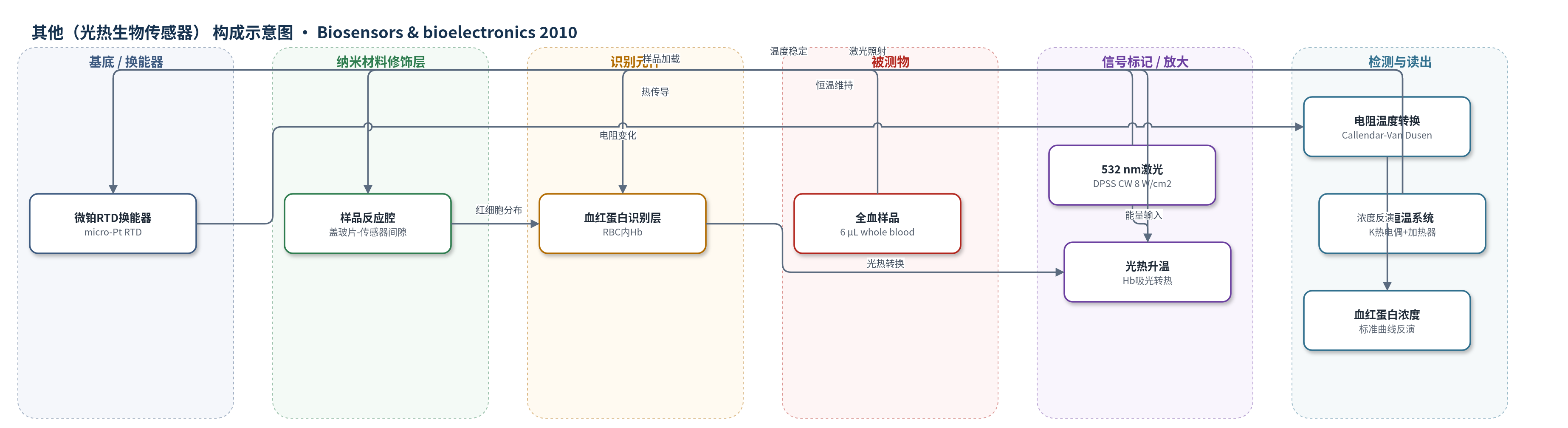
点击图片查看大图 · 依据论文自动绘制
传感器类型
其他(光热生物传感器)
检测对象
血红蛋白(Hemoglobin, Hb);样品基质:全血(whole blood,K3EDTA抗凝),标准曲线用红细胞/AB血浆
检测原理
全血样品置于微铂RTD与盖玻片之间,红细胞内血红蛋白作为内源性光热识别/信号元件。532 nm DPSS连续波激光以8.0 W/cm2功率密度照射样品,血红蛋白吸收光子后通过非辐射弛豫将光能转化为局部热能,使样品温度升高。温度升高幅度取决于血红蛋白浓度、光吸收系数和样品厚度;按Beer–Lambert–Bouguer定律,12.7 g/dL血红蛋白在532 nm下穿透深度约160.4 µm,6 µL样品厚度约74.4 µm时达到光热饱和。微铂RTD采用四线制测量电阻,消除引线电阻误差,并通过Callendar–Van Dusen方程将电阻变化换算为温度变化;PID恒温系统抑制环境温度波动。最终由温度变化经标准曲线反演血红蛋白浓度,实现贫血诊断。
检测灵敏度
检测范围: 0–10.8 g/dL;灵敏度: about 2.5 °C per 1 g/dL;R^2 = 0.9925
效应效果
系统对10名贫血患者全血样品进行3次重复测量,温度变化为66.33±2.72 °C至74.16±2.06 °C,对应血红蛋白7.2–9.8 g/dL;各样品RSD为0.5802%–4.101%,6 µL优化体积下RSD为0.6967%。恒温系统可将环境温度稳定在<±0.1 °C,四线制Pt RTD降低引线电阻误差。与ADVIA2120血细胞分析仪比较,最大血红蛋白浓度差为0.29 g/dL,低于常规仪器允许误差0.3 g/dL。方法无需氰化物等有毒化学试剂,避免红细胞裂解和血红蛋白转化步骤;样品量6 µL,仅为传统175 µL的约1/29,检测时间约3 s。检测范围0–10.8 g/dL虽窄于HiCN法0–25.6 g/dL,但足以用于贫血诊断。
传感器的构成
- 换能器层:微铂电阻温度探测器(micro-Pt RTD),MEMS制备,四线制,将温度变化转换为电阻变化
- 样品反应腔:微Pt RTD与盖玻片之间形成6 µL全血样品层,盖玻片厚0.13–0.17 mm
- 识别/信号元件:红细胞内血红蛋白(Hb),吸收532 nm光子并转化为热
- 光激发源:532 nm DPSS连续波激光模块,功率密度8.0 W/cm2
- 恒温控制层:K型热电偶与两个电加热器,PID控制器维持温度<±0.1 °C
- 读出层:四线制电阻测量与Callendar–Van Dusen方程,将电阻变化换算为温度
中文摘要
本文报道一种无需化学处理即可诊断贫血的热生物传感器。该方法利用红细胞(RBC)中血红蛋白分子吸收特定波长光子并将其转化为热能,引起红细胞温度升高。为测量红细胞温度变化,作者开发了微尺度铂电阻温度探测器(Pt RTD)。为维持恒定环境温度,设计了由K型热电偶和两个电加热器组成的恒温系统,热电偶监测温度,加热器与热电偶连接至PID控制器,可将温度稳定在<±0.1 °C。为特异性加热红细胞,采用532 nm波长、8.0 W/cm2功率密度的二极管泵浦固体态(DPSS)连续波(CW)激光模块。利用该系统,成功测量了10名贫血患者全血样品的温度变化(66.33±2.72 °C至74.16±2.06 °C),并据此确定血红蛋白浓度(7.2–9.8 g/dL)。与传统方法需175 µL全血相比,该方法仅需6 µL全血,并可在3 s内实现贫血即时诊断。
英文摘要
This article presents a thermal biosensor to diagnose the anemia without chemical treatments using temperature increase of red blood cells (RBC) when hemoglobin molecules absorb specific wavelength of photons and convert them to thermal energy. For measuring temperature change of red blood cell, the micro-scaled platinum resistance temperature detector (Pt RTD) was developed. For maintenance of constant ambient temperature, we designed and fabricated a thermostat system. The thermostat system consists of a K-type thermocouple and two electric heaters that serve to increase the system temperature, which is monitored by the thermocouple. Both heaters and the thermocouple were connected to a proportional-integral-derivative (PID) controller and enabled to maintain the temperature constant (<±0.1°C). For specific heating of red blood cell, 8.0 W/cm(2) diode pumped solid state (DPSS) continuous wave (CW) laser module was used with 532 nm wavelength. Using this system, we successfully measured the temperature variations (from 66.33±2.72°C to 74.16±2.06°C) of whole blood samples from 10 anemic patients and subsequently determined the concentration of hemoglobin (from 7.2 g/dL to 9.8 g/dL). The method proposed in this paper requires significantly less amount of whole blood sample (6 μl) compared with the conventional methods (175 μl) and allows instantaneous diagnosis (3 s) of anemia.