组成图示
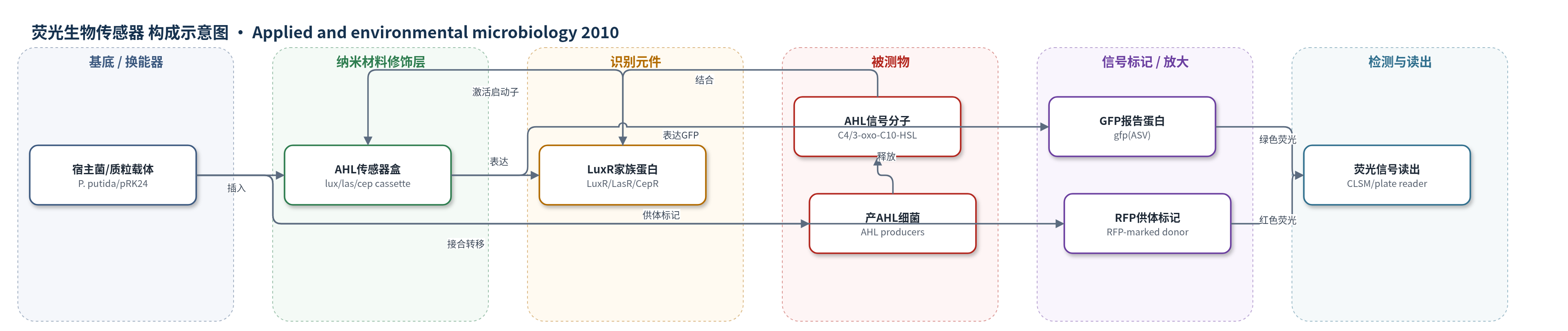
点击图片查看大图 · 依据论文自动绘制
传感器类型
荧光生物传感器
检测对象
N-酰基高丝氨酸内酯(AHLs,N-acyl-homoserine lactones,包括 C4-HSL、C6-HSL、C8-HSL、C10-HSL、C12-HSL、3-oxo-C10-HSL、3-oxo-C12-HSL);样品基质:LB 培养基、混合生物膜、湖泊沉积物微宇宙
检测原理
该传感器以活菌为换能单元。外源 AHL 信号分子扩散进入携带 RP4 传感器质粒的细胞后,与 LuxR 家族转录调控蛋白(LuxR、LasR 或 CepR)结合,形成 AHL-LuxR 复合物。复合物结合相应的 AHL 响应启动子(P_lux、P_las 或 P_cep),启动 gfp(ASV) 的转录与翻译,产生绿色荧光蛋白。AHL 浓度越高,启动子激活越强,GFP 荧光信号越强,从而实现浓度依赖的荧光读出。RP4 质粒具有接合转移能力,可自转移至环境中产 AHL 的受体菌;受体菌获得质粒后,其自身产生的 AHL 诱导 GFP 表达,使产菌呈现绿色荧光。RFP 标记供体菌可区分外源 AHL 诱导的供体细胞与获得质粒的转移子代。该策略无化学放大,主要依赖转录-翻译报告基因表达和质粒在受体菌中的维持。
检测灵敏度
原文未报告 LOD、线性范围、灵敏度斜率或相关系数;AHL 测试浓度范围: 9.76 nM–10 μM(2 倍系列稀释)
效应效果
传感器响应受宿主背景影响:P. putida KT2442(RP4lux) 仅响应 3-oxo-C10-HSL 和 3-oxo-C12-HSL,E. coli MT102(RP4lux) 响应多种 AHL;RP4las 和 RP4cep 在 P. putida KT2442 中对 C10–C12 链 AHL 敏感,在 E. coli MT102 中不工作。转移至产菌后,P. putida IsoF 中 RP4las、RP4cep、RP4lux 的 GFP 阳性细胞比例分别为 98%、86%、20%;P. aureofaciens 中分别为 10%、87%、40%。混合生物膜中约 10% 细胞呈红绿双荧光,证明质粒接合转移。湖泊沉积物中,5 天出现绿色荧光供体,8 天出现仅绿色荧光转移子代,10 天出现红绿双荧光激活供体;42 株转移子代 16S rRNA 序列归入 Aeromonas、Providencia、Pseudochrobactrum。作者认为该工具适合原位识别产 AHL 细菌。
传感器的构成
- 基底/换能器:宿主菌细胞(P. putida KT2442、E. coli MT102)与 RP4 衍生质粒 pRK24,作为活细胞换能单元
- 修饰层:AHL 传感器盒(lux、las、cep cassette),插入 pRK24 的 fivA、traC2 或未知基因位点
- 识别元件:LuxR 家族转录调控蛋白(LuxR、LasR、CepR),与 AHL 结合后激活下游启动子
- 调控元件:AHL 响应启动子(P_lux、P_las、P_cep),介导 AHL 浓度依赖的转录激活
- 信号标记物:gfp(ASV) 绿色荧光蛋白基因,AHL 诱导表达产生绿色荧光
- 终止/选择元件:T7 与 T1 转录终止子及 Kan^r 卡那霉素抗性基因,用于终止转录和筛选
- 供体标记:RFP 红色荧光蛋白标记供体菌,用于区分外源诱导供体与转移子代
中文摘要
许多细菌利用群体感应(QS)系统通过产生、释放和响应信号分子进行细胞间通讯,N-酰基高丝氨酸内酯(AHLs)在变形菌中尤为常见,可调控生物发光、毒力、运动性、生物膜形成和接合等功能。然而,由于缺乏能在自然生境中直接研究细菌群落 QS 的工具,AHL 在自然生态中的作用仍不清楚。本研究构建了可自转移的绿色荧光蛋白(GFP)基 AHL 传感器质粒,将三种分别响应不同 AHL 谱的传感器盒整合到广宿主范围质粒 RP4 的衍生载体中。结果表明,这些传感器质粒可通过双亲接合容易地转移至不同细菌物种,并在受体菌产生相应 AHL 时诱导 GFP 表达,使细胞呈现绿色荧光。此外,传感器质粒能在混合生物膜中自我扩散,并可用于湖泊沉积物微宇宙中识别产 AHL 细菌,为原位研究 AHL 介导的种间通讯提供了新工具。
英文摘要
Many bacteria utilize quorum sensing (QS) systems to communicate with each other by means of the production, release, and response to signal molecules. N-Acyl homoserine lactone (AHL)-based QS systems are particularly widespread among the Proteobacteria, in which they regulate various functions. It has become evident that AHLs can also serve as signals for interspecies communication. However, knowledge on the impact of AHLs for the ecology of bacteria in their natural habitat is scarce, due mainly to the lack of tools that allow the study of QS in bacterial communities in situ. Here, we describe the construction of self-mobilizable green fluorescent protein (GFP)-based AHL sensors that utilize the conjugation and replication properties of the broad-host-range plasmid RP4. We show that these novel AHL sensor plasmids can be easily transferred to different bacterial species by biparental mating and that they give rise to green fluorescent cells in case the recipient is an AHL producer. We also demonstrate that these sensor plasmids are capable of self-spreading within mixed biofilms and are a suitable tool for the identification of AHL-producing bacteria in lake sediment.