组成图示
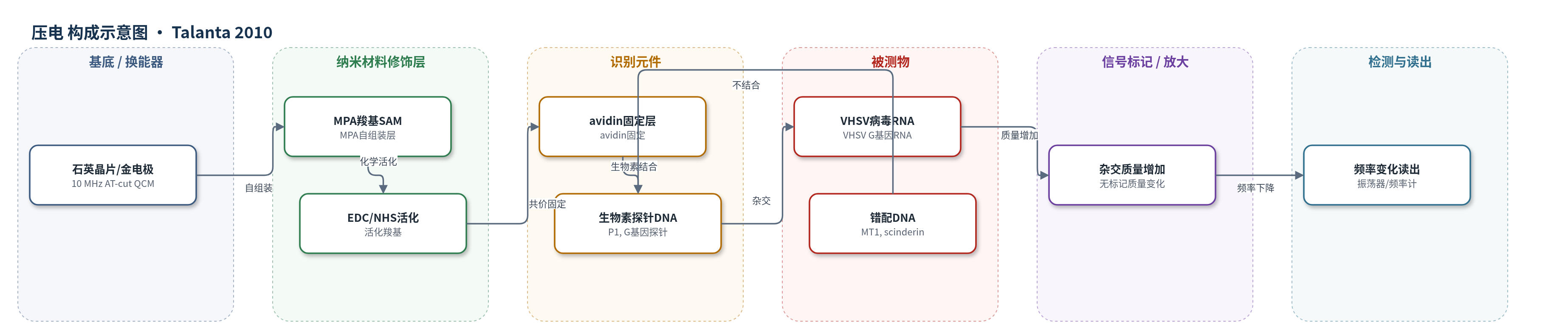
点击图片查看大图 · 依据论文自动绘制
传感器类型
压电(QCM)生物传感器
检测对象
VHSV 病毒 RNA(Viral haemorrhagic septicaemia virus RNA,编码 G 蛋白的 RNA),样品基质为鱼头肾组织提取总 RNA;性能验证用互补靶 DNA(T1)和错配 DNA(MT1)。
检测原理
该传感器以 QCM 为换能器,金表面经 MPA 自组装形成羧基 SAM,再用 EDC/NHS 活化并共价固定 avidin,随后通过 avidin–biotin 作用固定生物素化 DNA 探针。目标 VHSV G 基因 RNA(或 DNA)与探针杂交后,识别层质量增加,使石英晶片谐振频率下降,频率变化 Δf 与结合量相关。系统为无标记检测,无需逆转录和 PCR 放大;avidin 四聚体可结合多个生物素探针,提高表面探针密度。实际 RNA 经 65 °C 去除二级结构后直接注入,10 min 内完成结合监测。
检测灵敏度
LOD: 0.0016 µM;剂量响应范围: 0.0016–1 µM;频率变化: 40.6 ± 2.08 Hz 至 1.33 ± 0.58 Hz
效应效果
该传感器对互补靶 DNA 具有特异性,错配 DNA(MT1,scinderin 基因片段)未显示显著结合。生物素化探针芯片可耐受 32 次再生,信号无显著降低,表明 DNA 识别层比抗体更稳定。剂量响应实验 n=3,1–0.0016 µM 靶 DNA 引起 40.6±2.08 至 1.33±0.58 Hz 频率变化。实际样品中,3 条 VHSV 感染鱼头肾 RNA 的频率变化与感染程度相关;检测在 10 min 内完成,比 RT-PCR 所需 3 h 以上更快,作者认为其可用于鱼类 VHSV 快速诊断。
传感器的构成
- 基底/换能器:10 MHz AT-cut 压电石英晶片(quartz crystal),两面 5 mm 金电极,作为 QCM 质量换能器。
- SAM修饰层:3-巯基丙酸(MPA)在金表面形成羧基自组装单分子层,提供羧基反应位点。
- 活化层:EDC/NHS 活化 MPA 羧基,用于共价固定 avidin。
- 识别元件:avidin 固定层通过生物素-亲和素作用结合生物素化探针 DNA(biotinylated probe DNA, P1)。
- 识别元件:探针 DNA 序列 5′-biotin-CTGGTGACTGATAGCGGGT-3′,特异性识别 VHSV G 基因 RNA/DNA。
- 封闭剂:1 M ethanolamine-HCl 封闭未反应羧基/avidin 位点,降低非特异结合。
- 信号标记物:无外源信号标记;验证用 FAM 标记靶 DNA(T(F)1,5-carboxy fluorescein)荧光确认结合。
- 读出模块:自制振荡器、注射泵/注射阀流动池和频率计数器,监测谐振频率变化。
中文摘要
病毒性出血败血症(VHS)是由 VHSV 引起的重要鱼类病毒病,传统细胞培养和 RT-PCR 诊断耗时较长。本研究开发了一种快速、灵敏的 QCM 生物传感器,用于诊断鱼类 VHSV 感染。该传感器通过特异性 DNA 探针检测 VHSV 编码 G 蛋白的主要病毒 RNA。为最大化灵敏度,作者制备了三种末端修饰 DNA 探针,分别以硫醇、胺或生物素标记,并比较三种金表面固定方法:硫醇标记探针直接固定于裸金表面;胺标记探针固定于 MPA 制备的羧基芯片并经 EDC/NHS 活化;生物素标记探针固定于先固定 avidin 的羧基芯片。结果表明,avidin–biotin 相互作用固定探针 DNA 和检测靶 DNA 最有效。生物素化探针 QCM 系统可耐受 32 次再生,检出限为 0.0016 µM,诊断 VHSV 比传统 RT-PCR 更敏感且更快。
英文摘要
Viral haemorrhagic septicaemia (VHS) is one of the most serious viral diseases damaging both fresh and marine fish species. VHS caused by VHSV and diagnosis of VHSV has been dependent on the conventional methods, such as cell culture and RT-PCR, which takes a few days or several hours. This study demonstrates a rapid and sensitive QCM biosensor for diagnosis of VHSV infection in fish. The QCM biosensor was developed to detect a main viral RNA encoding G protein in VHSV using the specific DNA probe. To maximize the sensitivity of the biosensor, we prepared three different DNA probes which modified 3' end of DNA by thiol, amine, or biotin and compared three different immobilisation methods on quartz surface coated with gold: immobilisation of thiol labelled probe DNA on naked gold surface, immobilisation of amino labelled probe DNA on gold surface prepared as carboxyl chip using MPA followed by EDC/NHS activation, and immobilisation of biotin labelled probe DNA on gold surface after immobilising avidin on carboxyl chip prior to biotin. As a result, immobilisation method using avidin-biotin interaction was most efficient to immobilise probe DNA and to detect target DNA. The QCM biosensor system using biotinylated probe DNA was stable enough to withstand 32 times of repeated regenerations and the detection limit was 0.0016muM. Diagnosis using the QCM biosensor system was more sensitive and much faster than a conventional RT-PCR analysis in detecting the viral RNA.