组成图示
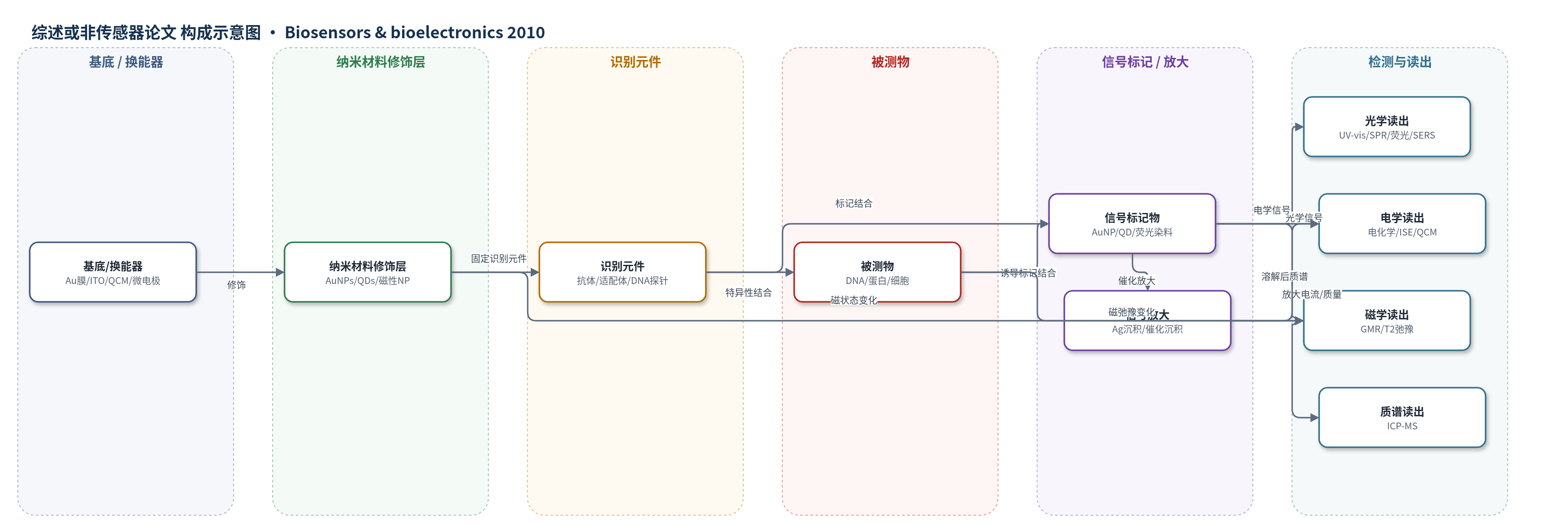
点击图片查看大图 · 依据论文自动绘制
传感器类型
综述或非传感器论文
检测对象
DNA/寡核苷酸(DNA/oligonucleotides)、蛋白(proteins,如PDGF、PDGFR、α-thrombin、CEA、AFP、S100β、c-myc肽)、细胞(cells,如HMy2、PC-3);样品基质:缓冲液、血清/临床样品、食品、环境水样、细胞悬液、微孔板/侧流试纸条
检测原理
综述中的纳米颗粒生物传感器通常以金膜、ITO、石英晶体、微电极、磁珠或侧流试纸条为基底,表面修饰AuNPs、QDs或磁性纳米颗粒,并固定DNA探针、抗体、适配体或细胞表面蛋白作为识别元件。当DNA杂交、免疫反应、适配体结合或细胞结合发生时,纳米颗粒发生聚集、距离改变、质量/电荷/磁状态变化,从而改变光吸收/散射、SPR、荧光猝灭/恢复、SERS、QCM频率、电导、电位、电化学电流或ICP-MS信号。常用放大策略包括AuNP催化Ag或Au沉积、QD溶解后重金属剥离、银增强、SPR电磁耦合和磁性聚集改变T2弛豫。被测物浓度越高,信号增强或降低越明显。
检测灵敏度
LOD: 20 fM;LOD: 130 fM for CEA, 714 fM for AFP and 2.72 pM for thrombin;LOQ: 10 pM limit of quantitation for 24-mer oligonucleotides;LOD: 10 fM;LOD: 500 fM;LOD: 5 ppb or 28 fmol of thrombin;LOD: 23 fg/mL;LOD: 4000 cells per 700 µL of suspension
效应效果
综述总结的纳米颗粒生物传感器通常具有较高选择性和灵敏度,可区分单碱基错配与SNP。SERS微阵列可区分6种DNA靶标和2种RNA SNP,检测限20 fM;单AuNP计数法CEA 130 fM、AFP 714 fM、thrombin 2.72 pM;SPR-AuNP对24-mer DNA LOQ 10 pM,T-SPR 10 fM,导电DNA阵列500 fM;电位法thrombin 5 ppb/28 fmol;磁免疫传感蛋白23 fg/mL;细胞传感4000 cells/700 µL;侧流试纸条比溴化乙锭凝胶染色高至少8倍;QD编码微珠识别准确率99.99%。作者认为其可替代PCR/ELISA等常规方法,用于临床、环境、食品安全和现场诊断。
传感器的构成
- 基底/换能器:金膜、ITO电极、石英晶体、微电极、磁珠或侧流试纸条,提供光学、电化学、压电或磁学信号转换
- 纳米材料修饰层:AuNPs、CdSe/ZnS QDs、Ag增强层、磁性纳米颗粒,提供局域表面等离子体、荧光、催化或磁分离功能
- 识别元件:寡核苷酸探针、抗体、适配体、生物素-链霉亲和素、细胞表面蛋白,用于特异性捕获DNA、蛋白或细胞
- 封闭剂:BSA,用于封闭微孔板非特异结合位点
- 信号标记物:AuNPs、QDs、荧光染料、Raman活性染料、Ag沉积物,用于信号放大或多重编码
- 读出层:UV-vis、SPR、荧光、SERS、QCM、电化学/ISE/ICP-MS等,将识别事件转换为可测信号
中文摘要
近年来,新型生物传感系统的需求急剧增加。具有特殊光学和电化学性质的纳米颗粒在临床分析、环境监测、食品安全与安全控制等领域带来显著优势。生物传感器技术为开发高效、快速、低成本且易于使用的检测装置提供了重要途径。在众多生物传感方案中,基于纳米技术和纳米材料的生物传感器是面向真实样品应用的极具吸引力且成本效益高的工具。所开发的装置基于多种平台,便于未来在多个领域扩展应用。本文讨论基于光吸收和光散射、表面等离子共振增强、荧光及其猝灭策略等光学检测方案,并重点介绍以纳米颗粒作为生物分子示踪剂的电学方法,包括机电检测、剥离分析、电位分析等。在多数实例中,纳米颗粒生物传感系统被提出作为现有常规策略/检测方法和相应设备的优秀筛查与优势替代方案。
英文摘要
The need for novel biosensing systems has increased enormously in the last few years. In this context nanoparticles with special optical and electrochemical properties are bringing significant advantages in fields such as clinical analysis, environmental monitoring, food and safety/security control. Biosensor technology represents an interesting alternative for the development of efficient, fast, low-cost and user-friendly biosensing devices. Between different biosensing alternatives the nanotechnology and nanomaterial oriented biosensors represent very attractive and cost-efficient tools for real sample applications. The developed devices are based on the use of various platforms which allows their future applications and extension in several fields. Optical detection alternatives based on light absorption and scattering, surface plasmon resonance enhancement, fluorescence (including its quenching strategies) between other methods will be discussed. In addition, a special emphasis on electrical methods (electromechanical, stripping analysis, potentiometric etc.) that use nanoparticles as tracers for biomolecules detection will be given. In most of the examples nanoparticle-based biosensing systems are being offered as excellent screening and advantageous alternatives to existing conventional strategies/assays and the corresponding equipment.