组成图示
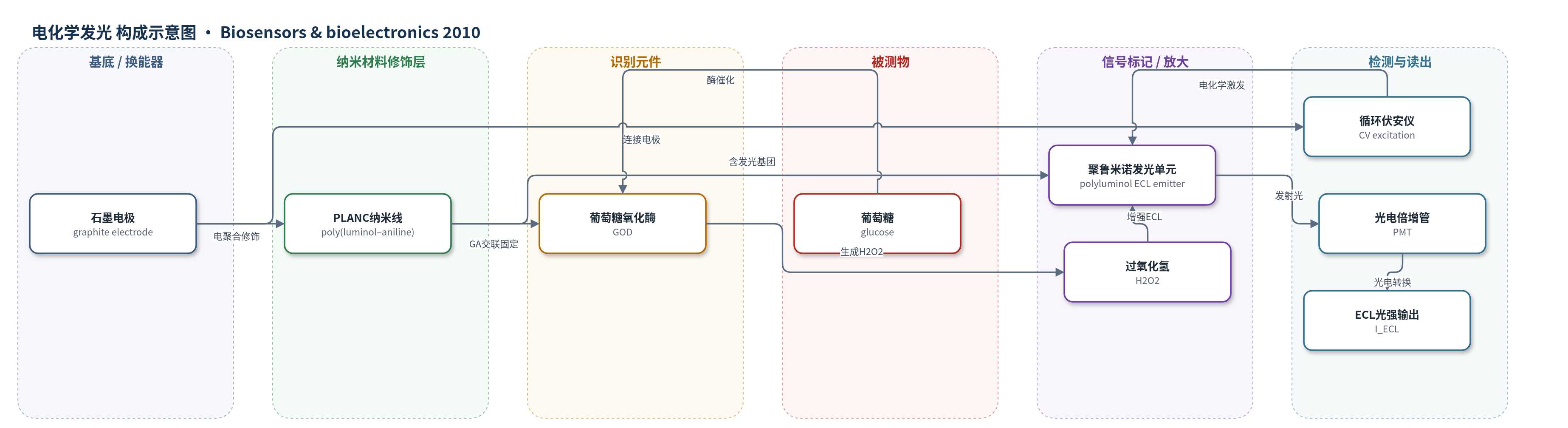
点击图片查看大图 · 依据论文自动绘制
传感器类型
电化学发光(ECL)生物传感器
检测对象
葡萄糖(glucose);样品基质:人尿(稀释100倍),文中表1标注为血清(serum)
检测原理
葡萄糖氧化酶(GOD)固定在PLANC修饰石墨电极表面,催化葡萄糖氧化生成过氧化氢(H2O2)。PLANC中的聚鲁米诺作为无试剂ECL发光基团,在硼酸盐缓冲液(pH 9.0)中经循环伏安扫描发生电化学氧化/还原,产生电生发光物种并发生ECL反应。H2O2可显著增强聚鲁米诺的ECL强度,因此ECL光强随葡萄糖浓度升高而增大。苯胺共聚形成的纳米线复合膜提供较大比表面积、较多酶固定位点和快速电子转移界面,从而提高灵敏度。
检测灵敏度
LOD: 3 × 10⁻⁸ mol L−1 (3σ);线性范围: 1.0 × 10⁻⁷–5.0 × 10⁻⁵ mol L−1;回归方程: I = 16.83C × 10^6 + 18.72;R^2 = 0.9952
效应效果
该传感器对1.0 μmol L−1葡萄糖连续11次测定RSD为4.3%。室温干燥保存1个月后ECL强度下降<5%;pH 9.0硼酸盐溶液中保存后下降9%;连续进样前50次稳定,RSD≤10%,之后渐降。干扰试验中,15倍尿酸、10倍苯甲酸/抗坏血酸、5倍蔗糖/乳糖/麦芽糖/Cu2+/Fe3+/Mn2+/Ni2+及0.1倍Co2+对1.0 μmol L−1葡萄糖无干扰(误差<5%)。人尿稀释100倍后测定,与医院比色法一致,回收率96.4%、97.3%、103.4%,RSD 2.15%–3.60%。
传感器的构成
- 基底/换能器:石墨电极(graphite electrode),作为工作电极提供电子转导与信号读出基础
- 纳米复合修饰层:聚(鲁米诺–苯胺)纳米线复合膜(PLANC),由鲁米诺(luminol)与苯胺(aniline)在H2SO4中电聚合形成,提供ECL发光基团、大比表面积和快速电子转移界面
- 交联固定剂:戊二醛(GA),通过席夫碱反应交联固定GOD与PLANC
- 识别元件:葡萄糖氧化酶(GOD),催化葡萄糖氧化并生成H2O2
- 反应介质:硼砂–硼酸盐缓冲液(0.05 mol L−1 borax–0.2 mol L−1 borate,pH 9.0),维持酶活与ECL反应
- 信号增强物:过氧化氢(H2O2),由GOD催化产生,增强PLANC中聚鲁米诺的ECL强度
中文摘要
本文在石墨电极表面通过电氧化鲁米诺与苯胺的混合溶液,在硫酸酸性介质中制备了聚(鲁米诺–苯胺)纳米线复合膜(PLANC),并用透射电子显微镜、电化学发光(ECL)和电化学阻抗谱对其进行了表征。结果表明,单独电氧化鲁米诺仅在电极表面形成聚鲁米诺膜;当加入适量苯胺时,可形成PLANC,且其对H2O2的ECL性能优于纯聚鲁米诺膜。PLANC修饰电极不仅具有更大比表面积,可负载更高量的葡萄糖氧化酶(GOD),还在电极表面形成纳米结构界面,改善ECL分析性能。基于PLANC与GOD经戊二醛交联固定,提出了一种新型葡萄糖ECL生物传感器,对葡萄糖表现出良好响应。
英文摘要
Poly(luminol-aniline) nanowires composite (PLANC) was synthesized on the surface of graphite electrode by electro-oxidizing the mixture of luminol with aniline in the H2SO4 acidic medium. The properties of the nanowires composite were characterized by transmission electron microscopy, electrogenerated chemiluminescence and electrochemical impedance spectroscopy. The investigating results showed that: firstly, while the luminol alone was electro-oxidized on the surface of the graphite electrode with the proposed synthetic method, only the polyluminol film was formed on electrode surface. However, while a suitable amount of the aniline was present in the luminol solution, the PLANC could be formed on the electrode surface and this PLANC presented better ECL properties for H2O2 compared with pure polyluminol film; secondly, since the PLANC modified electrode not only provided a larger surface area for higher glucose enzyme loading but also formed the nano-structured interface on the electrode surface to improve the analytical performances of the electrogenerated chemiluminescence (ECL) biosensor for glucose, the resulting ECL biosensor presented good response to glucose and a novel ECL biosensor for glucose was proposed.