组成图示
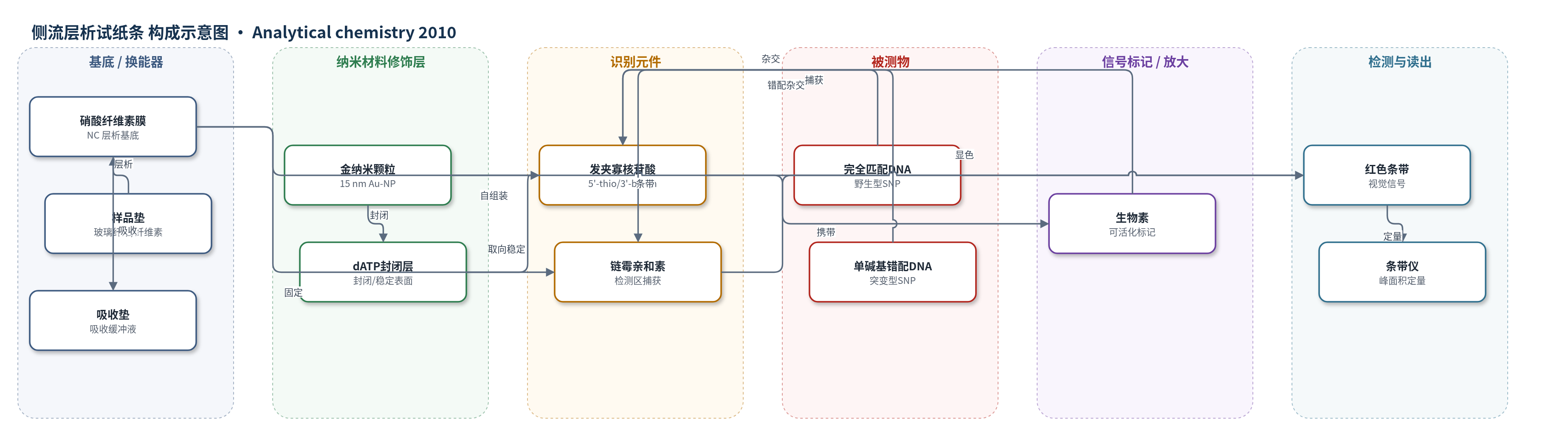
点击图片查看大图 · 依据论文自动绘制
传感器类型
侧流层析试纸条
检测对象
单核苷酸多态性 DNA(SNP DNA):完全匹配 DNA(perfect-matched DNA, PM DNA)、单碱基错配 DNA(single-base-mismatched DNA, MM DNA)、非互补 DNA(noncomplementary DNA, NC DNA);样品基质为 4× SSC 缓冲液含 4% BSA。
检测原理
检测基于发夹寡核苷酸(HO)的茎环构象开关。5′-巯基 HO 通过 Au-S 自组装固定于金纳米颗粒(Au-NP)表面,3′端生物素被 dATP 封闭层和 HO 茎环嵌入而失活。目标 DNA 与 HO 环区杂交后,完全匹配 DNA 使茎环打开,生物素远离 Au-NP 表面而活化;单碱基错配 DNA 打开程度低,活化生物素较少;非互补 DNA 不引起打开。活化生物素与硝酸纤维素膜检测区预固定的链霉亲和素结合,将 Au-NP 捕获并积累,形成红色条带。目标 DNA 浓度越高,捕获 Au-NP 越多,条带越强;每个 Au-NP 携带约 70 个 HO 探针,可放大信号。肉眼以 10 pM 为区分阈值,条带仪通过峰面积定量。
检测灵敏度
LOD: 10 pM(visual discrimination of perfect-matched DNA and single-base-mismatched DNA);定量 LOD: 0.1 pM (based on S/N = 3);线性范围: 0.1–10 pM 和 50 pM–2.5 nM(peak area vs logarithm of DNA concentration)
效应效果
该方法在 0.1 pM–1.0 nM 范围内选择性值约为 9.0,高于荧光分子信标法(4.0);5.0 nM 时选择性降至 4.3。非互补 DNA 至 2.5 nM 不产生检测区条带。野生型与突变型混合总浓度 2.5 nM 时,突变比例 10%(约 0.25 nM)即可引起条带强度明显变化。6 次重复的 CV 分别为 6.4%、4.0%、7.7% 和 6.1%,总体 RSD <7.0%。dATP 封闭使制备时间由 50 h 缩短至 8 h,检测限较先前工作降低 500 倍,定量 LOD 0.1 pM 较已报道侧流核酸传感器提高 1000 倍和 500 倍。25 min 内无需仪器,适用于分子诊断和即时检测。
传感器的构成
- 试纸条基底:硝酸纤维素膜(nitrocellulose membrane, NC)与塑料背衬(plastic adhesive backing),承载检测区/质控区并允许层析
- 层析组件:玻璃纤维样品垫(glass fiber sample pad)、纤维素纤维样品垫(cellulose fiber sample pads, CF-SP)、结合垫(conjugate pad)和吸收垫(absorbent pad),用于加样、释放探针和吸收缓冲液
- 纳米换能层:15±3.5 nm 金纳米颗粒(Au-NP),由 HAuCl4 与柠檬酸钠还原制备,提供红色光学信号
- 识别元件:5′-巯基/3′-生物素修饰发夹寡核苷酸(HO),自组装于 Au-NP 表面,与目标 DNA 杂交并打开茎环
- 封闭/稳定层:脱氧腺苷三磷酸(dATP)blocker,封闭 Au-NP 剩余表面、稳定颗粒并使生物素靠近表面失活
- 捕获元件:链霉亲和素(streptavidin)固定于 NC 膜检测区,捕获活化生物素修饰的 Au-NP;质控区固定链霉亲和素-生物素化 DNA 探针(streptavidin-biotinylated DNA probe)
- 信号标记物:生物素(biotin)位于 HO 3′端,作为可活化标记;Au-NP 作为可视信号载体
- 缓冲/封闭剂:4× SSC 缓冲液含 4% BSA 作为运行缓冲液,BSA 减少非特异吸附;PBSB(含 1% BSA)用于洗涤和重悬
中文摘要
本文报道了一种基于发夹寡核苷酸修饰金纳米颗粒(HO-Au-NP)和侧流层析试纸条(LFSB)的单核苷酸多态性(SNP)视觉检测方法。该方法利用5′端巯基、3′端生物素修饰的发夹寡核苷酸通过自组装偶联到金纳米颗粒表面,并以脱氧腺苷三磷酸(dATP)作为封闭剂。dATP 与发夹结构共同将生物素嵌入并靠近金纳米颗粒表面,使其处于失活状态。当目标 DNA 与发夹探针杂交时,完全匹配 DNA 能打开茎环结构,使生物素活化;单碱基错配 DNA 仅产生少量活化生物素。随后,活化生物素修饰的金纳米颗粒被试纸条检测区预固定的链霉亲和素捕获,金纳米颗粒积累形成红色条带,从而实现 SNP 的肉眼或条带仪检测。该方法将 HO-Au-NP 制备时间由 50 h 缩短至 8 h,检测限降低 500 倍,可在 25 min 内无仪器区分低至 10 pM 的完全匹配与单碱基错配 DNA,且背景更低、选择性更高,适用于分子诊断和即时检测。
英文摘要
We report a simple, fast, and sensitive approach for visual detection of single-nucleotide polymorphism (SNP) based on hairpin oligonucleotide-functionalized gold nanoparticle (HO-Au-NP) and lateral flow strip biosensor (LFSB). The results presented here expand on prior work ( Mao , X. , Xu , H. , Zeng , Q. , Zeng , L. , and Liu , G. Chem. Commun. 2009 , 3065-3067 .) by providing new approach to prepare HO-Au-NP conjugates with a deoxyadenosine triphosphate (dATP) blocker, which shortens the preparation time of the conjugates from 50 to 8 h and lowers the detection limit 500 times. A hairpin oligonucleotide modified with a thiol at the 5'-end and a biotin at the 3'-end was conjugated with Au-NP through a self-assembling process. Following a blocking step with dATP, the hairpin structure of HO and dATP embed the biotin groups, and make the biotin groups in close proximity to the Au-NP surface, leading to the biotins being "inactive". The strategy of detecting SNP depends on the unique molecular recognition properties of HO to the perfect-matched DNA and single-base-mismatched DNA to generate different quantities of "active" biotin groups on the Au-NP surface. After hybridization reactions, the Au-NPs associated with the activated biotins are captured on the test zone of LFSB via the specific reaction between the activated biotin and preimmobilized streptavidin. Accumulation of Au-NPs produces the characteristic red bands, enabling visual detection of SNP. The preparations of HO-Au-NP conjugates with dATP and the parameters of assay were optimized systematically, and the abilities of detecting SNP were examined in details. The current approach is capable of discriminating as low as 10 pM of perfect-matched DNA and single-base-mismatched DNA within 25 min without instrumentation. Moreover, the approach provides a lower background and higher selectivity compared to the current molecular beacon-based SNP detection. The protocol should facilitate the simple, fast, and cost-effective screening of important SNPs and could readily find wide applications in molecular diagnosis laboratories and in point-of-care testing (field testing).