组成图示
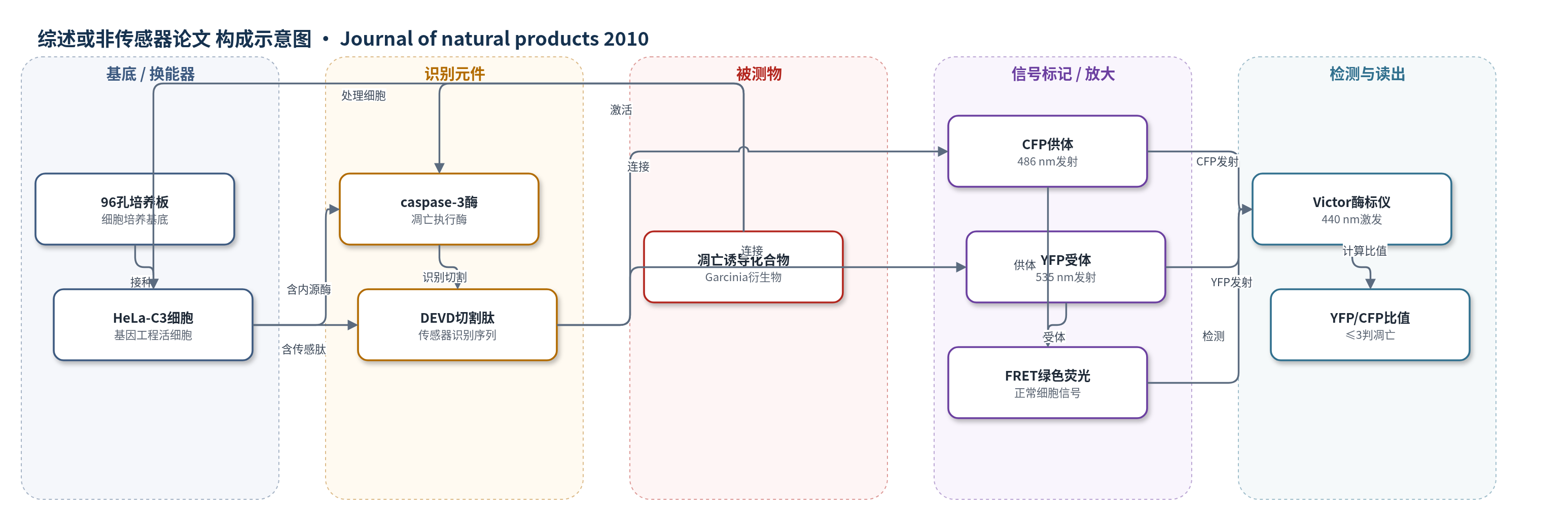
点击图片查看大图 · 依据论文自动绘制
传感器类型
综述或非传感器论文
检测对象
caspase-3 激活(caspase-3 activation)、凋亡诱导活性(apoptosis-inducing activity);样品基质:HeLa-C3 细胞培养体系(96孔板细胞培养液)
检测原理
化合物处理HeLa-C3细胞后诱导凋亡通路,使细胞内caspase-3被激活。激活的caspase-3识别并切割FRET传感器连接肽中的DEVD序列,导致CFP供体与YFP受体分离,FRET效率下降。正常细胞中CFP激发能量转移至YFP,YFP/CFP发射比通常为6–8;凋亡发生时比值降至≤3。酶标仪以440 nm激发,分别测量486 nm CFP和535 nm YFP发射,计算YFP/CFP比值。化合物浓度越高或作用时间越长,caspase-3激活越明显,比值下降越显著。
检测灵敏度
原文未报告 LOD、线性范围、灵敏度斜率或 R^2;阳性阈值:YFP/CFP emission ratio ≤ 3;正常细胞比值 6–8;测试浓度:25、50、100 µM。
效应效果
在72 h内,化合物1、3–9在≤100 µM时使YFP/CFP发射比降至≤3,提示caspase-3激活;6、8、9在25 µM即强促凋亡,1、4、7在50 µM阳性,3在100 µM阳性,5在100 µM阳性、50 µM比值3.3。化合物2和10无caspase-3依赖凋亡,2可能caspase非依赖,9高浓度可致死而不激活caspase-3。形态学见细胞皱缩脱落,与paclitaxel 500 nM一致。MTT IC50:1 17.5±0.7、2 23.0±2.6、3 14.3±0.2、4 14.9±2.6、5 12.4±2.4 µM。实验三重复。未报告选择性、稳定性、回收率及方法对比。
传感器的构成
- 细胞基底:HeLa-C3 基因工程细胞,作为完整活细胞传感平台,表达 caspase-3 荧光传感器
- 识别元件:caspase-3 酶,凋亡过程中被激活并识别切割传感器中的 DEVD 序列
- 传感肽:DEVD 切割序列,连接 CFP 与 YFP,被 caspase-3 切割后解除 FRET
- 荧光标记物:CFP 供体与 YFP 受体,通过 FRET 产生绿色荧光,切割后 CFP 蓝色荧光增强
- 读出装置:Perkin-Elmer Victor 酶标仪,440 nm 激发,分别检测 486 nm CFP 与 535 nm YFP 发射并计算 YFP/CFP 比值
中文摘要
通过生物活性导向分离,从多花藤黄果(Garcinia multiflora)枝条丙酮提取物中分离得到5个新的多异戊烯基化苯甲酰三羟苯基甲烷衍生物:garcimultiflorone D(1)、18-羟基garcimultiflorone D(2)、garcimultiflorone E(3)、garcimultiflorone F(4)和isogarcimultiflorone F(5),以及5个已知化合物:guttiferone E(6)、guttiferone F(7)、aristophenone A(8)、isoxanthochymol(9)和morelloflavone(10)。利用能检测caspase-3激活的荧光生物传感器HeLa-C3细胞评估其凋亡诱导活性。结果表明,化合物1和3–9在72 h内、浓度≤100 µM时可激活caspase-3;其中6、8和9在25 µM即表现出强促凋亡作用。化合物2和10未显示caspase-3依赖的凋亡诱导效应。
英文摘要
With bioassay-guided fractionation, five new polyprenylated benzoylphloroglucinol derivatives, garcimultiflorone D (1), 18-hydroxygarcimultiflorone D (2), garcimultiflorone E (3), garcimultiflorone F (4), and isogarcimultiflorone F (5), and five known compounds, guttiferone E (6), guttiferone F (7), aristophenone A (8), isoxanthochymol (9), and morelloflavone (10), were isolated from the acetone extract of the twigs of Garcinia multiflora. The compounds were evaluated for their apoptotic effects against HeLa-C3 cells, which have been genetically engineered to produce a fluorescent biosensor capable of detecting caspase-3 activation. Compounds 1 and 3-9 activate caspase-3 in HeLa-C3 cells within 72 h after treatment at a concentration of 100 microM or lower. In particular, compounds 6, 8, and 9 showed strong apoptosis-inducing effects at a concentration of 25 microM.