组成图示
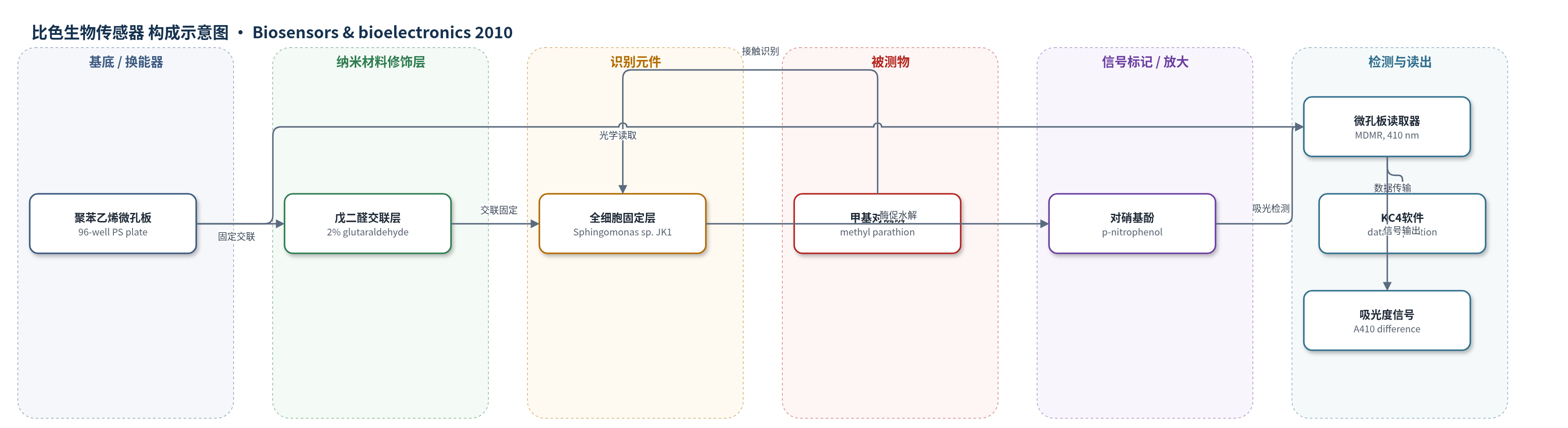
点击图片查看大图 · 依据论文自动绘制
传感器类型
比色生物传感器
检测对象
甲基对硫磷(methyl parathion, MP);样品基质为磷酸盐缓冲液(phosphate buffer, pH 8.0)中的标准/模拟样品
检测原理
该传感器以固定于聚苯乙烯微孔板孔底的 Sphingomonas sp. JK1 全细胞作为生物识别与催化元件。全细胞中含有有机磷水解酶 OPH,当加入含甲基对硫磷(MP)的磷酸盐缓冲液时,OPH 催化 MP 水解,生成发色产物对硝基酚(PNP)。PNP 在 410 nm 处具有特征吸收,微孔板读取器测量反应初始与终末吸光度差值。由于 PNP 生成量与 MP 水解量相对应,在 4–80 μM 范围内吸光度差值随 MP 浓度线性增加。信号放大主要依赖全细胞 OPH 的酶促催化作用,未采用 HCR、RCA 或 CRISPR-Cas 等额外放大策略。
检测灵敏度
线性范围: 4–80 μM;灵敏度斜率: 0.004(y = 0.02329 + 0.004x);R^2 = 0.99369
效应效果
未报告选择性、抗干扰或实际样品加标回收率。96 孔微孔板可同一平台同时处理多份样品,响应时间约 5 min。固定细胞微孔板可重复使用 75 次反应,仍保留 80% 酶活性;4 °C 储存 18 天后仍保留 80% 活性。80 μM MP 响应 RSD 为 0.156(n=6),校准曲线 RSD 为 0.00698。与现有方法相比,其检测范围高于碱性磷酸酶抑制化学发光生物传感器(50 ppb)和安培 OPH 生物传感器(约 0.4 μM),灵敏度较低,但与电位法(2 μM)和光学法(2–8 μM)OPH 生物传感器相当。作者认为适合大批量样品快速筛查。
传感器的构成
- 基底/反应容器:聚苯乙烯 96 孔微孔板(polystyrene 96-well microplate),提供固定表面与 96 个独立反应池
- 生物识别/催化元件:Sphingomonas sp. JK1 全细胞(whole cells),含有机磷水解酶 OPH,催化甲基对硫磷水解
- 交联固定剂:2% 戊二醛(glutaraldehyde, GA),交联细胞并固定于微孔板表面,减少细胞泄漏
- 反应介质:磷酸盐缓冲液(phosphate buffer, pH 8.0),提供酶促水解反应环境
- 被测物:甲基对硫磷(methyl parathion, MP),加入孔中被 OPH 水解
- 信号产物:对硝基酚(p-nitrophenol, PNP),发色产物,在 410 nm 产生吸光度
- 光学读出:多检测微孔板读取器(multidetection microplate reader, MDMR)与 KC4 软件,测量 410 nm 吸光度并处理数据
中文摘要
有机磷农药甲基对硫磷在农业害虫防治中广泛使用,其残留及降解产物会造成环境污染和生态问题。为监测此类农药,本文报道了一种基于微孔板的光学微生物生物传感器。作者从田间土壤中分离并鉴定出能水解甲基对硫磷的 Sphingomonas sp. JK1,该菌可将甲基对硫磷水解为发色产物对硝基酚(PNP)。将 Sphingomonas sp. 全细胞直接固定于聚苯乙烯 96 孔微孔板孔表面,并以 2% 戊二醛交联,SEM 证实细胞成功固定。固定菌微孔板直接连接微孔板读取器作为光学转导器,通过检测 410 nm 吸光度变化定量 PNP。该传感器具有 96 个反应池,可在同一平台上同时检测多个样品,线性检测范围为 4–80 μM 甲基对硫磷,固定细胞微孔板可重复使用至 75 次反应。研究提出以微孔板作为微生物固定支持,构建可重复使用的微生物生物元件。
英文摘要
Organophosphorus pesticides such as methyl parathion have been widely used in the field of agriculture for insect pest control. These pesticides and their degradation products cause environmental pollution and ecological problem. With a view to monitor these pesticides biosensors are being developed. A bacterium Sphingomonas sp. from field soil has been isolated and identified in our laboratory that hydrolyzes the methyl parathion upto a chromophoric product, p-nitrophenol (PNP). PNP can be detected by electrochemical and colorimetric methods, which can be exploited to develop a biosensor for detection of the organophosphate pesticide. Whole cells of Sphingomonas bacteria were immobilized directly onto the surface of the wells of polystyrene microplates (96 wells) using glutaraldehyde as the cross-linker. SEM study confirmed the immobilization of Sphingomonas sp. Immobilized bacterial microplate was associated directly with the optical transducer, microplate reader. The microplate-based biosensor is having advantages as it has 96 reaction vessels and therefore it provides a convenient system for detecting multiple numbers of samples in a single platform. Detection range of the biosensor from the linear range was determined to be 4-80 μM methyl parathion. Cells-immobilized microplates were having reusability upto 75 reactions. Present study reports an innovative concept where the microplate can be used as immobilizing support for development of reusable microbial biocomponent.