组成图示
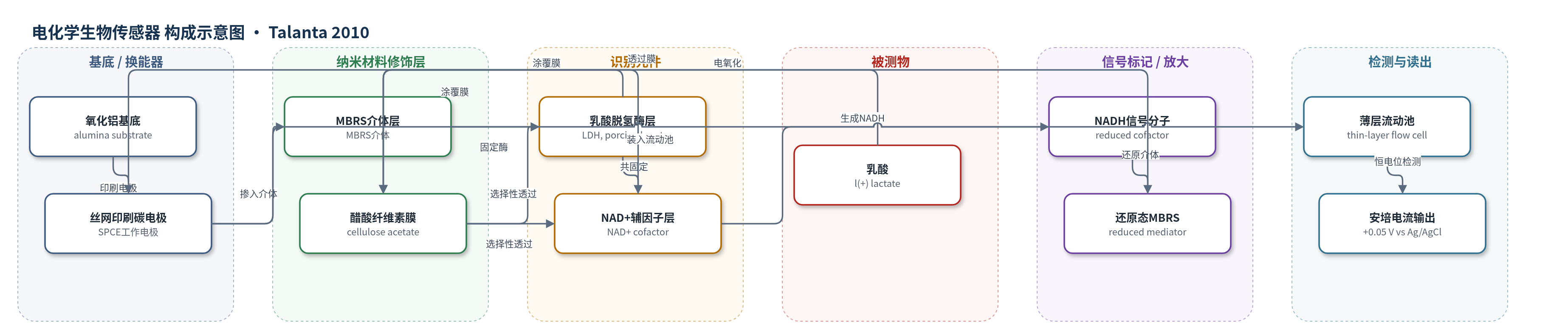
点击图片查看大图 · 依据论文自动绘制
传感器类型
电化学生物传感器
检测对象
乳酸(lactate / l(+) lactate);样品基质:血清(serum,文中为牛犊血清 calf serum)及磷酸盐缓冲液标准液
检测原理
乳酸进入传感器后,在猪心乳酸脱氢酶(LDH)催化下被氧化为丙酮酸,同时 NAD+ 被还原为 NADH。NADH 将电子转移给掺入丝网印刷碳电极的 Meldola's Blue-Reinecke salt(MBRS)氧化态,生成还原态 MBRS;还原态 MBRS 随后在 +0.05 V(vs Ag/AgCl)的 SPCE 表面被电氧化,产生与乳酸浓度成正比的安培电流。MBRS 介导使 NADH 在低电位下发生电催化氧化,醋酸纤维素膜提供选择性并减少干扰物进入。流动注射薄层池实现快速恒电位读出。
检测灵敏度
LOD: 0.55 mM;线性范围: 0.55-10 mM(摘要);pH 10 校准线性范围: 0.25-10 mM;斜率: 4.2092;R^2 = 0.9935
效应效果
该传感器在 10 mM 乳酸标准液中 10 次重复进样的变异系数为 4.28%(结论中为 4.29%),4 mM 乳酸 3 次重复 CV 为 3.1%。对未预处理牛犊血清直接进样 6 次,本底乳酸平均 4.69 mM,加标 8.00 mM 后测得 13.21 mM,平均回收率 106.45%,测得值 CV 为 6.96%。响应时间约 10 s,4 ℃ 干燥保存至少 17 天稳定。作者认为其性能可媲美需超滤预处理的 HPLC 法,适合低成本、高通量临床乳酸检测。
传感器的构成
- 基底/换能器电极:氧化铝基底(alumina substrate)上丝网印刷碳工作电极(SPCE),并印刷 Ag/AgCl 参比/对电极
- 介体修饰层:含 2% Meldola's Blue-Reinecke salt(MBRS)的碳墨,介导 NADH 电催化氧化并降低过电位
- 识别/催化元件:猪心来源乳酸脱氢酶(LDH,NAD+ 依赖),催化乳酸氧化为丙酮酸
- 辅因子:NAD+(225 μg),接受乳酸反应电子生成 NADH
- 固定化/封闭剂:BSA(294 μg)与戊二醛(15 μg),用于固定酶并封闭非特异结合
- 选择性膜:2% 醋酸纤维素(cellulose acetate)涂覆层,阻挡大分子干扰并保留 NAD+
- 流动池/读出:商用薄层安培流动池(thin-layer amperometric flow cell),FIA 恒电位检测
中文摘要
本文报道了一种用于血清乳酸测定的安培生物传感器。该传感器以丝网印刷碳电极为基底,碳墨中掺入 Meldola's Blue-Reinecke salt(MBRS)作为介体,工作电极表面固定猪心来源的乳酸脱氢酶(LDH)和辅酶 NAD+,并在顶部涂覆醋酸纤维素膜作为选择性膜。传感器装入商用薄层安培流动池,在 +0.05 V(vs Ag/AgCl)下工作,流动相为含 0.1 M KCl 的 0.2 M 磷酸盐缓冲液(pH 10),流速 0.8 mL/min。乳酸在 LDH 催化下氧化并生成 NADH,NADH 经 MBRS 介导电催化氧化产生安培信号。传感器对乳酸在 0.55-10 mM 范围内线性响应,检出限为 0.55 mM;10 mM 乳酸标准液 10 次重复进样的变异系数为 4.28%。该体系可直接测定未经预处理血清中的乳酸,具有高通量、低成本和临床适用潜力。
英文摘要
A biosensor for the measurement of lactate in serum has been developed, which is based on a screen-printed carbon electrode, modified with Meldola's Blue-Reinecke Salt (MBRS-SPCE), coated with the enzyme lactate dehydrogenase NAD(+) dependent (from Porcine heart), and NAD(+). A cellulose acetate layer was deposited on the top of the device to act as a permselective membrane. The biosensor was incorporated into a commercially available, thin-layer, amperometric flow cell operated at a potential of only +0.05 V vs. Ag/AgCl. The mobile phase consisted of 0.2 M phosphate buffer pH 10 containing 0.1 M potassium chloride solution; a flow rate of 0.8 ml min(-1) was used throughout the investigation. The biosensor response was linear over the range 0.55-10 mM lactate; the former represents the detection limit. The precision of the system was determined by carrying out 10 repeat injections of 10 mM l(+)lactic acid standard; the calculated coefficient of variation was 4.28%. It was demonstrated that this biosensor system could be applied to the direct measurement of lactate in serum without pre-treatment; therefore, this would allow high throughput-analysis, at low cost, for this clinically important analyte.