组成图示
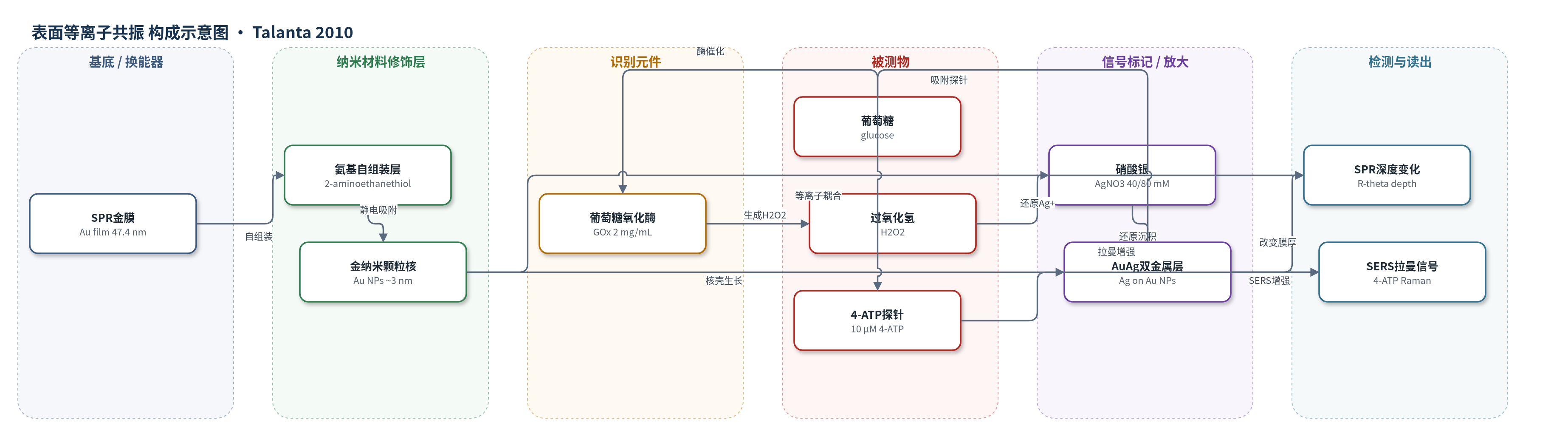
点击图片查看大图 · 依据论文自动绘制
传感器类型
表面等离子共振(SPR)生物传感器
检测对象
过氧化氢(H2O2)、葡萄糖(glucose,经GOx催化间接检测)、4-氨基硫酚(4-ATP,SERS探针);样品基质为HEPES缓冲液(0.01 M,pH 7.0)水溶液及4-ATP水溶液。
检测原理
在SPR金膜上先构建氨基自组装层并固定Au NPs。当H2O2存在时,其作为还原剂将AgNO3中的Ag+还原为Ag,并在Au NPs表面沉积形成AuAg双金属纳米颗粒。Ag壳层使金属膜厚度和界面光学性质改变,导致SPR反射强度-角度曲线深度下降;H2O2浓度越高,沉积Ag越多,深度下降越大。若以GOx为催化识别元件,葡萄糖被氧化生成H2O2,再触发上述银沉积,从而将葡萄糖浓度转换为SPR深度变化。AuAg双金属纳米颗粒还可增强4-ATP的拉曼散射,实现SERS读出。
检测灵敏度
原文未报告LOD、线性范围、灵敏度斜率或相关系数。
效应效果
对照实验显示,缺少Au NPs或H2O2时SPR深度无变化;GOx体系中O2、GOx和葡萄糖均为银沉积所必需。H2O2从0.07增至1.2 mM时,SPR R-θ深度由0.287降至0.424;0.2和0.6 mM下SEM粒径约16–19 nm和18–23 nm。葡萄糖升高使SPR深度下降,高浓度时变化趋缓,提示GOx位点饱和。4-ATP在AuAg膜上1580、1436、1391、1142和1078 cm−1拉曼峰强于普通拉曼。作者认为该体系可用于H2O2、葡萄糖检测及SERS分子传感。
传感器的构成
- 基底/换能器:SPR金膜(Au film,47.4 nm)或石英片(quartz slide),提供SPR换能或SERS基底
- 自组装单层:2-氨基乙硫醇(2-aminoethanethiol)或3-氨基丙基三乙氧基硅烷(APTES),形成正电荷表面以吸附Au NPs
- 纳米核层:柠檬酸钠稳定金纳米颗粒(Au NPs,约3 nm),作为银沉积核并产生局域表面等离子体
- 催化识别元件:葡萄糖氧化酶(GOx,2 mg/mL),催化葡萄糖氧化生成H2O2,用于葡萄糖检测
- 还原剂/电子供体:过氧化氢(H2O2),介导Ag+还原并作为直接检测对象
- 信号沉积层:硝酸银(AgNO3,40 mM或80 mM)在H2O2介导下还原为Ag,沉积于Au NPs表面形成AuAg双金属纳米颗粒
- 反应介质:HEPES缓冲液(0.01 M,pH 7.0),维持银还原和酶反应环境
中文摘要
本文报道了一种基于过氧化氢介导银还原制备AuAg双金属纳米颗粒膜的方法。首先将柠檬酸钠稳定的金纳米颗粒(Au NPs)吸附到2-氨基乙硫醇自组装单层修饰的SPR金膜或3-氨基丙基三乙氧基硅烷(APTES)修饰的石英片表面;随后用含硝酸银(AgNO3)和H2O2的溶液处理,使银沉积在Au NPs表面形成AuAg双金属纳米颗粒。通过调节H2O2浓度可方便调控AuAg颗粒尺寸。表面等离子共振(SPR)表征表明,银在Au NPs修饰金膜上的沉积使SPR反射强度-角度曲线深度明显下降,该效应可用于H2O2的定量SPR检测。将葡萄糖氧化酶(GOx)催化葡萄糖生成H2O2的反应与银沉积结合,可构建基于SPR的葡萄糖生物传感器。此外,所制备的AuAg双金属纳米颗粒膜还可作为有效的表面增强拉曼散射(SERS)基底。
英文摘要
A method to fabricate AuAg bimetallic nanoparticles film by H(2)O(2)-mediated reduction of silver was reported. Gold nanoparticles (Au NPs) were first adsorbed onto the surface of a self-assembled 2-aminoethanethiol monolayer-modified gold film or 3-aminopropyltriethoxysilane (APTES) monolayer-modified quartz slide. Upon further treatment of this modified film with the solution containing silver nitrate (AgNO(3)) and H(2)O(2), silver was deposited on the surface of Au NPs. The size of the AuAg bimetallic particles could be readily tuned by manipulating the concentration of H(2)O(2). Surface plasmon resonance (SPR) was used to investigate the process, the deposition of silver on Au NPs modified gold film resulted in an obvious decrease of depth in the SPR reflectance intensity and minimum angle curves (SPR R-theta curves), which may be utilized for the quantitative SPR detection of the analyte, H(2)O(2). Combination of the biocatalytic reaction that could yield H(2)O(2) by using the enzyme, glucose oxidase, with the deposition of silver may enable the design of a glucose biosensor by SPR technique. Furthermore, we evaluated the AuAg bimetallic nanoparticles film for their ability to be an effective substrate for surface-enhanced Raman scattering (SERS).