组成图示
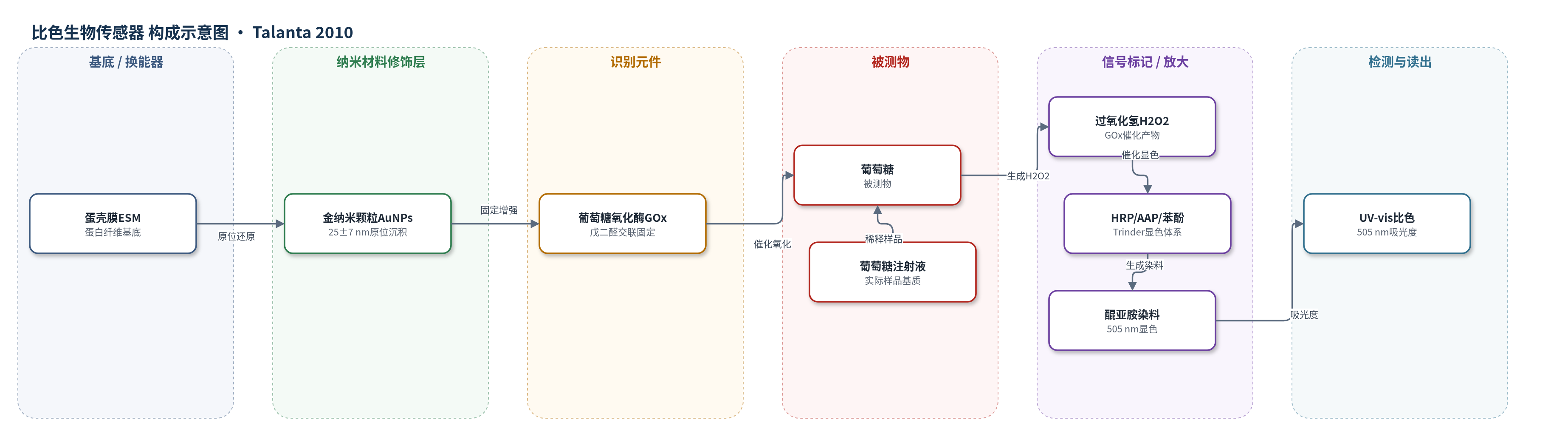
点击图片查看大图 · 依据论文自动绘制
传感器类型
比色生物传感器
检测对象
葡萄糖(glucose);样品基质:磷酸盐缓冲液标准溶液、商业葡萄糖注射液(稀释后)
检测原理
该传感器以葡萄糖氧化酶(GOx)为识别元件,特异性催化葡萄糖氧化生成葡萄糖酸和过氧化氢(H2O2)。蛋壳膜(ESM)上的金纳米颗粒(AuNPs)提供生物相容界面并促进电子转移,从而提高 GOx 的催化活性与响应。随后,外加辣根过氧化物酶(HRP)以 H2O2 为底物,催化 4-氨基安替比林(AAP)与苯酚发生 Trinder 反应,生成红色醌亚胺染料。染料浓度与 H2O2 量成正比,而 H2O2 量与葡萄糖浓度成正比,因此 505 nm 处吸光度随葡萄糖浓度增加而线性增大,实现比色定量。
检测灵敏度
LOD: 17 μM (S/N = 3);线性范围: 20 μM–0.80 mM
效应效果
该传感器对葡萄糖具有良好选择性,100 倍 Na+、Mg2+、K+、NO3-、HCO3-、SO4^2- 和 Cl- 均不干扰。重复测定 0.25 mM 葡萄糖(n=5)RSD 为 2.98%;4°C 储存 70 天后保留 87.3% 初始响应。用于 5 份商业葡萄糖注射液,测定值分别为 4.63、10.1、50.9、50.7 和 52.4 g/100 mL,加标回收率为 94.0%、101%、100%、99.2% 和 94.4%,回收 RSD 为 1.97%–8.80%。与文献纳米颗粒葡萄糖传感器相比,其 LOD 17 μM 低于多数报道,且 70 天稳定性较好。作者认为该 AuNPs/ESM 平台简单、无毒、绿色,适用于葡萄糖检测及生物催化。
传感器的构成
- 基底/载体:蛋壳膜(ESM),天然蛋白纤维网络,提供多孔支撑、固定位点及原位还原 Au(III) 的醛基
- 纳米材料修饰层:金纳米颗粒(AuNPs),原位沉积于 ESM 纤维表面,粒径约 25±7 nm,增强电子转移与酶活性
- 识别元件:葡萄糖氧化酶(GOx),特异性催化葡萄糖氧化
- 交联固定剂:戊二醛(glutaraldehyde),交联固定 GOx 于 ESM/AuNPs/ESM
- 信号显色体系:辣根过氧化物酶(HRP)、4-氨基安替比林(AAP)和苯酚(phenol),通过 Trinder 反应生成醌亚胺染料
- 缓冲介质:磷酸盐缓冲液(PBS),pH 6.0 用于 AuNPs 合成,pH 7.0 用于葡萄糖检测
中文摘要
本文报道一种简便绿色方法,利用天然蛋壳膜(ESM)在室温下原位合成金纳米颗粒(AuNPs)。将 ESM 浸入 pH 6.0 的氯金酸(HAuCl4)缓冲水溶液中,无需外加还原剂,ESM 蛋白纤维中的醛基将 Au(III) 还原为 Au(0),形成核径约 25±7 nm 的 AuNPs。通过 SEM、EDS、XPS 和 XRD 证实 AuNPs 在 ESM 上形成。pH 显著影响 Au(III) 吸附、还原及 AuNPs 形貌:pH≤3.0 或 ≥7.0 时未观察到 AuNPs,pH 4.0–6.0 时小粒径 AuNPs 均匀分散,pH 6.0 最优。随后将葡萄糖氧化酶(GOx)通过戊二醛交联固定在 AuNPs/ESM 上,构建葡萄糖比色生物传感器。AuNPs 可增强 GOx 活性并提高葡萄糖检测灵敏度。传感器对葡萄糖线性范围为 20 μM–0.80 mM,检出限 17 μM(S/N=3),并成功用于商业葡萄糖注射液中葡萄糖含量测定。该策略简单、无毒、绿色,具有生物传感应用潜力。
英文摘要
A facile green biosynthesis method has been successfully developed to prepare gold nanoparticles (AuNPs) of various core sizes (25+/-7 nm) using a natural biomaterial, eggshell membrane (ESM) at ambient conditions. In situ synthesis of AuNPs-immobilized ESM is conducted in a simple manner by immersing ESM in a pH 6.0 aqueous solution of HAuCl(4) without adding any reductant. The formation of AuNPs on ESM protein fibers is attributed to the reduction of Au(III) ions to Au(0) by the aldehyde moieties of the natural ESM fibers. Energy dispersive X-ray spectroscopy, scanning electron microscopy, X-ray photoelectron spectroscopy, and X-ray powder diffraction unambiguously identify the presence of AuNPs on ESM. The effect of pH on the in situ synthesis of AuNPs on ESM has been investigated in detail. The pH of the gold precursor (HAuCl(4)) solution can influence the formation rate, dispersion and size of AuNPs on ESM. At pH < or =3.0 and > or =7.0, no AuNPs are observed on ESM while small AuNPs are homogeneously dispersed on ESM at pH 4.0-6.0. The optimal pH for AuNPs formation on ESM is 6.0. AuNPs/ESMs are used to immobilize glucose oxidase (GO(x)) for glucose biosensing. AuNPs on ESM can increase the enzyme activity of GO(x). The linear response range of the glucose biosensor is 20 microM to 0.80 mM glucose with a detection limit of 17 microM (S/N=3). The biosensor has been successfully applied to determine the glucose content in commercial glucose injections. Our work provides a very simple, non-toxic, convenient, and green route to synthesize AuNPs on ESM which is potentially useful in the biosensing field.