组成图示
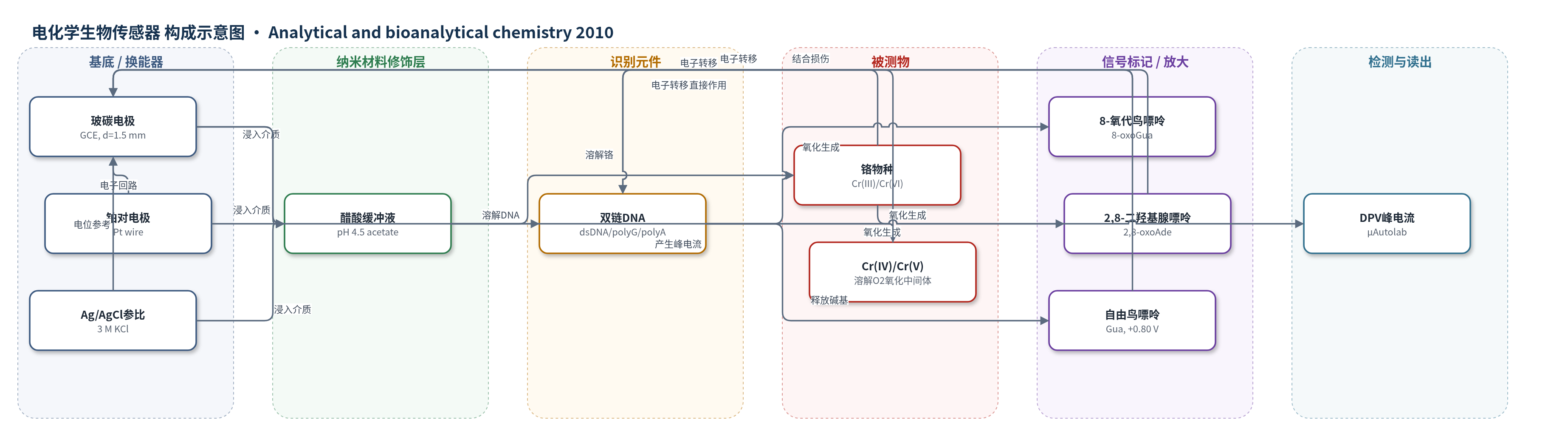
点击图片查看大图 · 依据论文自动绘制
传感器类型
电化学生物传感器
检测对象
铬物种(Chromium, Cr(III)/Cr(VI)及其中间体Cr(IV)/Cr(V))诱导的双链DNA(dsDNA)氧化损伤(8-oxoguanine、2,8-dihydroxyadenine、free guanine);样品基质:pH 4.5醋酸缓冲液中的dsDNA、poly[G]、poly[A]溶液。
检测原理
在pH 4.5醋酸缓冲液中,Cr(III)可被溶解O2逐步氧化为Cr(IV)、Cr(V)和Cr(VI)。Cr(IV)/Cr(V)活性中间体与dsDNA结合,优先作用于鸟嘌呤富集区,氧化鸟嘌呤生成8-oxoGua,并氧化脱氧核糖C1′位导致自由鸟嘌呤释放;Cr(VI)则破坏氢键、引起双螺旋展开,使碱基暴露。DPV在GCE上检测dGuo(+1.03 V)、dAdo(+1.30 V)、8-oxoGua/2,8-oxoAde(+0.45 V)和自由Gua(+0.80 V)的氧化峰。随铬浓度和孵育时间增加,相关峰电流增大;N2除氧条件下无氧化损伤,说明信号来自铬中间体介导的DNA氧化损伤。
检测灵敏度
原文未报告LOD、线性范围、灵敏度斜率或相关系数。
效应效果
DPV相比稳态伏安法具有更高信噪比和选择性,GCE抛光后基线稳定,实验重现性好。Cr(III)与dsDNA孵育10 min时未见明显相互作用,24–60 h后dGuo、dAdo峰电流增加,并出现+0.45 V和+0.80 V新峰;Cr(VI)孵育1 h即增加dGuo/dAdo峰,24–60 h出现自由鸟嘌呤峰。poly[A]几乎无损伤,poly[G]出现8-oxoGua和Gua峰,证明铬中间体优先损伤鸟嘌呤富集区。UV-Vis未检测到明显差异,说明电化学检测更灵敏。作者认为该方法可原位区分不同铬价态与DNA的相互作用,有助于理解铬诱导肿瘤机制,但需与体内方法进一步关联。
传感器的构成
- 换能器电极:玻碳电极(GCE,d=1.5 mm),抛光后作为电子转移动电位检测DNA碱基氧化。
- 参比电极:Ag/AgCl(3 M KCl),提供稳定电位参考。
- 对电极:铂丝(Pt wire),完成电化学回路。
- 支持电解质:pH 4.5 0.1 M 或 0.2 M 醋酸缓冲液,维持pH、离子强度并促进Cr(III)/Cr(VI)平衡。
- 识别/生物分子:双链DNA(dsDNA,牛胸腺DNA,100 μg mL−1)或均聚物 poly[G]/poly[A],作为被检测生物分子和氧化信号源。
- 信号标记物:8-氧代鸟嘌呤(8-oxoGua)、2,8-二羟基腺嘌呤(2,8-oxoAde)和自由鸟嘌呤(Gua),其氧化峰指示DNA氧化损伤。
- 信号读出:差分脉冲伏安法(DPV)/循环伏安(CV),μAutolab记录峰电流变化。
中文摘要
本研究采用差分脉冲伏安法(DPV)在玻碳电极(GCE)上原位评估铬物种与双链DNA(dsDNA)的直接相互作用。通过监测鸟嘌呤和腺嘌呤碱基氧化峰的变化,电化学检测DNA损伤。结果表明,Cr(III)在溶解O2作用下生成的Cr(IV)和Cr(V)活性中间体可与dsDNA结合,引起B-DNA结构改变并造成氧化损伤。利用鸟嘌呤和腺嘌呤均聚核苷酸进一步证明,Cr(IV)/Cr(V)–DNA相互作用优先发生在鸟嘌呤富集区,导致鸟嘌呤氧化产物8-氧代鸟嘌呤(8-oxoguanine)生成,该产物是DNA氧化损伤的生物标志物。Cr(VI)与dsDNA相互作用则引起氢键断裂、构象变化和双螺旋展开,使其他氧化剂更易接近DNA,从而促进DNA氧化损伤。
英文摘要
The in situ evaluation of the direct interaction of chromium species with double-stranded DNA (dsDNA) was studied using differential pulse voltammetry at a glassy carbon electrode. The DNA damage was electrochemically detected following the changes in the oxidation peaks of guanosine and adenosine bases. The results obtained revealed the interaction with dsDNA of the Cr(IV) and Cr(V) reactive intermediates of Cr(III) oxidation by O(2) dissolved in the solution bound to dsDNA. This interaction leads to different modifications and causes oxidative damage in the B-DNA structure. Using polyhomonucleotides of guanine and adenine, it was shown that the interaction between reactive intermediates Cr(IV) and Cr(V)-DNA causes oxidative damage and preferentially takes place at guanine-rich segments, leading to the formation of 8-oxoguanine, the oxidation product of guanine residues and a biomarker of DNA oxidative damage. The interaction of Cr(VI) with dsDNA causes breaking of hydrogen bonds, conformational changes, and unfolding of the double helix, which enables easier access of other oxidative agents to interact with DNA, and the occurrence of oxidative damage to DNA.