组成图示
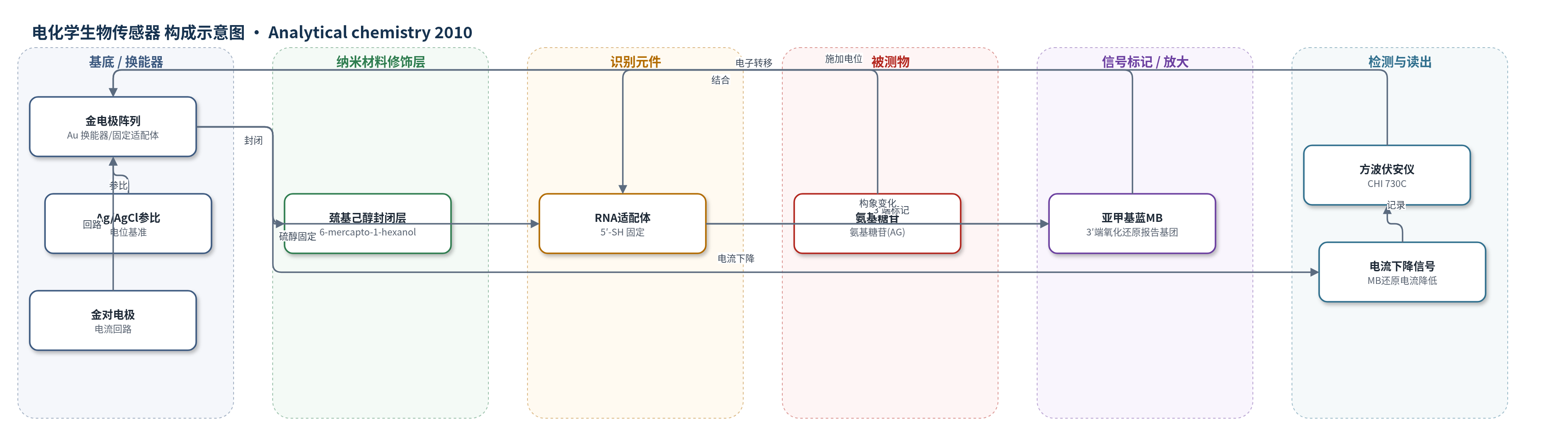
点击图片查看大图 · 依据论文自动绘制
传感器类型
电化学生物传感器
检测对象
氨基糖苷类抗生素(aminoglycoside antibiotics):妥布霉素(tobramycin)、卡那霉素(kanamycin)、庆大霉素(gentamicin);样品基质:缓冲液、新生牛血清、超滤血清、人血清校准样品
检测原理
该传感器将 5′-硫醇修饰的氨基糖苷 RNA 适配体固定于金电极表面,3′端连接亚甲基蓝(MB)氧化还原报告基团,并用 6-巯基-1-己醇封闭非特异位点。氨基糖苷进入适配体茎环结合口袋后,诱导适配体构象变化,使 MB 与金电极距离增大,电子转移速率下降,MB 还原法拉第电流降低。电流变化随药物浓度增加而增大,并在饱和浓度下出现约 60% 信号抑制。由于无需外加酶或标记试剂,信号可在约 10 s 内平衡;血清核酸酶会降解 RNA 适配体,因此采用 3000 Da 超滤去除核酸酶后,可在治疗相关低微摩尔范围检测庆大霉素。
检测灵敏度
原文未报告明确 LOD、线性范围、灵敏度斜率或相关系数;可监测治疗相关范围 2–6 µM(4–10 µg/mL);tobramycin 与 kanamycin 的表观解离常数分别为 319 µM 和 281 µM;饱和药物浓度下信号抑制约 60%。
效应效果
该传感器对妥布霉素、卡那霉素和庆大霉素均强响应,饱和浓度下信号抑制约 60%,但存在同家族交叉反应。RNA 传感器在缓冲液中数天内退化,直接浸入新生牛血清后 1 h 内信号降至不可接受水平且不可再生;2′-O-甲基化保留亲和力但未提高血清稳定性,2′-氟修饰降低亲和力且保护有限,DNA 等价物在血清中稳定,但对三种药物亲和力分别降低 4、2、3 倍,检出限超出治疗范围。经 3000 Da 超滤去除核酸酶后,原始 RNA 传感器可稳定工作,并在加标新生牛血清和人血清校准样品中于 2–6 µM(4–10 µg/mL)范围定量庆大霉素;超滤增加约 30 min。原文未报告 RSD、回收率或与 ELISA/HPLC/qPCR 的直接对比。
传感器的构成
- 换能器电极:金(Au)电极阵列,固定适配体并传导亚甲基蓝还原法拉第电流
- 参比电极:Ag/AgCl 电极,提供电化学测量电位基准
- 对电极:金(Au)对电极,与金工作电极构成电流回路
- 识别元件:26-碱基氨基糖苷 RNA 适配体(stem-loop,5′-硫醇修饰),结合 tobramycin、kanamycin、gentamicin
- 信号标记物:亚甲基蓝(methylene blue, MB),3′端氧化还原报告基团,结合后远离电极使电流下降
- 封闭剂:6-巯基-1-己醇(6-mercapto-1-hexanol),封闭金表面非特异结合位点
中文摘要
基于 RNA 适配体的生物传感器有望用于即时医疗诊断,但在临床样品中易受核酸酶降解。为探索保护 RNA 传感器的方法,作者构建并表征了一种用于检测氨基糖苷类抗生素的电化学适配体传感器。在缓冲液中,该传感器具有低微摩尔检出限和亚分钟平衡时间,但直接浸入血液血清时迅速失效。为此,作者测试了同一适配体的修饰版本。首先将结合口袋外所有 2′-羟基甲基化,所得传感器灵敏度与未修饰母体相当,但在血清中未显著提高稳定性。其次将 RNA 碱基替换为更耐降解的 DNA 等价物;该 DNA 适配体仍保留结合氨基糖苷的能力,但亲和力低于母体 RNA。基于 DNA 适配体的传感器在血清中稳定,但因亲和力降低,检出限高于治疗相关范围。最后,通过低分子量截断超滤离心柱快速去除庆大霉素加标血清中的核酸酶,使原始 RNA 传感器能在临床相关浓度下便捷检测该氨基糖苷类抗生素。
英文摘要
Biosensors built using ribonucleic acid (RNA) aptamers show promise as tools for point-of-care medical diagnostics, but they remain vulnerable to nuclease degradation when deployed in clinical samples. To explore methods for protecting RNA-based biosensors from such degradation we have constructed and characterized an electrochemical, aptamer-based sensor for the detection of aminoglycosidic antibiotics. We find that while this sensor achieves low micromolar detection limits and subminute equilibration times when challenged in buffer, it deteriorates rapidly when immersed directly in blood serum. In order to circumvent this problem, we have developed and tested sensors employing modified versions of the same aptamer. Our first effort to this end entailed the methylation of all of the 2'-hydroxyl groups outside of the aptamer's antibiotic binding pocket. However, while devices employing this modified aptamer are as sensitive as those employing an unmodified parent, the modification fails to confer greater stability when the sensor is challenged directly in blood serum. As a second potentially naive alternative, we replaced the RNA bases in the aptamer with their more degradation-resistant deoxyribonucleic acid (DNA) equivalents. Surprisingly and unlike control DNA-stem loops employing other sequences, this DNA aptamer retains the ability to bind aminoglycosides, albeit with poorer affinity than the parent RNA aptamer. Unfortunately, however, while sensors fabricated using this DNA aptamer are stable in blood serum, its lower affinity pushes their detection limits above the therapeutically relevant range. Finally, we find that ultrafiltration through a low-molecular-weight-cutoff spin column rapidly and efficiently removes the relevant nucleases from serum samples spiked with gentamicin, allowing the convenient detection of this aminoglycoside at clinically relevant concentrations using the original RNA-based sensor.