组成图示
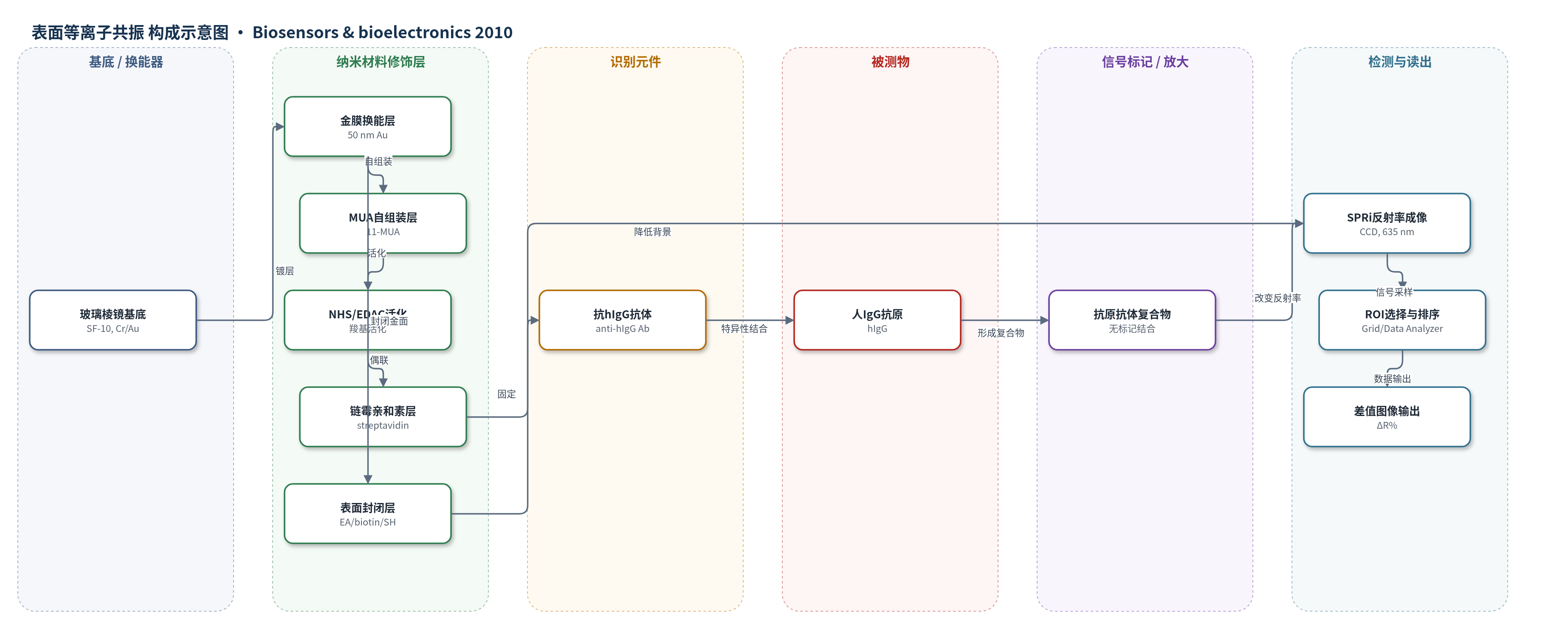
点击图片查看大图 · 依据论文自动绘制
传感器类型
表面等离子共振(SPR)生物传感器
检测对象
人免疫球蛋白G(human IgG, hIgG),样品基质为 HEPES/Tween 20 结合缓冲液中的标准溶液。
检测原理
该传感器基于表面等离子共振成像(SPRi)的无标记检测原理。抗人 IgG 抗体经 MUA、NHS/EDAC 和链霉亲和素固定于金膜表面,形成识别层。当样品中的 hIgG 流过芯片时,与固定抗体特异性结合,使金膜表面质量与局部折射率增加,改变 Kretschmann 配置下表面等离子体共振条件,导致 635 nm p 偏振光反射率下降,表现为 ΔR% 信号。CCD 同时采集多个 ROI 的实时传感器图和差值图像。hIgG 浓度越高,结合量越大,ΔR% 越大。本文不采用化学标记或酶放大,而是通过高密度 ROI 预分析、三维数据重建和按灵敏度、变异系数、特异性/非特异性比加权排序,选择最佳 ROI,从而提高信噪比、重现性和选择性。
检测灵敏度
校准浓度范围: 0.7–3.0 ppm;未报告 LOD、线性范围、灵敏度斜率或相关系数。
效应效果
在 3 ppm hIgG 预分析中,与传统整点采样(B)和人工三点采样(C)相比,所提方法 D 的平均 SPRi 信号分别提高约 4 倍和 3 倍,且各点标准差降低,平均变异系数 CVav% 改善。特异性结合与非特异性结合信号比由 B 的 3.4、C 的 3.1 提高到 D 的 19.2,约 6 倍,说明抗干扰和选择性明显增强。在 0.7–3.0 ppm hIgG 校准范围内,R7 点的方法 D 结合曲线关联相斜率更高,表明可改善结合动力学评估。作者认为该方法通用、标准化,可提升 SPRi 灵敏度、选择性和重现性,适用于复杂基质中的亲和传感。
传感器的构成
- 基底/换能器:SF-10 玻璃棱镜,5 nm Cr 与 50 nm Au,Kretschmann 配置,用于 SPR 耦合与反射率成像
- 阵列掩膜:PDMS 薄膜微孔掩膜,定义抗 hIgG 点阵区域
- 自组装单层:11-巯基十二烷酸(MUA),在金表面形成羧基末端,用于共价偶联
- 活化层:NHS 与 EDAC,活化 MUA 羧基以偶联氨基
- 亲和连接层:链霉亲和素(streptavidin),结合生物素化抗体
- 识别元件:生物素化抗人 IgG 抗体(biotinylated anti-hIgG),特异性结合 hIgG
- 封闭层:乙醇胺(EA)与生物素(biotin)封闭残余位点;11-巯基十二醇与 1-巯基己醇封闭金表面
- 信号读出:SPRi-Lab+ 仪器,CCD 成像,635 nm p 偏振光,记录反射率变化 ΔR%
中文摘要
表面等离子共振成像(SPRi)是光学传感的前沿技术,可实现实时、无标记、同时多分析物检测,并广泛用于研究核酸、肽、蛋白质和碳水化合物等多种亲和相互作用。在 SPRi 测量中,信号采样与数据管理是获得良好分析性能的关键步骤。本文提出一种用于选择传感区域(感兴趣区域,ROI)的策略,以改善 SPRi 传感器性能。作者以抗原–抗体相互作用为模型,将抗人 IgG 抗体以阵列形式固定于芯片表面,并检测溶液中的特异性配体人 IgG。该方法具有通用性,证明理性选择敏感区域并标准化处理 SPRi 数据会显著影响传感器行为。其标准流程包括:建立高密度 ROI 图谱;在预分析步骤中评估所有 ROI 的 SPRi 结合信号;对结果进行三维处理;并按分析性能对 ROI 排序,最终选择用于正式检测。使用标准抗原溶液比较三种 ROI 选择方法的分析性能,结果表明所提出的创新方法最适合 SPRi 传感应用。
英文摘要
Surface plasmon resonance imaging (SPRi) is at the forefront of optical sensing, allowing real-time and label free simultaneous multi-analyte measurements. It represents an interesting technology for studying a broad variety of affinity interactions with impact in chemistry, both in fundamental and applied research. Signal sampling and management is a key step in SPRi measurements to achieve successful performances. This work aims to develop a strategy for selecting the sensing areas, called Regions of Interest (ROIs), to be sampled for recording SPRi signals that could results in improved sensor performances. The approach has been evaluated using antigen-antibody interaction: anti-human IgGs are immobilized on the chip surface in an array format, while the specific ligand (hIgG antigen) is in solution. This approach has general applicability and demonstrates that rational selection of sensitive areas and standard management of SPRi data has dramatic impact on sensor behaviour. The criteria of the method are: (a) creation of high density maps of ROIs, (b) evaluation of the SPRi binding signals on all the ROIs during a pre-analysis step, (c) 3D elaboration of the results, and (d) ranking of the ROIs for their final selection in further biosensor analysis. Using standard solution of antigen, three different ROIs selection approaches have been compared for their analytical performances. The proposed innovative method results to be the best one for SPRi-based sensing applications.