组成图示
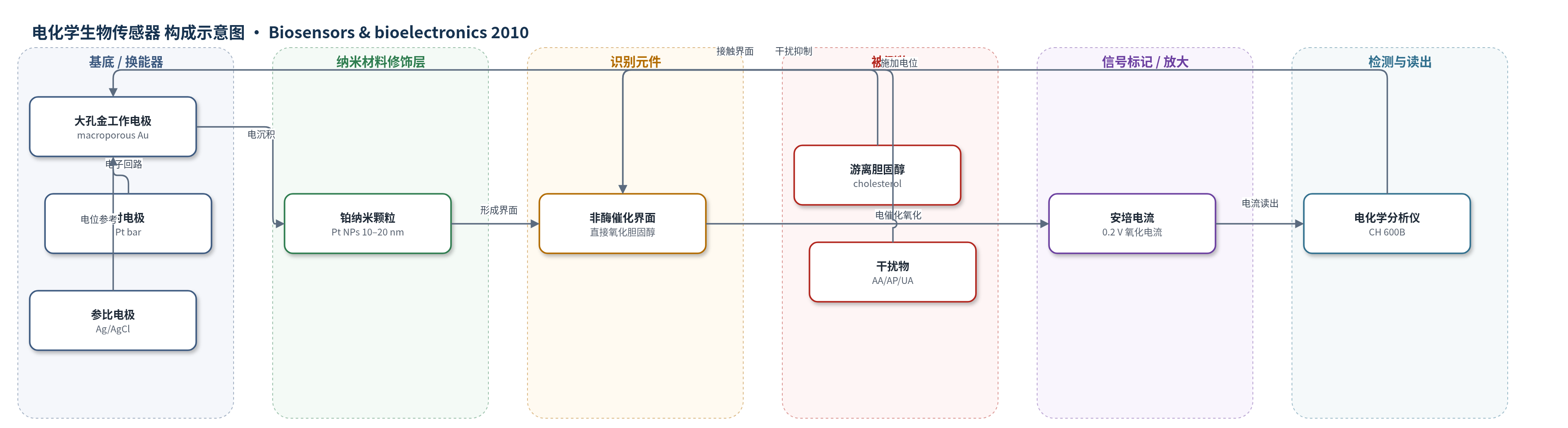
点击图片查看大图 · 依据论文自动绘制
传感器类型
电化学生物传感器
检测对象
游离胆固醇(free cholesterol, cholesterol);样品基质:0.1 M PBS(pH 7.0)缓冲液,含Triton X-100和2-丙醇助溶
检测原理
该传感器为非酶型电化学生物传感器。珊瑚状大孔金电极提供高比表面积和连通孔道,使胆固醇分子易于接近活性位点;电沉积的铂纳米颗粒进一步增大粗糙因子并提供电催化活性位点,降低胆固醇氧化过电位。在0.2 V工作电位下,游离胆固醇在铂纳米颗粒/大孔金界面发生直接电催化氧化,电子经金基底传递至电化学分析仪,形成阳极电流。随着胆固醇浓度升高,参与氧化的分子数增加,安培电流线性增大,线性范围至5 mM。低电位策略可避免抗坏血酸和对乙酰氨基酚的直接氧化,尿酸干扰亦被抑制。信号放大主要来自大孔结构的高粗糙因子和铂纳米颗粒的电催化作用,无需酶或介体。
检测灵敏度
LOD: 0.015 mM;线性范围: 0–5 mM;灵敏度: 226.2 μA mM−1 cm−2
效应效果
该电极对胆固醇具有较高选择性和抗干扰能力:在0.1 mM抗坏血酸、对乙酰氨基酚和尿酸存在下,1 mM胆固醇的安培响应保持稳定且线性,未出现明显干扰。三个独立制备电极在0–5 mM线性范围内最大相对标准偏差为12.1%,表明重现性可接受。电极可通过电化学清洗再生,化学稳定性较好,适合非一次性使用。与作者前期工作相比,其灵敏度显著提高,且无需酶或介体,响应快速、制备简单、成本低。论文未报告实际血清加标回收率或与ELISA、HPLC等方法的直接对比,但作者认为该非酶电极可用于电化学游离胆固醇生物传感器。
传感器的构成
- 工作电极基底:珊瑚状大孔金(macroporous Au)电极,孔隙率约50%,窗口孔径100–300 nm,提供高比表面积、导电通道和反应物可及性。
- 催化修饰层:铂纳米颗粒(Pt nanoparticles, nPts,约10–20 nm),电沉积于大孔金表面,提高粗糙因子和胆固醇电催化氧化活性。
- 识别元件:无特异性生物识别元件(非酶型),胆固醇直接在电极表面发生电催化氧化。
- 信号标记物:无外源标记物,以胆固醇氧化产生的安培电流作为信号。
- 电化学池/参比系统:三电极体系,Pt棒对电极、Ag/AgCl参比电极,用于电位控制和电流读出。
中文摘要
本文报道了一种通过铂纳米颗粒修饰获得高粗糙表面的大孔金电极(macroporous Au-/nPts),用于非酶型游离胆固醇电化学生物传感器。该电极采用模板法制备珊瑚状大孔金结构,并通过电沉积将约10–20 nm的铂纳米颗粒沉积于其表面。场发射扫描电镜显示铂纳米颗粒均匀分布,大孔金孔隙率约50%,窗口孔径为100–300 nm。循环伏安法测得该电极粗糙因子为2024.7,显著高于大孔金电极的46.07,表明其具有更大的电化学活化面积。在中性介质中,电极在0.2 V下对胆固醇氧化表现出强电催化活性,响应电流在0–5 mM范围内线性增加,检出限为0.015 mM,灵敏度为226.2 μA mM−1 cm−2。同时,抗坏血酸、对乙酰氨基酚和尿酸等常见干扰物未引起明显响应。该非酶电极无需酶或介体,具有快速响应、稳定可再生和低成本等优点,适用于电化学胆固醇检测。
英文摘要
A sensitive macroporous Au electrode with a highly rough surface obtained through the use of with Pt nanoparticles (macroporous Au-/nPts) is reported. It has been designed for nonenzymatic free-cholesterol biosensor applications. A macroporous Au-/nPts electrode was fabricated by electroplating Pt nanoparticles onto a coral-like shaped macroporous Au electrode structure. The macroporous Au-/nPts electrode was physically characterized by field emission scanning electron microscopy (FESEM). It was confirmed that the Pt nanoparticles were well deposited on the surface of the macroporous Au electrode. The porosity and window pore size of the macroporous Au electrode were 50% and 100-300 nm, respectively. The electroplated Pt nanoparticle size was approximately 10-20 nm. Electrochemical experiments showed that the macroporous Au-/nPts exhibited a much larger surface activation area (roughness factor (RF)=2024.7) than the macroporous Au electrode (RF=46.07). The macroporous Au-/nPts also presented a much stronger electrocatalytic activity towards cholesterol oxidation than does the macroporous Au electrode. At 0.2 V, the electrode responded linearly up to a 5 mM cholesterol concentration in a neutral media, with a detection limit of 0.015 mM and detection sensitivity of 226.2 μA mM(-1) cm(-2). Meanwhile, interfering species such as ascorbic acid (AA), acetaminophen (AP), and uric acid (UA), were effectively avoided. This novel nonenzymatic detection electrode has strong applications as an electrochemically based cholesterol biosensor.