组成图示
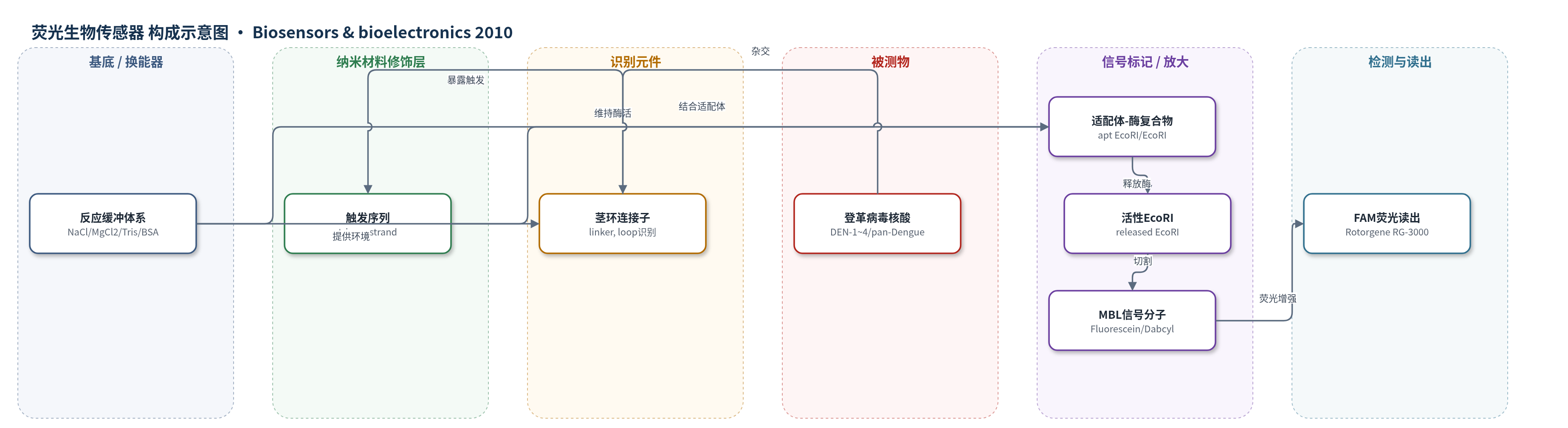
点击图片查看大图 · 依据论文自动绘制
传感器类型
荧光生物传感器
检测对象
登革病毒血清型特异性核酸序列(Dengue virus serotype-specific nucleic acid sequences, DEN-1、DEN-2、DEN-3、DEN-4)及泛登革核酸序列(pan-Dengue sequence);样品基质为合成寡核苷酸模拟的体外核酸样本(含非登革基线对照)
检测原理
该传感器采用溶液相模块化设计。茎环连接子的环区与登革病毒目标核酸杂交,使茎区触发序列暴露;触发序列与抑制性适配体apt EcoRI结合,破坏适配体对限制性内切酶EcoRI的抑制,释放活性EcoRI。活性EcoRI识别并切割MBL信号分子茎区中的EcoRI识别位点,使5′荧光基团与3′淬灭基团分离,FAM荧光增强。由于EcoRI具有高度进程性,可连续切割多个MBL,实现信号放大。反应在30 ℃等温条件下进行,通过pH介导的变性与复性完成杂交,荧光强度随时间增加并反映目标核酸存在与否。
检测灵敏度
未报告LOD、线性范围、灵敏度斜率或相关系数。
效应效果
该传感器在体外合成寡核苷酸体系中表现出高选择性:四种血清型特异性连接子均只响应目标序列,非目标血清型对照与非登革基线信号无法区分,未见交叉杂交;泛登革连接子可区分泛登革目标与非登革基线。触发实验显示加入触发序列后2 min即可明显产生荧光,MBL在16 min内被完全切割;登革目标检测在20 min后信号清晰可辨。所有处理均设4个重复并以±1 SD表示误差,未报告RSD与回收率。作者认为其试剂成本低、模块灵活、稳健,有望替代ELISA和RT-PCR等复杂昂贵方法,用于登革及其他传染病快速诊断。
传感器的构成
- 检测模块:茎环寡核苷酸连接子(linker),环区含目标互补序列(target-complementary moiety),茎区含触发序列(trigger),用于识别登革病毒核酸序列
- 信号转导模块:抑制性适配体(apt EcoRI)与限制性内切酶(EcoRI)复合物,apt EcoRI 抑制 EcoRI,触发序列结合后释放 EcoRI
- 信号分子:分子断裂发光寡核苷酸(MBL),茎区含 EcoRI 识别序列,5′ 荧光基团(如 Fluorescein/FAM)和 3′ 淬灭基团(Dabcyl),切割后荧光增强
- 反应缓冲体系:含 NaCl、MgCl2、Tris–HCl、Triton X-100 和 BSA 的缓冲液,维持 EcoRI 活性与杂交/酶切反应条件
- 读出系统:Rotorgene RG-3000 实时荧光检测仪,FAM 通道每 30 s 读取荧光强度
中文摘要
登革热是由埃及伊蚊传播的病毒性疾病,现有诊断技术复杂、耗时且昂贵,难以在疾病高发的发展中国家推广。本文报道了一种用于快速识别登革病毒基因组相关序列的模块化生物传感器。该传感器由寡核苷酸连接子模块、适配体/限制性内切酶信号转导模块和荧光信号分子组成。连接子具有茎环结构,环区含目标互补序列,茎区含触发序列;与目标核酸结合后,变性茎区的触发链可与信号转导模块中的适配体结合,破坏适配体对限制性内切酶EcoRI的抑制,释放活性EcoRI。活性EcoRI可快速切割多个含其识别位点的信号分子,产生可检测荧光信号。该传感器能高特异性地检测四种登革病毒血清型特异性序列,并检测所有血清型共有的泛登革序列。
英文摘要
Arthropod-borne diseases affect a significant portion of the world's population. Dengue fever, a viral disease carried by the Aedes aegypti mosquito, is one of the most wide-spread, with many fatalities evident each year. To date, Dengue viral diagnostic technologies have been too complex, time-consuming and expensive to be widely deployed, particularly in developing countries where the disease is most prevalent. Here we demonstrate a modular biosensor that is able to rapidly identify sequences associated with the Dengue virus genome. The biosensor consists of an oligonucleotide linker module, an aptamer/restriction endonuclease signal transducer and a fluorescent signalling molecule. The linker molecule has a simple stem/loop conformation and comprises a target-complementary moiety within the loop and a trigger moiety within the stem. When bound to the target nucleic acid, the trigger strand of the denatured stem can bind to the aptamer within the signal transducer. Disruption of the aptamer releases the restriction endonuclease EcoRI from aptamer-mediated inhibition. Active EcoRI is able to rapidly cleave multiple signalling molecules to generate a detectable signal. The biosensor was able to detect sequences derived from each of the four Dengue virus serotypes with a great degree of specificity. Along with sequences specific to each serotype, a pan-Dengue sequence, common to all serotypes, was also detected.